It set out to beat Google for people, and sold search to machines instead
Pitched as Google 2.0 for people; ChatGPT arrived two weeks after launch. Now search for agents, valued at $2.2B.
The product
Exa is a web search engine whose users are programs. An AI agent sends it a question in plain language and gets back the pages that answer it, with the text already pulled out. Cursor, Cognition, HubSpot and monday.com build on it, and since August it answers web questions inside Firefox.
How it works
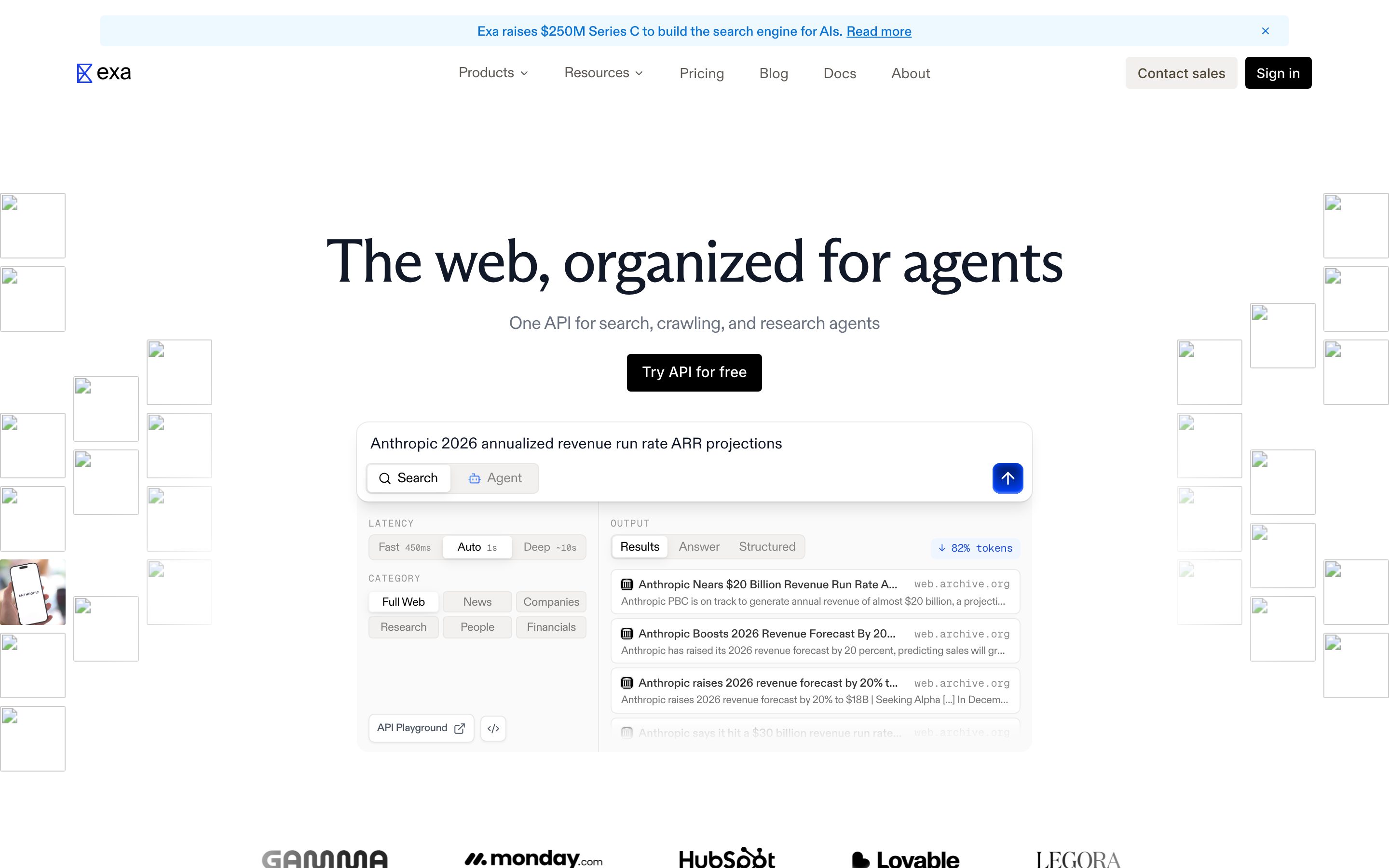
A developer calls one API. The query can be long and descriptive, and the developer picks how long to wait – about 450 milliseconds, a second, or around ten for a deep search – and where to look: the whole web, news, companies, people, research papers or financial data. What comes back can be a list of results, a written answer, or structured fields. Each result can carry highlights: excerpts chosen by a model trained to find the part of a page that matters, so the agent reads a paragraph instead of a page.
For work that needs completeness over speed, Websets keeps searching for minutes or hours and checks each result with a language model, to return a full list – every company, person or paper that fits the description.
Business model
Developers pay by the call: $7 per thousand searches, $1 per thousand pages of content, $5 per thousand answers, and from about a cent to a dollar per request for the agent, depending on how hard it works. New accounts get $20 of credit and $10 more each month. Enterprise contracts add volume discounts, service levels and zero data retention – queries are never stored. Exa's argument is that many search APIs wrap Google and so cannot offer it; Exa built its own engine.
The spike
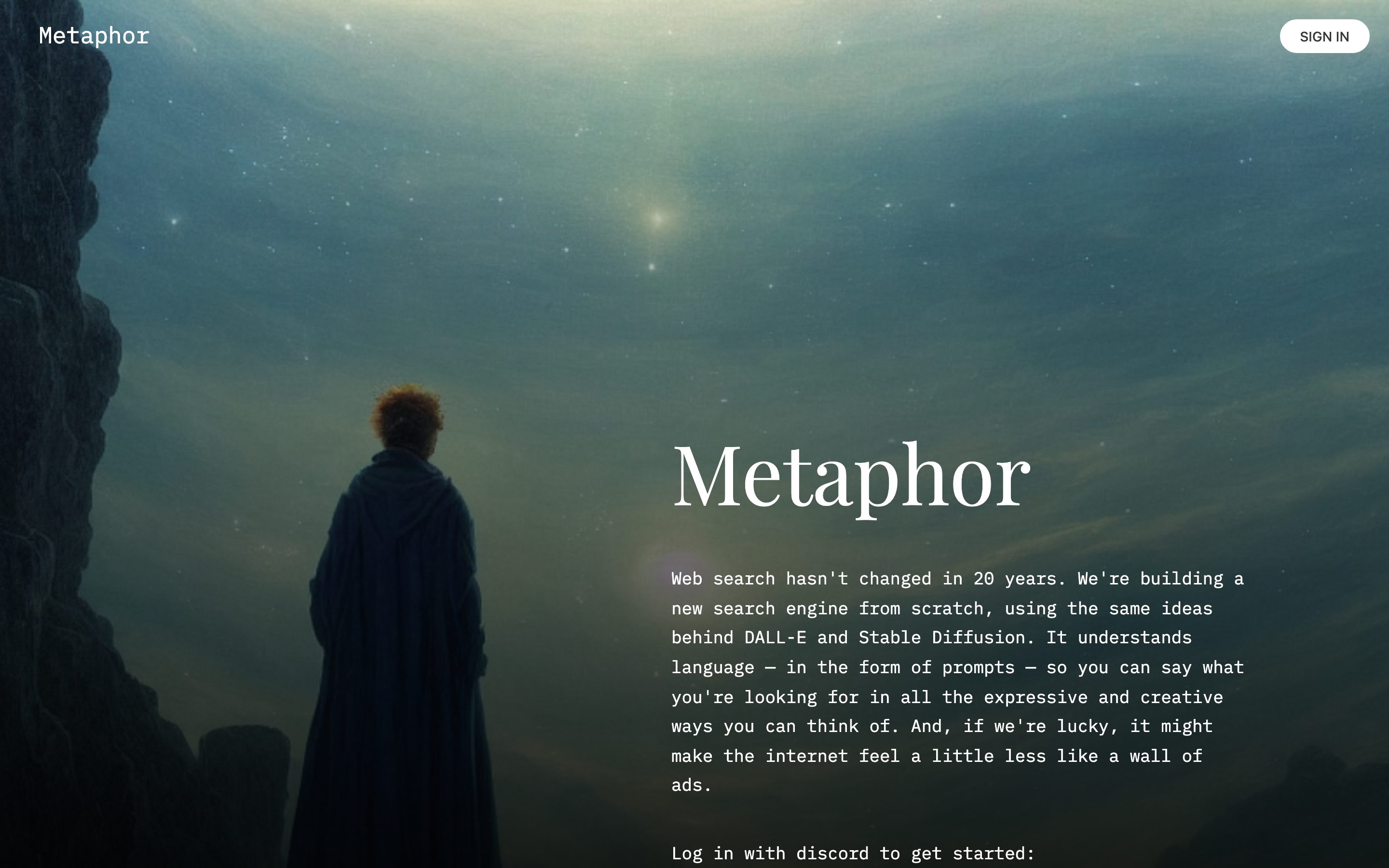
Exa began in 2021 as Metaphor, with a plan to beat Google at search for people. The founders bought a GPU cluster, built an index, and after over a year of experiments arrived at a model that predicts the next link the way GPT-3 predicts the next word. Searching it meant writing the sentence someone would post just before sharing the link you wanted – a prompt, not keywords. It launched on 10 November 2022, and you signed in with Discord to use it. On Hacker News people liked the results and struggled with the phrasing; one commenter explained that "you have to kind of talk as though you've stumbled upon someone talking about the thing you're looking for."
Two weeks later ChatGPT came out. Exa's own account is short: "We quickly started getting requests for API access to our search." It announced a search API for AI in early 2023, and by November 2023 the homepage said "Our API is live." In January 2024 Metaphor became Exa, on a .ai domain. What it put down was the search page for people; what it kept was the index and the model behind it. As the company put it in 2023, "the search engine we had built for humans was also the search engine that LLMs need."
The fit, as we see it, ran deeper than demand. The thing people found awkward – describing what you want in a full sentence instead of three keywords – is exactly what a language model writes anyway. Exa's own list of what LLMs need includes "queries that are themselves LLM outputs." The product did not change its core; it changed who was typing.
Why it matters
Developers building AI apps already had web search to call. Google and Bing results were available through SERP APIs, and in January 2024 Exa wrote that most of its customers had tried them and left because "those APIs work for humans, but not for LLMs." What they returned was a ranked list of links and titles, tuned for someone who would skim and click. Getting the right text from behind those links into the model was left to the developer. Microsoft itself drew the line in 2025: it shut the Bing Search APIs on 11 August and pointed customers to search inside its own Azure agents.
Exa returns the text itself, cut down to what the model needs. By the company's figures, its extraction models reduce LLM token counts by over 20 times, and up to 25 trillion tokens a week now reach models as those excerpts. On the retrieval benchmarks it publishes, it scores 54.4% on FRAMES against 44.5% for Perplexity and 21.6% for Brave. In May its chief executive, Will Bryk, wrote: "six months ago we were worse than Google at code search, and now we're used by nearly every coding agent."
Use grew with it: "thousands" of companies and revenue tripling in a few months in July 2024, more than 5,000 companies and 400,000 developers by May 2026. The rounds followed – $22M in 2024, $85M at a $700M valuation in September 2025, $250M at $2.2B in May 2026 – $357M across the three announced rounds.
The playbook
Services built for people can be rebuilt for programs: return the content itself, trimmed to what a model needs, instead of a ranked list of links, and charge by the call. Every API that wraps a human-facing product and leaves developers cleaning its output before a model can use it is a target. According to Exa, its extraction cuts LLM token counts by over 20 times, and over 5,000 companies used it by May 2026. The gap shuts if the incumbent sells the clean version itself.
The lesson
Two rules come off this path, and neither needs the company's name.
One is about whom to serve. Exa's founders pitched Y Combinator in 2021 on "Google 2.0" – a better search engine for people. That is a fight for the leader's own customers, on the leader's own ground. The customer that turned up instead was one the leaders did not want: programs that needed the web as input. Google and Bing sold them results built for people, and in 2025 Microsoft closed the Bing Search APIs altogether. The customer a leader will not serve is the one it cannot defend.
The second is about how to find that customer. Exa did not predict it. Soon after ChatGPT, people it had not built for started asking for API access, and it followed them – and the flaw its first users complained about turned out to be the fit for the new one.
Try it on your own work: who keeps asking you for something you don't sell – and is the flaw your current users complain about exactly what that customer needs?
Where else it could work · our reasoning, not a finding
Payments for agents
Card networks were built for a person at a checkout; an agent paying cents per call fits them badly.
Market data for models
Terminals sell a screen to a person by the seat; a model needs the raw feed, priced by the request.
Verified bots
Platforms fight bots wholesale, and nobody lets the honest agent through.
Track record
Exa · exa.ai ↗
- Metaphor, a search engine trained to predict the next link, launches on Hacker News ↗
- Homepage on metaphor.systems: “Log in with discord to get started” ↗
- Homepage on metaphor.systems: “Our API is live. Build web retrieval in a few lines of code.” ↗
- Metaphor renamed Exa, on a .ai domain ↗
- $22M seed and Series A, led by Lightspeed ↗
- Show HN: Websets, a search that runs for minutes to build complete lists ↗
- Series B, $85M at a $700M valuation, led by Benchmark ↗
- Series C, $250M at a $2.2B valuation, led by a16z ↗
- Mozilla picks Exa to power web search in Firefox's AI features ↗