Raised $200M · · reported by The Information
Published
Technology: Agents
Model: Aggregating Suppliers
#ai · #search · #agents
Its demo became the company, and the money came once it stopped counting users
Shipped as a demo in December 2022; after dropping ads for a $200 agent, annualized revenue reportedly passed $750M.
The product
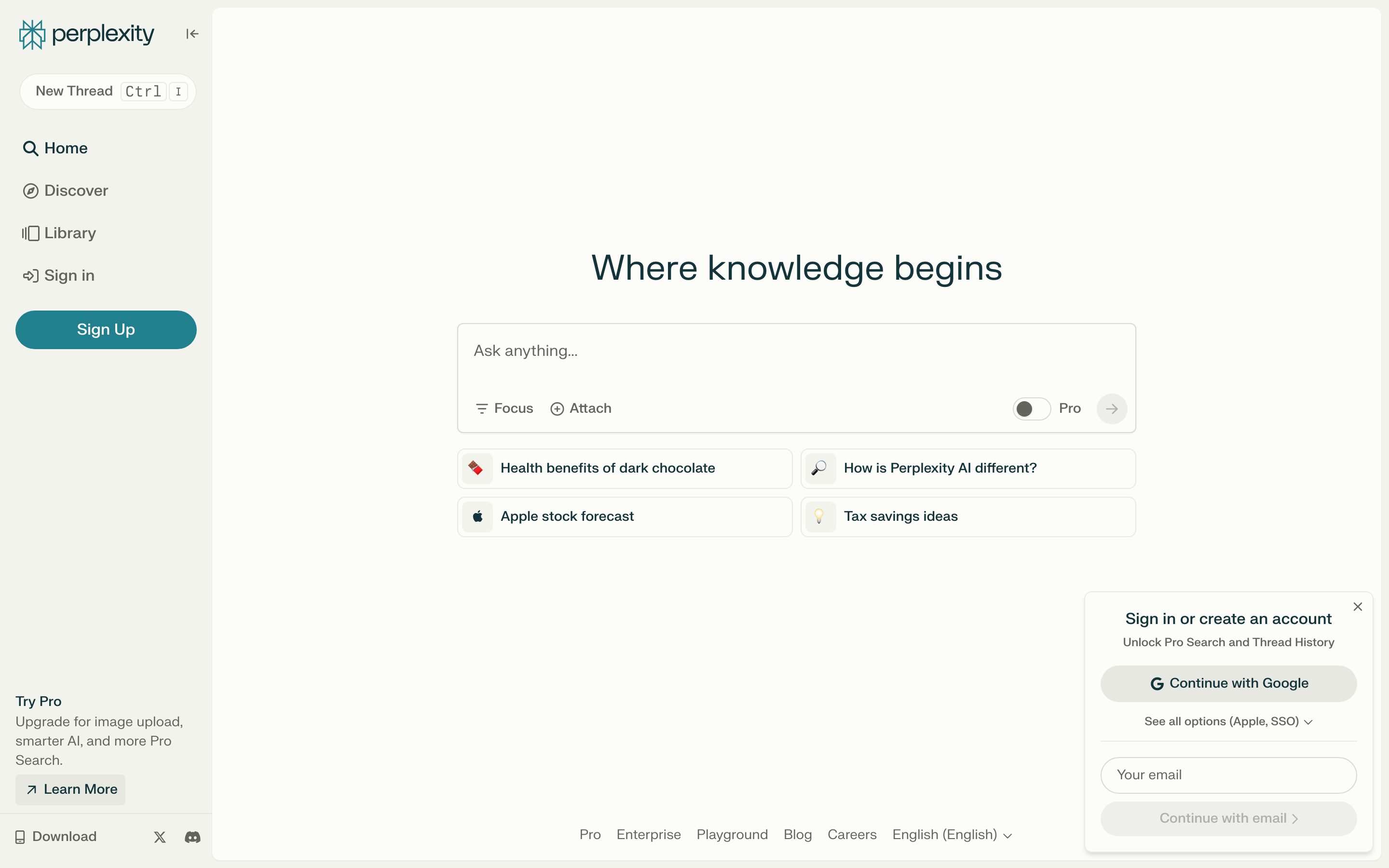
Perplexity answers questions from the web. You ask in plain words; it searches, writes an answer and puts a citation next to each claim, so you can see where it came from. Since February 2026 it also does the work that follows the question: Perplexity Computer takes a described outcome and carries it out.
How it works
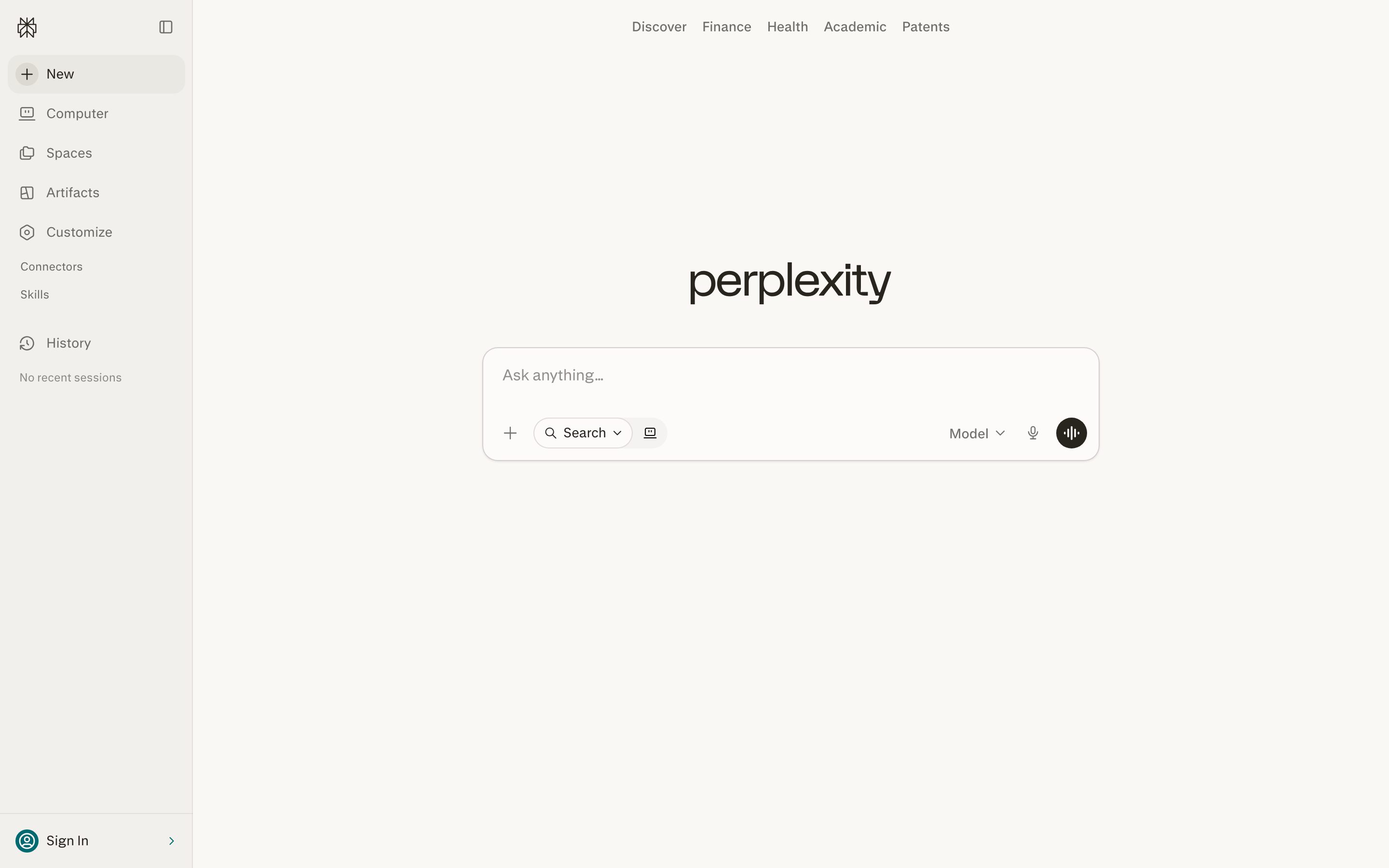
The page opens on one box, "Ask anything...". A plain search returns a written answer with inline citations and follow-up questions. The same box can be switched to Computer, and a model picker lets the user choose which model answers; by default Perplexity picks one per query from ChatGPT, Gemini, Claude and NVIDIA's Nemotron.
Computer, as the company describes it, "breaks it into tasks and subtasks, creating sub-agents for execution". One drafts a document while another gathers the data; each task runs in an isolated environment "with access to a real filesystem, a real browser, and real tool integrations", and it checks in "if it truly needs you". At launch it ran Claude Opus 4.6 as its core and handed work to Gemini, Veo, Grok and ChatGPT by what each does best. Companies can call it from Slack and connect it to Snowflake, Salesforce, SharePoint and HubSpot.
Business model
People pay by the month. Search is free, with citations. Pro, at $20, adds deep research, a choice of model and some Computer credits; Max, at $200, adds 10,000 Computer credits a month. Enterprise plans pool credits across an organisation and bill heavy use on top. Perplexity also sells its search as an API. There are no ads: the company tested sponsored answers from 2024 and abandoned them. A subscription fits because what the user buys is the answer's reliability, and an agent's work is billed by how much of it runs.
The spike
Perplexity turned twice.
The first came before launch. Aravind Srinivas pitched his first investor, Elad Gil, on beating Google by letting people ask about "whatever they see visually through a glass". Gil told him to "identify a edge right now". The founders' edge was text-to-SQL: questions turned into database queries. They built it over a scrape of Twitter – Bird SQL, which could answer "who is Lex Fridman following that Elon Musk is also following?" Beside it they had a plainer tool, GPT-3.5 reading Bing results and citing them, grown out of a Slack bot that had been wrong about their own health insurance. They released the two a week apart in December 2022. The answer engine was meant as a calling card: "maybe some enterprises will talk to us ... and maybe we could use that to build a business. That was the extent of our ambition."
People used it over Christmas, which Srinivas took as "a very powerful signal". Twitter changed its API terms on 9 February 2023, and in March he wrote that they "had to take down" Bird SQL, "the first thing we ever worked on". The founders had already chosen: Twitter search "was not scalable or doable for us". What they kept was the side project.
The second turn came in 2025. Perplexity had tried to fund answers the way search is funded, with sponsored answers under the replies. Late that year it dropped them; in February 2026 executives said even labelled ads undermined users' trust in the answers. One said that each morning he now looked at the latest revenue instead of the previous day's queries; another, "You don't hear us talk about MAUs ever." A week later came Computer, only on the $200 plan.
Our reading is that both turns are the same move: keep what people rely on, and drop what it was leaning on – a platform's data, an advertiser's money.
Why it matters
In December 2022 the alternatives were a search engine and a chatbot. The search engine gave links; the reader clicked through them, scrolled past what the launch post called "irrelevant content", and read the ads. The chatbot gave a fluent reply and no way to tell whether it was true – the founders' own bot "was saying incorrect things". Both left the same step to the user: checking. Perplexity did the reading and showed its sources, so the check took one click.
People stopped doing that step by hand at scale. Three thousand queries on the first day; 10 million monthly visits by February 2023, growing about 100% a month; over half a billion queries in 2023; 780 million in May 2025 alone, still growing 20% a month, by the company's figures. Databricks' chief executive estimated it saved his team 5,000 working hours a month.
Revenue came with the second turn. Executives put annualized revenue at about $200 million in February 2026, the month ads were dropped and Computer launched. By August The Information reported it above $750 million, from less than $250 million at the start of the year – and Nvidia in talks to invest at more than $30 billion. The earlier valuations are reported too: IVP's $500 million at $9 billion in December 2024, $20 billion in September 2025. The last round we found announced by Perplexity itself was $62.7 million in April 2024.
The playbook
Wherever people still read a page of results and check each source by hand, a tool that does the reading and cites every claim can charge monthly for being right, and bill its agent's follow-up work by how much runs. Research desks, buyers comparing suppliers and analysts reading filings all do that step themselves. The Information put Perplexity's annualized revenue above $750 million by August 2026. If the sources are unreliable, a citation proves nothing.
The lesson
Perplexity's path turns on two decisions, three years apart.
One is about which of your projects is the company. The founders' plan was text-to-SQL for enterprises; the answer engine was a public demo meant to bring those enterprises in. What decided it was behaviour nobody had asked for: people using an unknown tool over their Christmas holiday. The founders followed that, and let go of the project that stood on someone else's data when that data was closed.
The other concerns which revenue to refuse. For its first three years Perplexity measured itself in queries and users, and from 2024 it sold sponsored answers. Then it gave up the ads, said it was no longer out to get as many users as possible, and priced for people whose decisions depend on the answer being right – $200 a month for an agent that does the work. A business that sells being right cannot also sell a slot beside the answer.
To run on your own work: which thing you shipped as a demo do people keep using when nobody points them to it? And which of your revenue lines makes your best customers trust you less?
Where else it could work · our reasoning, not a finding
Free tools from B2B firms
Calculators and checkers published to collect leads; the one people keep using when no campaign points to it is a product nobody has priced.
Public demos from research labs
A demo put up to show a paper gets daily use from people who never read it – use the lab usually does not measure.
Product reviews
Affiliate commissions pay per click-through, so readers discount every verdict; a reader who pays for the verdict removes the reason to doubt it.
Software selection for companies
Rankings paid for by the vendors being ranked leave buyers checking the ranking; a buyer-paid comparison sells exactly that check.
Track record
Perplexity · perplexity.ai ↗
- Show HN: web search powered by GPT and Bing – Perplexity Ask launches ↗
- Show HN: Bird SQL, natural-language search over a scrape of Twitter ↗
- Bird SQL taken down after Twitter's API changes of 9 February ↗
- Form D: $28.8M in equity, first sale a week before the Series A announcement ↗
- Series A, $25.6M, led by NEA; iOS app launches ↗
- Series B, $73.6M at $520M, led by IVP; 10M monthly active users ↗
- Series B-1, $62.7M at more than $1B, led by Daniel Gross; Enterprise Pro at $40 a month ↗
- Homepage: “Where knowledge begins” ↗
- Reported: $500M at $9B, led by IVP, closed – by Bloomberg; not announced by the company ↗
- Comet, an AI browser, launches for $200-a-month Max subscribers ↗
- Reported: $200M at $20B – by The Information; not announced by the company ↗
- Ads dropped: sponsored answers, tested since 2024, end over trust – reported by the FT ↗
- Perplexity Computer launches for Max subscribers ↗
- Homepage: Computer, Connectors and Skills in the sidebar ↗
- Reported talks: Nvidia to invest at more than $30B, annualized revenue above $750M – by The Information ↗