Nobody could say what the work was worth, so it built the meter and signed for the shortfall
Prices engineering by the human hour it saves, and funds a customer's usage up to $10M when the count falls short.
The product
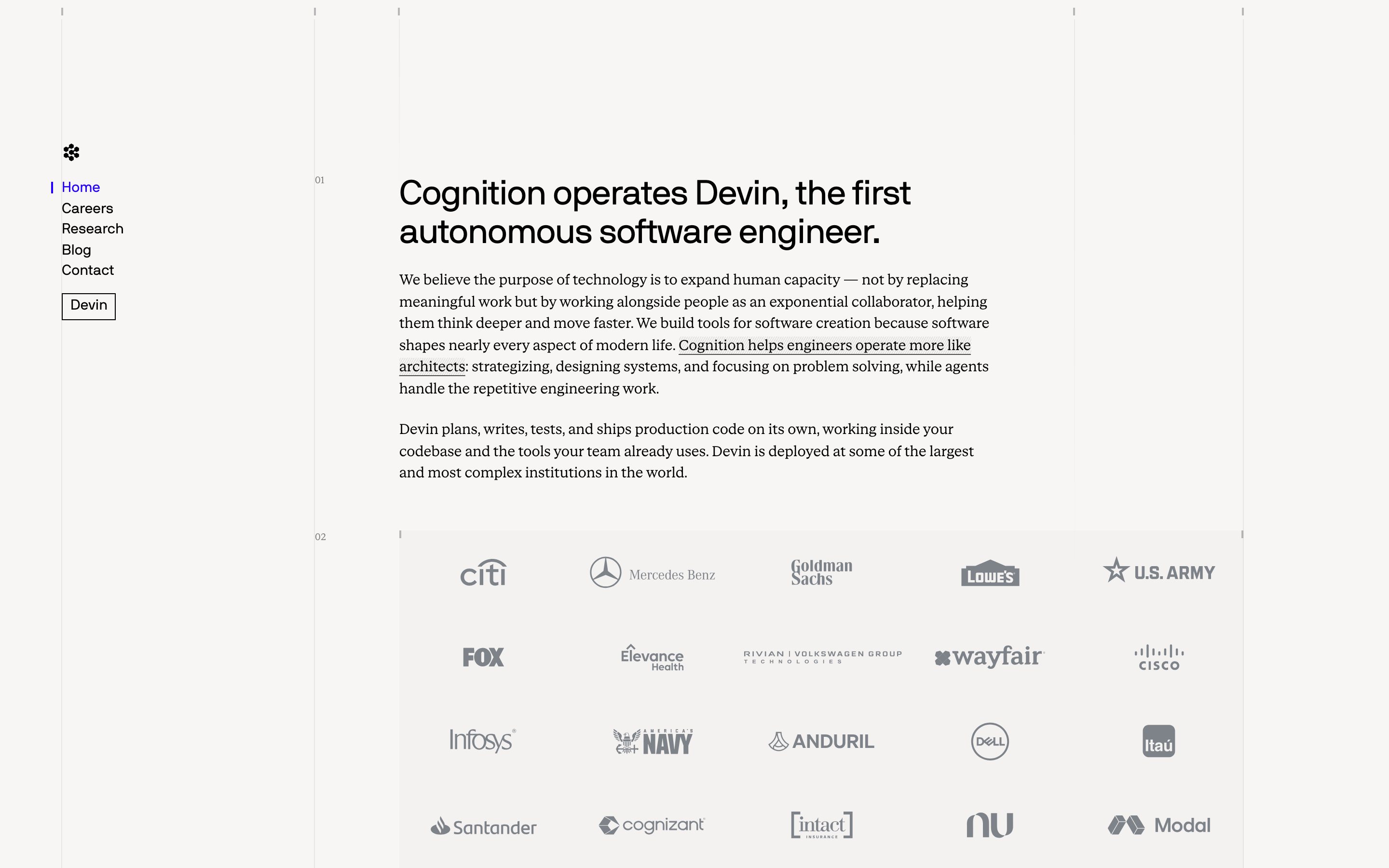
Cognition operates Devin, which it calls the first autonomous software engineer. It is neither an editor nor an autocomplete. You describe a job – fix this bug, upgrade this dependency, find out why signups fell on Tuesday – from Slack, from a ticket, from a browser tab or over an API, and Devin goes off to a machine of its own in the cloud, works there, and comes back with a pull request for somebody to read. The company calls itself an agent lab rather than a model lab: it buys reasoning from every frontier supplier it can and post-trains its own models on open ones, so that it can pick whichever suits a job "rather than tie customers to one provider". Devin is sold to large institutions – the homepage names Citi, Mercedes-Benz, Goldman Sachs, Lowe's, AT&T, the U.S. Army and Exa among them – and since June 2026 it carries an unusual condition: if it turns out to be worth less engineering than the customer paid for, Cognition covers the bill.
How it works
You give Devin your repositories and it indexes them, building a wiki of the architecture with links back to the source, so that a question about the code comes back answered and cited. That index is what every session starts from. Tag Devin on a ticket or in a channel and within seconds it answers with the files it thinks are involved and a plan you can correct before it begins. Then it works alone in a sandbox with a shell, an editor and a browser, tests what it wrote, and opens the pull request. A second Devin reorganises that diff for review, labels the bugs it finds by confidence, and keeps fixing whatever the linters and bots complain about until the checks pass. Instructions that get repeated turn into Playbooks – the outcome wanted, the steps, the things forbidden – so the next person gets the same result without writing them again. None of this happens on your own computer, which is the distinction Cognition insists on: the session outlives a closed laptop. Since June 2026 it sells the other half too. Devin Desktop is the editor it bought as Windsurf, with the cloud agents run from inside it and any rival agent allowed to work there beside them.
Business model
Devin went on general sale in December 2024 at $500 a month for a team, with no seat limits. Sixteen months later that plan was gone. The lineup today is free to start, $20 a month for an individual, $200 for a heavy one, and $80 a month plus $40 a seat for a team, each with a quota of usage attached; enterprises negotiate, and their consumption is still metered in the company's own units. The same change ended the free ride for three products that had been given away – codebase questions, the generated wikis, and the review tool – because, Cognition wrote, "pricing will now reflect the real compute they use". Where the real revenue is, a condition now runs the other way. An enterprise that spends a year on Devin has its consumption compared, near the end of the contract, against an estimate of the engineering hours that work was worth, converted at a standard rate. If the hours come to less than the money, Cognition issues credits – up to $10M.
The spike
Two things stood between an autonomous engineer and a line in an enterprise budget. The agent was not where the work happened, and nobody could tell what it had done once it was. Cognition spent two years taking these away one at a time, and neither fix was the product getting better.
The launch, in March 2024, led with a number. On SWE-bench, the company wrote, Devin "correctly resolves 13.86% of issues end-to-end, far exceeding the previous state-of-the-art of 1.96%". A month later a developer's video pulling the demo apart reached the front page of Hacker News with 302 points; the thread's own reading of it was that the problem Devin was shown solving "doesn't match the stated requirements". Cognition never answered it directly. What it did instead took a year and a half to say out loud, in the middle of a model release: "Performance on coding benchmarks is often not representative of the real-world experience of using an agent, which is why we stopped reporting SWE-Bench numbers in 2024." The claim it launched on was quietly withdrawn.
Reach came first, and it came from somebody else's misfortune. Devin asked engineers to leave the editor they lived in; Windsurf was an editor with hundreds of thousands of people already inside it. In July 2025 Google paid $2.4B in licensing fees and compensation to hire Windsurf's chief executive, its other co-founder and its research leaders, hours after a $3B offer from OpenAI had expired. The people were gone and the business was not. Cognition called on the Friday evening and signed on the Monday morning, taking the editor, the brand, an $82M-a-year business and over 350 enterprise customers, fewer than one in twenty of whom were already its own. Scott Wu's reason is about shape rather than opportunity – "the two main forms of AI coding tools are IDEs and agents. Engineers naturally want both" – and the arithmetic backed him: the purchase more than doubled the company's revenue, and combined enterprise revenue rose over 30% in the seven weeks that followed.
Proof came second, and Cognition built it rather than bought it. By mid-2026 the industry's problem had inverted: "Six months ago, every CTO was concerned their team wasn't using enough tokens. That trend has reversed as token usage and AI spend have skyrocketed." Wu put the gap plainly in June: "Companies are spending more on AI than ever, but most of them can't tell you what they're getting for it. Dashboards show activity metrics like tokens consumed and lines of code generated, but none of them actually answer the question: how much value is the business actually getting out?" His conclusion was not that customers should measure better. It was that "AI vendors should be the ones to provide it".
So Cognition built an estimator that reads every finished session and answers two questions – did this produce anything useful, and how long would a human engineer have taken to produce it – and then priced against its own answer. The instrument it used was the by-product of the thing it had been selling all along. "Every Devin session has a full execution trace: the user's request, every action taken, the resulting code, codebase context. This gives us a record of production engineering work at a level of detail that is difficult to obtain from surveys, aggregate activity metrics, or open-source benchmarks alone." A cloud agent has to keep that trace to work at all, and it proved to be the only audit of software work anyone had. Four days later the company published a test of its own – FrontierCode, which asks not whether code passes unit tests but whether a human maintainer would actually merge the pull request – and put a leaderboard of everyone's models on its homepage, its own suppliers' among them.
What changed, read from outside the company, is what the customer is buying. A benchmark score is an argument about the product; hours of work is a number on the buyer's own books, and once the vendor agrees to be paid against it, the argument stops. Cognition made the measurement its second product and then put a ceiling on its own revenue to be believed.
Why it matters
Engineers already had help. By Cognition's own count of the field there were two shapes of it – the editor "for when you want to make each decision yourself, with a speedup from AI assistance", and agents for delegating a whole task – and until July 2025 it sold only one of them. What the editor-shaped kind leaves to the person is stated by Cognition as a limit rather than a preference: a local agent "runs on your machine, in your session, but when you close your laptop, it stops". What the alternatives never took away was the waiting. Work moved only while somebody watched it move, so "the ceiling on a local agent is your attention".
Underneath that was a second step nobody removed, and it belonged to the person signing the invoice. Whatever tool a company bought, the dashboards counted tokens and lines of code, and the engineering director had to decide on faith whether any of it was worth the spend. Cognition's own paper says why the obvious measure fails: predicting the number of engineering hours from lines changed gives a fit of 0.27, "confirming that code volume is a weak proxy for engineering effort".
The money says people stopped doing both steps. Devin's revenue went from $1M a year in September 2024 to $73M by June 2025, on total net burn under $20M since the company started. Windsurf's $82M came on top, and by May 2026 the combined run rate was $492M, with enterprise usage up more than tenfold in five months; four months after that it was almost $900M. Inside Cognition the shift is visible in its own repository: 659 Devin pull requests merged in a single week in February 2026, against 154 in its best week of the year before, and by May 89% of the code its engineers committed was committed by Devin. Customers report the same shape of change – Mercedes-Benz says an eight-month modernisation took eight days, Itaú that 70% of its security vulnerabilities are now fixed without anyone starting the fix.
The measurement is honest about being rough, which is the part worth copying. The estimator was validated against 258 sessions from 126 users who were asked how long the same work would have taken them; individual predictions are off by two or three times in either direction often enough that Cognition says so; the figure it reports is the uncorrected one, which its own evaluation shows runs about 1.4 times below what the engineers themselves claimed. Its chief executive will not claim more than that either: asked in May 2026 where Devin stands, Wu placed it "somewhere between a junior and a mid-level engineer depending on the task at hand".
The playbook
Software work can be handed over whole to an agent that keeps going while nobody watches and returns finished changes for review, sold by usage to institutions with backlogs of routine engineering. Pick trades where today's assistants still need a person present at every step. Devin's revenue went from $1M a year in September 2024 to $73M by June 2025, by Cognition's figures. Work no reviewer can check at the end defeats it.
The lesson
What Cognition sold, its buyer could not audit, and the fix was not a better demo. It turned the measure of its own worth into a second product: counted the value in the unit the customer already budgets in – hours of work, not activity – published the method and its error bars, and let the year's bill be settled against that number. Where buyers cannot tell what you are worth, build the count before the next feature, publish how it works, and agree to be paid against it. The condition is a record nobody else holds; the price is a ceiling on your revenue and a number that can embarrass you. Perplexity made the matching choice, giving up revenue that made its answers worth less.
The second decision was about reach, and it was open for one weekend. Cognition needed to be where engineers already sat, and a company that was already there had just had its founders and researchers bought out from under it for $2.4B. What was left – the editor, the name, the customers – was cheap for the reason it was still there. A rival whose people are bought separately from its business leaves that business on the market as a remainder; if it holds the half of the market you cannot reach, it is the cheapest distribution you will be offered.
Both come down to a question this week. Which number does your customer write into a budget to justify buying you, and would you let this year's invoice be settled against it? And if your nearest competitor's best people were hired away tomorrow, what would be left standing – and is it the half you have been losing?
Where else it could work · our reasoning, not a finding
Industrial maintenance contracts
A plant already budgets in hours of unplanned downtime, and the service company is the only party holding a record of what each callout prevented; a fee settled against downtime avoided is there for whoever will publish the count.
Agronomy advice
A farm's year is denominated in yield per hectare, the adviser sees every decision taken in every field, and nobody today can say which advice moved the harvest – so the first to measure it can be paid out of the difference.
Architecture and engineering practices
When a larger firm hires out a studio's principals, the signed backlog, the name and the client list stay behind with an owner who can no longer serve them.
Specialist medical practices
A hospital group that recruits a clinic's surgeons leaves the site, the licences and the patient list with someone who cannot staff them.
Track record
Cognition · cognition.com ↗
- Devin is announced as “the first AI software engineer”, with a $21M Series A led by Founders Fund named in the same post ↗
- “Debunking Devin” reaches the Hacker News front page with 302 points, arguing the launch demo did not solve the task it was shown solving ↗
- $175M at about $2B, led by Founders Fund; reported closed by The Information, never announced by the company ↗
- cognition.ai: “Makers of Devin, the first AI software engineer” over a waitlist, and a banner for the Series A ↗
- Devin becomes generally available at $500 a month with no seat limits ↗
- A round at a valuation close to $4B, led by 8VC; the amount is reported only as hundreds of millions (Bloomberg) ↗
- Devin 2.0: several sessions at once, each with its own cloud editor, and a plan starting at $20 ↗
- Show HN: Kevin-32B – how to do multi-turn RL on writing CUDA kernels. Seven points, no comments ↗
- Show HN: Blockdiff – the file format behind Devin's virtual-machine snapshots. Eleven points, one comment ↗
- Google pays $2.4B in licensing fees and compensation to hire Windsurf's chief executive, its other co-founder and its research leaders, days after a $3B offer from OpenAI expires ↗
- Cognition signs to buy what is left of Windsurf: the editor, the brand, $82M of ARR and 350+ enterprise customers. Price undisclosed ↗
- Over $400M at $10.2B post-money, led by Founders Fund. Devin's ARR had gone from $1M in September 2024 to $73M in June 2025, on net burn under $20M ↗
- SWE-1.5, its first frontier-size model, post-trained on an open base and served at up to 950 tokens a second ↗
- 659 Devin pull requests merged into Cognition's own codebase in one week, against 154 in its best week of 2025 ↗
- Plans rebuilt: the $500 team plan and the no-minimum plan are retired, and Ask Devin, DeepWiki and Devin Review start charging ↗
- Over $1B at $26B, led by Lux Capital, General Catalyst and 8VC; run-rate revenue $492M, and 89% of the code its engineers commit is committed by Devin ↗
- Windsurf is renamed Devin Desktop, with the agent manager as the editor's default surface ↗
- The AI Productivity Guarantee: if Devin is worth fewer engineering hours than the customer paid for, Cognition funds the usage, up to $10M ↗
- FrontierCode, its own benchmark, asks whether a human maintainer would merge the pull request ↗
- Buys The Interaction Company of California, makers of Poke, a personal agent that lives in text messages ↗
- Series E: over $2B at $48B, led by Andreessen Horowitz and Accel. Run-rate revenue almost $900M, from $492M in May ↗
- RSA-260, the largest RSA challenge number publicly factored, is done with an implementation written and run with Devin ↗
- SWE-2, post-trained from a 2.8-trillion-parameter open model, scores 50.0% on its own benchmark at 64% less than the model a point ahead of it ↗