Raised $153M ·
Published
Technology: Robotics
Model: Outsourcing Non-Core
#robotics · #hardware · #logistics
Every dollar of its $300M order book is rented rather than sold – which is why it needs $620M to fill it
Sold robots for $1.78M in 2025; by May 2026 all $300M of orders were monthly subscriptions instead.
The product
Digit is a two-legged robot about the height of a person that carries totes around a warehouse or a factory floor: it walks down the aisles people walk down, lifts a box off a shelf and puts it on a conveyor. Agility Robotics builds it in Salem, Oregon, and sells it with Agility Arc, cloud software that watches a fleet of them, pushes updates and hands them their work. It was spun out of Oregon State University in 2015 to commercialise a laboratory's research on how two-legged things stay upright, and its own filing still calls it a development stage company.
How it works
A customer rarely meets a robot first. Since late 2025 the way in has been the Customer Acceleration Program, which costs about $500,000 and runs a buyer through a proof of technology, then a proof of concept on its own site, and only then a subscription deployment; four customers had signed up by May 2026 and more than thirty more were in conversation. What arrives at the end is one robot with a person from Agility to place it, for a deployment fee of about $25,000. At GXO it takes totes off collaborative robots and sets them on a conveyor. It works in the aisles without a cage around it – Digit v4 deployments have passed field evaluations by an OSHA-recognised testing laboratory, which is what lets it share a floor rather than a pen. Digit 5, shown on 15 September 2026, lifts 50 lb and recharges a 90-minute battery in nine minutes, which its maker puts at more than twenty productive hours in a day.
Business model
There are two prices. Under the subscription, Agility keeps the robot and the customer pays $8,500 a month for it, with the software and the maintenance folded in, on top of that one-time deployment fee – priced, the company says, "at a discount to a customer's fully burdened labor cost". Under the other, the customer buys the machine outright for about $200,000 and keeps paying roughly $36,000 a year for Arc and support. Management's own unaudited arithmetic, put in front of the buyer's board in April 2026, has a subscribed robot returning about $500,000 over an assumed five-year life against about $400,000 for a sold one, with the money spent building it back inside a year; a robot costs about $150,000 to build today and is meant to cost $75,000 at a thousand a year. As of May 2026, all $300M of the orders for the next model were written as subscriptions.
The spike
For its first nine years the company sold machines. The homepage in July 2017 had Products in its navigation and said so plainly: "We build machines today for academic, corporate, and military research and development", with Cassie – a pair of legs and no torso – available to research and development markets. By January 2020 Digit was for sale too, and Ford was the first buyer, pairing it with early self-driving cars to carry parcels the last few metres. Every one of those deals asked somebody to put capital into a machine nobody had run for a year.
On 27 June 2024 that stopped being the offer. GXO signed a multi-year agreement that both companies called the industry's first commercial humanoid deployment and its first Robots-as-a-Service contract, and Digit went to work in the warehouse GXO runs for Spanx outside Atlanta without GXO buying anything. The robot did not change. What changed was who owned it.
The change took two years to show up in the numbers, and when it did it showed up completely. In 2025 the company's entire revenue was $1,781,967, of which $1,550,360 was robots sold outright and $213,349 was deployment and services. By May 2026 every dollar of the order book for the next model was a subscription – a thousand robots on three-year terms, the buyer unnamed and holding warrants that vest as the robots arrive.
Agility's account of why is about the customer: the subscription "lowers the barriers to adoption by reducing upfront capital requirements", and the fact that the whole order book came in that shape "indicates a strong customer preference for recurring, low-friction adoption". That is true and it is half of it. The other half is on Agility's side of the table, and the filing states it in a risk factor rather than a pitch: because it keeps the robots, it now carries their deterioration, their damage and their repairs, and "the RaaS model also requires significant upfront capital investment before subscription revenue is received over time". A company that rents out machines has to buy them first. That is what the $620M the merger with Churchill Capital Corp XI is meant to raise is for, and why the going-concern paragraph in the audit and the thousand-robot order book are two readings of the same decision.
Why it matters
A warehouse that wants more done has four things to turn to already, all of them older and better proven: autonomous mobile robots that drive themselves down the aisles, collaborative arms bolted to a bench, fixed material-handling equipment, and more people. Agility's own risk factors name the first three and concede they have "decades of proven track records". The fourth is the one the company is really selling against: there are, its chief executive told TechCrunch, over a million jobs in these roles in the United States that nobody fills.
What each of the alternatives leaves to the buyer is the same thing. An arm needs a cell built around it and a job that never varies; a conveyor needs the building arranged to suit it; a fleet of driving robots needs the floor marked out for it. All of them are bought, financed and installed by the customer before they do any work, and all of them ask the room to change shape. Digit is pitched at rooms that will not: facilities "built around human workers", moving between workflows rather than sitting in a cell.
The evidence that buyers stopped doing the step is in how much work has actually gone through. Across nine customer facilities Digit has logged more than 65,000 hours. At GXO it has moved more than 100,000 totes at about 98% operational accuracy; at Schaeffler, about 25,000 at the same rate. Four companies have paid roughly half a million dollars each simply to run the evaluation. And when the biggest order yet was written, it was written as rent.
NEURA Robotics builds humanoids too, and the decision that opened its market was about who owned the company rather than who owns the robot. Generalist went looking for the recorded experience robots learn from and made it with clamps on people's wrists; Agility has been collecting the same thing by accident, in customers' buildings, for two years – its chief executive claims "the largest data lake of actual operating robotics data in real-world environments", a company figure nobody outside can check.
The playbook
A machine shaped like the worker it stands in for fits a room built for people, so the buyer automates without rebuilding the floor. The sign is an industry where automation exists but every version asks the site to change shape first: cells, cages, marked floors. Digit has logged more than 65,000 hours across nine customer facilities and moved over 100,000 totes at GXO at about 98% accuracy. Where the task never varies, a fixed arm does it cheaper.
The lesson
For nine years the thing on offer was the machine. Laboratories bought Cassie, Ford bought a Digit, warehouses were asked to buy one too, and each sale asked a buyer to spend capital on something nobody had run for a year. The decision that changed the size of the order book was to stop asking. Agility kept the robots, priced a month of their work under the wage bill it replaces, and let the customer pay out of a budget it already fills.
None of that needs a robot in it. When buyers will not risk capital on something unproven, stop selling the thing and sell what it produces, billed against a cost they already carry every month. The asset stays yours, and so does the argument: nobody is being asked to believe a forecast any more, only to compare two numbers they already read.
What it costs is the balance sheet. Every machine on subscription is bought by you before a single payment arrives, which is why a company with an auditor's going-concern paragraph against it needs hundreds of millions at once; and whoever owns the asset owns the repairs, the idle weeks and the guess about how long it lasts. Which line of your buyer's monthly costs would your product replace, and what would you have to own outright to be paid from that line instead of from their capital budget?
Where else it could work · our reasoning, not a finding
Chairside dental manufacturing
A practice already pays a laboratory invoice every month, and is offered a milling machine as capital it will not finance; whoever owns the machine could stand it in the surgery and bill per crown against the invoice that is already there.
Orchard and vineyard machine work
Growers budget for contract crews every season, but a thinning or harvesting machine is priced beyond what one farm can justify against one crop; the owner of the machine sells passes per hectare out of the crew line.
Industrial process heat
A plant renews its gas bill monthly and has no capital line for an electric boiler or a high-temperature heat pump; whoever owns the equipment can sell delivered heat by the therm against the fuel line.
Municipal depots
A city's fuel and maintenance budget is renewed every year while a capital request for vehicles and chargers waits for a council vote; the owner of the depot sells kilometres run.
Track record
Agility Robotics · agilityrobotics.com ↗
- Incorporated in Delaware as a spin-off of Oregon State University, to commercialise the Dynamic Robotics Laboratory's work on bipedal locomotion, with initial funding from DARPA ↗
- Cassie, “a commercially available research robot”, goes on sale to laboratories ↗
- The homepage has Products in its navigation: “We build machines today for academic, corporate, and military research and development” ↗
- First sale under a Form D – $8M offered, $7.5M sold; no announcement ↗
- Digit is for sale, and Ford is the first customer, pairing it with early self-driving vehicles for last-mile delivery ↗
- $150M Series B led by DCVC and Playground Global, with the Amazon Industrial Innovation Fund joining; the Form D dates the first sale to 16 March 2022 ↗
- The version of Digit built for logistics work is shown at ProMat, with a face and hands ↗
- RoboFab announced in Salem, Oregon – a plant designed for up to 10,000 robots a year ↗
- Peggy Johnson, formerly of Microsoft and Magic Leap, is appointed chief executive; co-founder Damion Shelton, chief executive since 2015, becomes president ↗
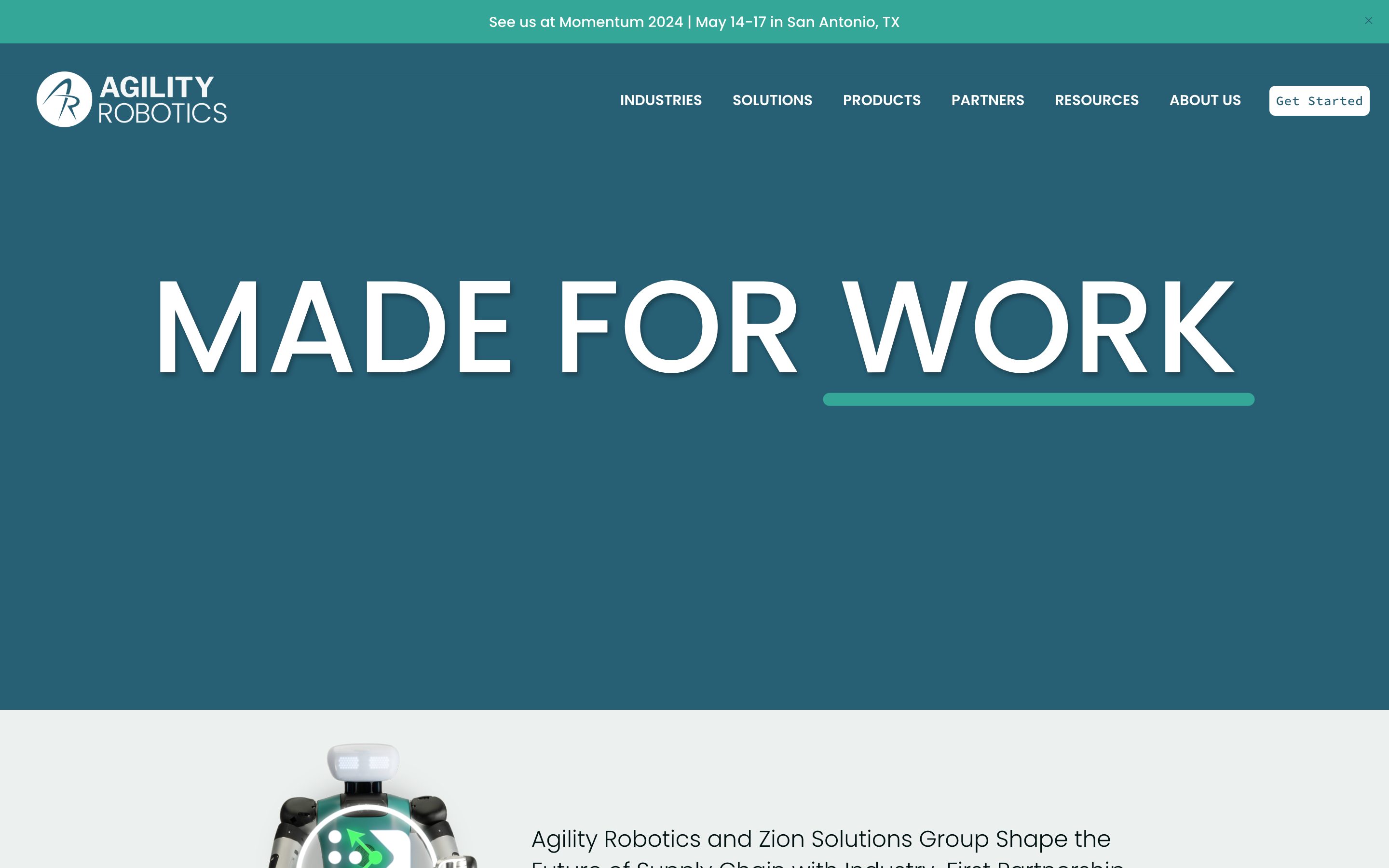
- The homepage, as the Wayback Machine captured it – “MADE FOR WORK”, with Products still in the navigation and a Get Started button ↗
- GXO signs a multi-year agreement both companies call the industry's first commercial humanoid deployment and its first Robots-as-a-Service contract, after a proof of concept in GXO's warehouse for Spanx ↗
- Series C-1 priced at $36.8583 a share; $11,106,134 of convertible notes converts into Series C-2 ↗
- The Customer Acceleration Program is established late in the year: about $500,000 a participant for a proof of technology, an on-site proof of concept and then a subscription deployment ↗
- Series C-3 priced at $66.1452 a share, authorised up to $400M of new cash, at a post-money valuation of about $1.985B ↗
- Mercado Libre signs a commercial agreement to deploy Digit ↗
- Churchill Capital Corp XI completes its own IPO, putting $414,000,000 into trust ↗
- Toyota Motor Manufacturing Canada signs a commercial agreement ↗
- The company rebrands from Agility Robotics to Agility ↗
- Last closing of the Series C-3; $152,940,865 of it had been issued by 31 December 2025, and about $5,004,410 more of Series C money arrived during 2026 ↗
- $300M of multi-year orders for Digit v5 – 1,000 robots on three-year subscriptions, with warrants to the buyer that vest as robots are deployed; the customer is not named ↗
- Merger agreement with Churchill Capital Corp XI at a $2.5B pre-money value, with more than $620M of expected gross proceeds: $420M of trust money and a PIPE of $201,025,000 led by Foxconn. Not a completed listing – the vote and the SEC review are still ahead ↗
- $100M raised through simple agreements for future equity ↗
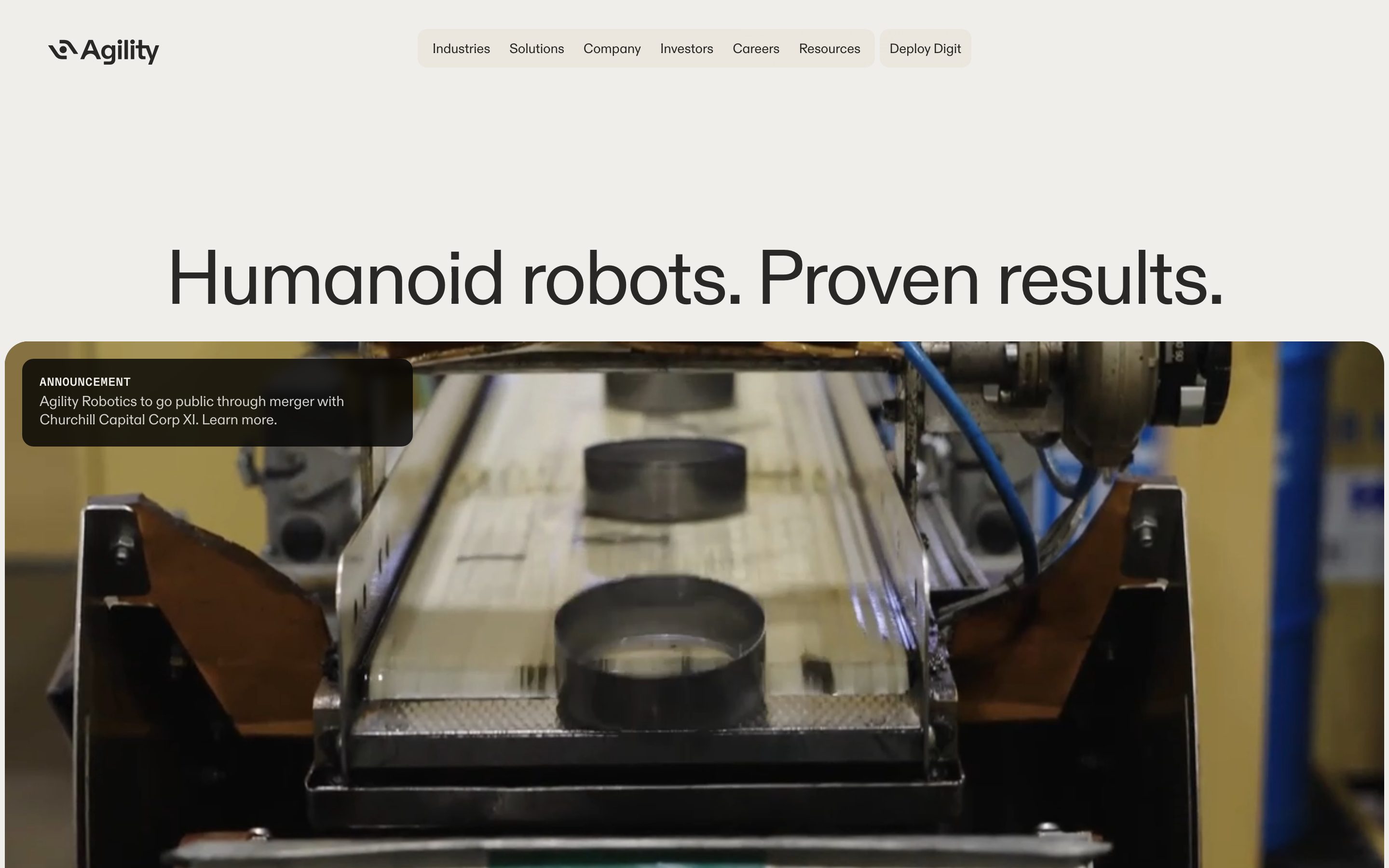
- The homepage, as the Wayback Machine captured it – “Humanoid robots. Proven results.”, Investors in the navigation, Deploy Digit where Get Started used to be ↗
- The Form S-4 is filed: $1,781,967 of 2025 revenue, a $138,086,000 net loss, and an auditor's paragraph on substantial doubt about the company continuing as a going concern ↗
- Digit 5 is unveiled – 50 lb payload, a 90-minute battery with a 9-minute charge, and early access pushed to the first half of 2027 ↗