Raised $600M · · reported by TechCrunch
Published
Technology: Robotics · AI Models
Model: Collapsing Costs
#robotics · #ai
Its founders wrote the field's workaround for missing data, then left and made the data instead
Strap-on grippers on human wrists produced 270,000 hours by November 2025; GEN-1's pretraining contains no robot data.
The product
Generalist sells the intelligence and none of the machinery. Its models take in camera and sensor data and emit action trajectories at 100 Hz, and the arm that executes them was bought from somebody else – a Flexiv Rizon 4, a Universal Robots UR5. Give the model roughly an hour of demonstrations of a job and it does the job: kitting car parts for over an hour without intervention, folding t-shirts 86 times in a row, servicing robot vacuums past two hundred, packing blocks past eighteen hundred.
The homepage puts it in two lines – "a frontier AI research and product driven company building general intelligence for the physical world", then "We train robots that work" – over videos labelled "All videos 1x speed, fully autonomous". The label answers a complaint the company makes about its own field: "demo videos of dexterous general-purpose models are too slow."
How it works
A customer arrives with a task, not a program. Someone performs the task while wearing what Generalist calls data hands: strap-on devices worn at the wrists that turn a pair of human hands into the pincers the robot has, recording what is seen and felt. That recording is what the model learns from.
Since August 2026 the shortest route needs no training run at all. Three to twelve seconds of a single demonstration are dropped into the model's thirty-second context window, and GEN-1.5 attempts the task immediately – 59% average success across ten tasks the company measured, with not one gradient step taken. Ten steps on five minutes of data raise that to 83%. An hour of robot data takes the tasks published with GEN-1 to 99%.
What follows is not a replay. Shown how to sweep a block into a bowl with a brush and then handed a banana, the model sweeps with the banana; handed a dustpan, it stops sweeping and lifts. Taught a task using only the right hand, it will use the left when the left is nearer. Generalist calls this improvisation, counts it as a capability, and says plainly that it cuts both ways, since "the definition of success in robotics is not universal – it is task-specific, workflow-specific, and ultimately user-defined." The model is also fairly indifferent to what it is holding: it has been trained across about 9,000 end-effector variations, from power screwdrivers to tongs to whisks, and the hand can be swapped mid-task while it keeps going.
Business model
No price is published, and none ever has been. The only stated way in is an email address, partnerships@generalistai.com, opened with GEN-1 in April 2026 for "early access partners"; TechCrunch reports the company "works with select customers to refine the model for specific applications". Which customers, on what terms, for how much – none of that is public.
The spending is legible even where the revenue is not. Generalist buys no robots to rent out and builds no machine to sell. The money goes into compute and into a data operation: custom recording hardware, thousands of collection devices, dedicated internet lines laid to carry the uplink, dozens of petabytes compressed, on the order of ten thousand cores processing what arrives. Of the 23 jobs open in September 2026, every one of them on site in San Francisco or Boston, one is a Data Collection Lab Manager and another is Data Partnerships. Some of the corpus is bought rather than made: GEN-0's pretraining mixtures are tabulated by Partner A, Partner B and Partner C, and the post refers to data foundries. NEURA Robotics runs the opposite way, building cobots and humanoids and selling them as finished machines; NVIDIA has money in both companies.
The loop the company describes is the business it is underwriting: "scaling robot learning creates better models, better models can do more useful physical work, and data from real businesses drives the next generation of more capable models."
The spike
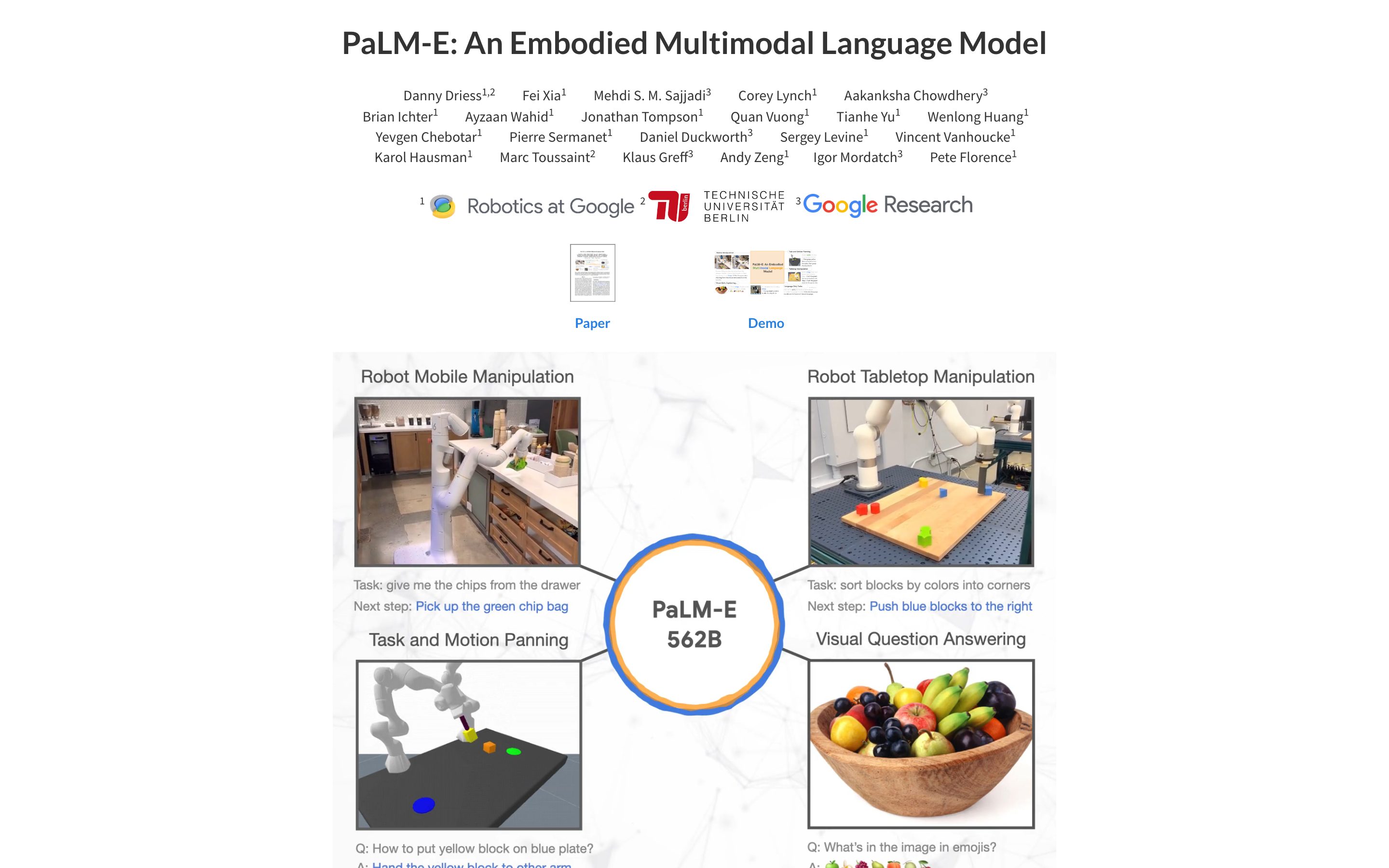
In March 2023 a paper called PaLM-E put a 562-billion-parameter language model at the centre of a robot. Andy Zeng was a co-author; Pete Florence was its last author. That July RT-2, with Florence again among the authors, gave the method a name – vision-language-action models – and by Generalist's own account "VLAs had theirs from 2023 to 2025": two years in which the field's answer to an awkward fact, that robots have nothing resembling the internet to learn from, was to borrow a model that does.
In the spring of 2024 Florence left Google DeepMind, after four and a half years there, to start a company with Zeng, who left Google DeepMind too, and Andy Barry, who left Boston Dynamics. boldstart ventures and NVIDIA wrote the first cheque on 24 March 2024, into a Delaware corporation then called Artificial General Dexterity, Inc. Then, for fifteen months, nothing. The only page they put up was black: a mission sentence, the logos of four former employers and an address to write to.
What emerged used almost none of the method its founders had written. About 99% of GEN-1's parameters are trained from scratch: no vision-language model underneath, no teleoperation corpus, no simulation data. Florence's own word for the thing he helped invent is a crutch. "A big part of the motivation for bringing vision-language training into robotics was that we didn't have enough data inside robotics itself," he wrote in April 2026. "What's after the crutch? Will you still want the crutch?" The same post is blunt about what GEN-1 is not – "a fine-tuned vision-language model with robot actions bolted on" – and notes that the company has never described its models as VLAs, although "we co-invented VLAs".
What survived the move is the second thing language models taught: that capability comes from pretraining at scale, and improves predictably. GEN-0, in November 2025, was the claim that this holds for robots too – scaling laws, and a threshold around seven billion parameters below which models stop absorbing data while larger ones keep improving.
Florence's stated reason for leaving is about pace and shape rather than method. DeepMind was "fantastic", he told Joe Lonsdale in August 2026, but "it overall felt like there was this window of opportunity", and "we could move significantly faster if we were to build a team from scratch that was just like shaped for the shape of the problem" – a problem that included "all these operational challenges with scaling data" and the unanswered question of "how we get these models out into the world."
The crutch, though, was a response to an assumption, and the assumption is what actually got dropped. Everybody in the field, as Florence describes it, was "just assuming that we'll never have a lot of data for robotics and we need to do everything we can to try and design our system smarter". Generalist did not argue with that; it went into the business of producing the missing data. The instrument had been in Florence's hands since graduate school, when he strapped a GoPro to his head, took a pair of Irwin quick-grip clamps as substitute hands and made himself an iced latte in what he calls hard mode – spilling things, cleaning them up, refilling the ice tray, opening a new box of capsules – to find out how much a person could do with nothing better than a robot's pincers. Zeng arrived at the same place watching somebody pick up trash with a grabber in Newport Beach. Clamps on a wrist cost almost nothing, need no robot and no lab, and can be worn in the homes, bakeries, laundromats and factories the corpus is now collected in. By November 2025 it stood at 270,000 hours and was growing by 10,000 hours a week; five months later it was past half a million. GEN-1's pretraining contains no robot data at all.
The traces are few and recent, because the company is not yet three years old: out of stealth on 17 June 2025, GEN-0 that November, GEN-1 on 2 April 2026, $400M led by Radical Ventures two months after that, and a $200M extension at a $3 billion valuation that TechCrunch reported on 25 August 2026 and the company has still not mentioned.
Why it matters
Everyone in this market has the same shortage and three older ways around it. Teleoperation – a person driving the robot through the task on a rig – makes genuine robot data, and is what Physical Intelligence, valued at $11 billion, leans on; Generalist's objection is that such datasets are "expensive and difficult to scale" and that they "naturally produce slower, less fluid data due to the lack of force feedback, latency issues, and visibility challenges". Vision-language pretraining borrows generality from the internet, and internet data, as Zeng wrote in January, "has no proprioception, no intervention, no consequence". Simulation sidesteps the world altogether – GEN-1.5's pretraining contains none of it, "neither rendered video nor simulated dynamics". And classical industrial automation reaches reliability by a fourth route, which Generalist describes without much argument: a history "built on precision and tightly controlling the robot's environment, not intelligence".
Each of those leaves the customer holding the same piece of work – producing enough task-specific data, again, for every new task, every new cell and every new arm. What the published numbers claim is that the piece keeps shrinking. On Generalist's own tasks, a model trained only on the task reaches 19%; GEN-0 fine-tuned reaches 64%; GEN-1 reaches 99%, on about one hour of robot data. On servicing a robot vacuum alone the three figures are 2%, 50% and 99%. Folding a box went from the roughly 34 seconds that both GEN-0 and π0 took to 12.1. And in August the requirement fell below that hour entirely: 59% from a single demonstration and no training, 83% after ten gradient steps on five minutes of data.
What that buys is easiest to see outside a lab. Universal Robots invited Generalist to run GEN-0 in its booth at GTC in March 2026, on a mobile platform that had not existed a month before – UR7e arms on a MiR base in a Vention frame. The robot reached the Boston office and was running the task two days later; shipped to San Francisco, it was running within a day, with three work days of preparation left; in the exhibition hall it used no data collected there and, the company says, "its performance was identical to operating in our offices."
Every figure above is Generalist's own. It publishes its own limits beside them: not every task attempted reaches those rates, GEN-1.5's tasks are "simple and short-horizon", and the Lego assembly was tested only on three-brick structures. The case against is worth having in the words Brad Porter, once head of robotics at Amazon and now running Cobot, gave Forbes: "Just brute forcing a huge amount of data against a not-perfect architecture is really expensive and not necessarily going to get you the result you want."
The playbook
Robot arms bought for one job already stand in plants, and the model that drives them can be sold apart from the machine: the customer keeps the hardware and pays for the learning each new task used to demand as fresh data. Trades where specialists reconfigure installed equipment for every new task show the same gap. On its own tasks Generalist reports 99% success from about one hour of robot data. With no published price or named paying customer, the scheme is unproven as a business.
The lesson
A market can spend a decade getting good at not having something. Robotics accepted it would never have an internet's worth of experience to learn from, and its best people competed at working around the gap. Florence and Zeng wrote one of those workarounds, and it made their names. Then they left and spent a company's first fifteen months producing the thing the workarounds stood in for, with the cheapest instrument that could: clamps on a person's wrists, worn by people doing ordinary work in homes, bakeries and warehouses.
None of that needed robots. When a field is organised around a missing input, the opening is not a better way around it but a cheap way to make it – cheap being the load-bearing word: the instrument has to be something hundreds of untrained people can be handed and left running. What you end up owning is a supply nobody can download.
It is slow, expensive and invisible while it runs – for fifteen months the only public evidence of this company was a page listing where its people used to work – and it pays only if the workaround really was a substitute. Which input does your market design around not having, and what is the cheapest thing you could put into ordinary people's hands to start producing it?
A second decision here belongs to the people rather than the company. The method that carries your name is the one you are least free to call a crutch; an organisation known for an approach will keep refining it long after the condition that made it necessary has gone. Leaving is what let these two say so out loud, and what made them the right people to say it is that they knew exactly what their own method had been compensating for. What in your current plan exists only because of a shortage, and is the shortage still there?
Where else it could work · our reasoning, not a finding
Field agronomy
Crop models are trained on satellite passes and laboratory images because nothing records what a scout sees and decides while walking a field; the scouts already walk it, and a chest camera costs less than one misread outbreak.
Appliance and vehicle repair
Manufacturers design serviceability and price warranties from guesses, because the sequence a technician actually performs in a customer's kitchen is written down nowhere and the manufacturer is never in the room.
Surgical technique
A surgeon whose name is on a procedure is the last person able to publish that most of its advantage was compensating for instruments that have since improved; someone who leaves the teaching hospital can, and operating time is measurable.
Method-branded consultancies
The framework is the sales asset, so the firm cannot say the problem it was built for is now absorbed by software; a team that walks out can sell the remaining work without the framework, and price it accordingly.
Track record
Generalist · generalistai.com ↗
- PaLM-E is published – a 562B-parameter language model driving a robot. Andy Zeng is a co-author, Pete Florence the last author ↗
- The PaLM-E project page, as the Wayback Machine captured it – “Robotics at Google”, the model in the middle of four robot tasks ↗
- RT-2 names the approach: vision-language-action models. Florence is among the authors; Generalist later writes that it co-invented VLAs and never calls its own models that ↗
- boldstart ventures leads the inception round with NVIDIA; boldstart dates its first cheque to 24 March 2024. The company is incorporated in Delaware that year as Artificial General Dexterity, Inc. ↗
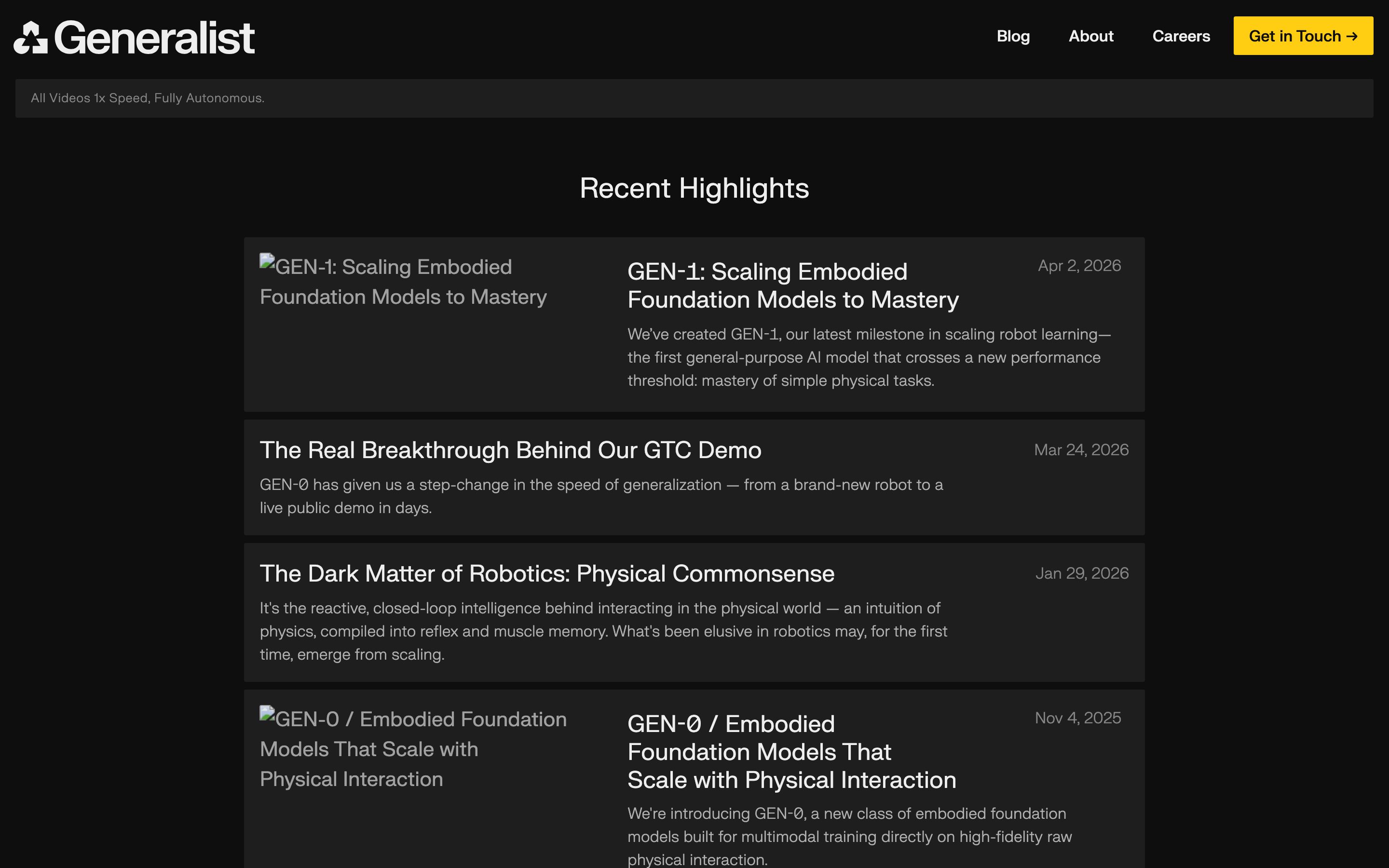
- generalistai.com is a black page: “Our mission: make general-purpose robots a reality”, four former-employer logos – OpenAI, Google DeepMind, Boston Dynamics, Zoox – and an email address ↗
- Out of stealth with a research preview: end-to-end models emitting 100 Hz actions, transferring between a Flexiv Rizon 4 and a UR5. Florence posts that he left Google DeepMind “last Spring” ↗
- GEN-0: scaling laws in robotics, a phase transition above 7B parameters, and 270,000 hours of manipulation data growing by 10,000 hours a week ↗
- At NVIDIA GTC, GEN-0 runs in the Universal Robots booth on a UR7e/MiR/Vention platform that did not exist a month earlier, with no data collected in the hall ↗
- GEN-1: 99% average success where earlier models reach 64%, on about one hour of robot data. Early access opens to partners by email ↗
- The homepage the day after GEN-1, as the Wayback Machine captured it ↗
- “Going Beyond World Models & VLAs”: about 99% of GEN-1's parameters trained from scratch, and vision-language training named as a crutch ↗
- $400M Series B announced, led by Radical Ventures, at a $2B valuation; the company puts its total raised at more than half a billion dollars ↗
- Form D: $400.0M offered, $363.8M sold to 39 investors, first sale 29 May. The issuer's previous name is given as Artificial General Dexterity, Inc. ↗
- GEN-1 is shown across roughly 9,000 end-effector variations, and keeps running when the hand is swapped mid-task ↗
- GEN-1.5 learns a task in-context from 3 to 12 seconds of one demonstration: 59% average success across ten tasks with no training at all ↗
- Form D: $208.2M offered, $198.2M sold to 32 investors, first sale 7 August ↗
- TechCrunch reports a $200M extension led by 8VC at a $3B valuation, taking the Series B to $600M. The company has published nothing about it ↗