Raised up to $1.4B ·
Published
Technology: Robotics
Model: Selling Shovels
#robotics · #hardware · #ai
Its only investor also made what it sold – and the buyout, not the robot, was the decision that opened the market
Built on $80M from its Chinese parent, NEURA bought the parent out – and Kawasaki now badges cobots 'powered by NEURA'.
The product
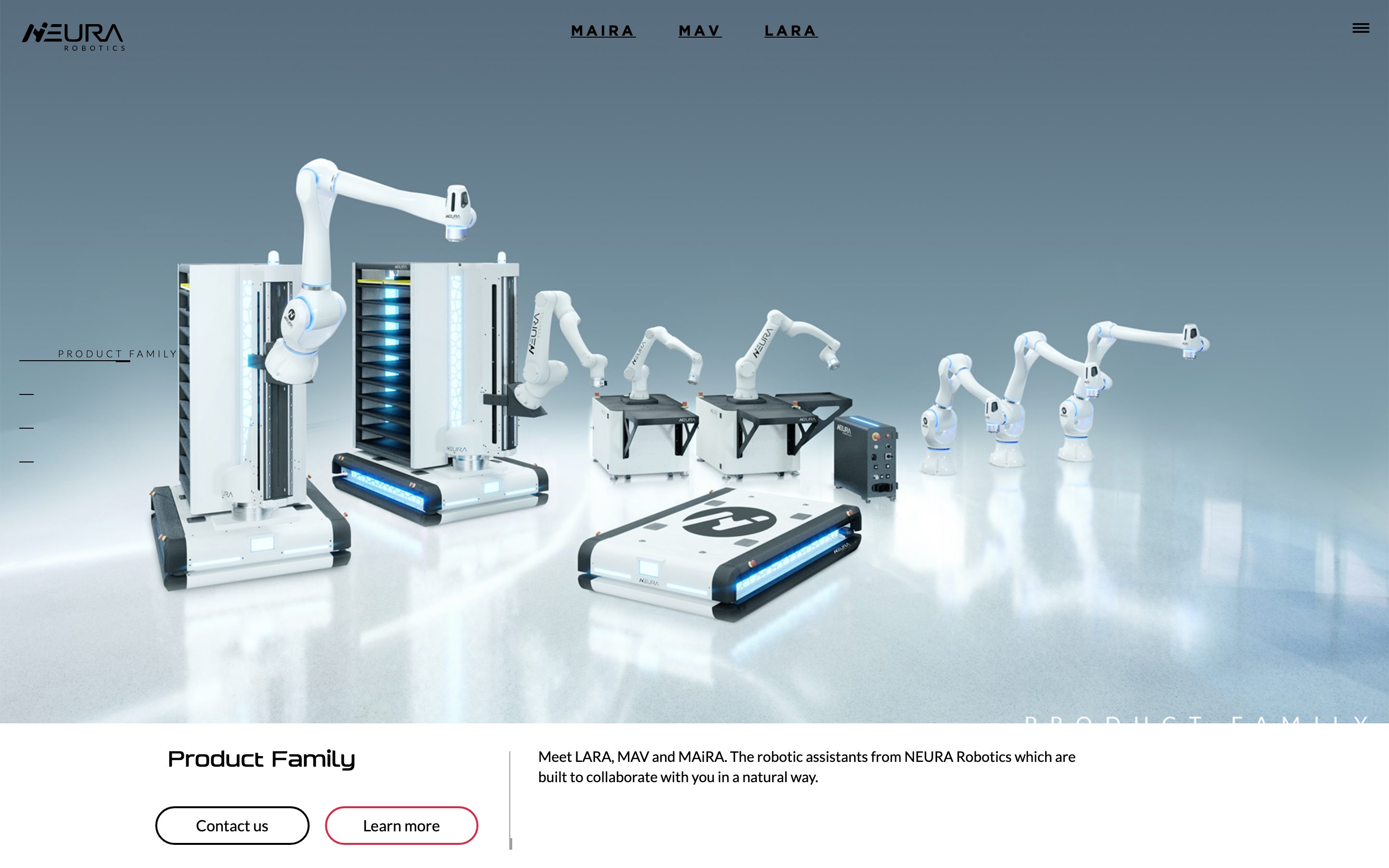
NEURA Robotics, of Metzingen in Baden-Württemberg, builds machines that arrive with their own senses. There are arms that see and feel – LARA, MAiRA – a self-driving cart called MAV, a two-armed household assistant called MiPA, a four-legged machine, and a humanoid, 4NE1. The company's word for the whole range is cognitive: vision, hearing and touch built into the machine instead of bolted on afterwards, with the model running on board rather than in a data centre. The homepage today offers "Europe's first production-ready humanoid robot", and says when: end of 2026.
How it works
You meet NEURA as a price list, which is not how humanoid robotics usually introduces itself. A 4NE1 Gen 3.5 is €98,000 for one to nineteen units and €60,000 each from twenty, before tax and shipping, and it ships as a working machine – high-dexterity hands, a high-capacity battery, a charging station – with third-party end effectors left out of the box. MiPA Home is €9,999 as an introductory price for private households. Either is held with a €100 reservation fee, refundable at any point before the purchase agreement is signed and credited against the price once it is. Both are promised for late 2026.
Behind the machine is the Neuraverse, which NEURA calls "the continuously learning operating system for the era of cognitive AI". Partners "develop capabilities once and distribute them globally"; a skill written for one robot – vacuuming, emptying a dishwasher – is meant to be available to the rest, and partners can list what they have trained for others to license. The material that trains it comes from NEURA Gyms, training centres where robots work through real application scenarios, and from partners' own factory floors.
Business model
Three things are sold here and only one of them is a robot. The first is the machine itself, at a published price – the industrial arms sat between €5,000 and €40,000 in 2023 – and it is taken as an order years ahead of any delivery date. The second is supply to the industry itself: Kawasaki Robotics' cobot line carries "powered by NEURA" on the casing. The third is the marketplace, where a partner who has trained a skill can license it on and turn that training into a running line of revenue; NEURA publishes no rate for it.
The shapes fit their buyers. A factory budgets per machine and commits well before installation, so a refundable deposit is the only honest demand signal available to a product still a year from shipping. A skill, once written, costs nothing to sell a second time.
The spike
Begin with a clock. For at least a year the company's site was a logo and a countdown – days, hours, minutes, seconds – under the promise "Revolutionizing the automation industry." and a footer reading © Han's Robot Germany GmbH. That was the company: Han's Robot GmbH, a subsidiary of Han's Laser Technology Industry Group, staffed with more than a hundred people out of Han's Motor Research Institute and selling the group's motors, drives, controllers, vision systems, Cartesian robots, automated guided vehicles and SCARA arms into Europe. In November 2020 it renamed itself NEURA Robotics and put out LARA, a six-axis arm with an encoder and joint torque sensors of its own, claimed as the cheapest collaborative robot in Europe. "We've developed our own components and software," David Reger said – and the machine he measured LARA against was the Elfin, his own parent's cobot.
What it dropped was the money. Everything NEURA had raised, roughly $80M, had come from Han's Group alone, and by the summer of 2023 that shareholder had been bought out to clear the cap table for financial investors. Reger's reason was geopolitical: "In today's deglobalized world, we have decided that Neura as an independent company has much more potential worldwide." The making stayed: the motor people, and with them the habit of building encoders and sensors rather than buying them.
There is a second reading, and it is ours rather than his. While the group held the shares, every other robot maker was a competitor of NEURA's owner, and a competitor of your owner is not going to buy your arms. Three months before that interview ran, Kawasaki Robotics had introduced its first cobot line – four arms from 3 kg to 10 kg, designed and built in Germany, each badged with NEURA's name. Neither company has ever said the two things are connected.
The second turn is quieter to look at and carries the money. Until May 2025 the site called itself "NEURA Robotics - we serve humanity."; by the first of July, a week after the Automatica announcements, the headline was "Cognitive Robotics" and what was being sold had become a platform – the Neuraverse, the Gyms, the humanoid, the home robot. The industrial partners arrived in order: Schaeffler in November 2025 with actuators and a promise to run NEURA humanoids in its own plants, Bosch in January 2026 with sensor suits recording how its workers move, Qualcomm in March with processors. Each of them turns up again in the June 2026 investor list, next to Tether, Amazon, NVIDIA and the European Investment Bank. Where one Chinese group stood in 2019 there is now a list of ten names, and not one of them alone.
Why it matters
Collaborative arms were not scarce when NEURA started. Established makers sold them, and cheap arms were coming out of Asia – NEURA's own first business was selling its Chinese parent's. What none of that solved was the work around the robot. "In almost all industrial projects, we had to adapt the existing environment to the robot," Reger said in 2023. "But I was sure that in the long run, it would make more sense to modify the robots themselves so that they could be used safely in any environment alongside humans." The obvious patch does not hold either: "You can add a camera to a cobot, but it can't recognize something within five minutes."
The evidence that buyers preferred to skip the integration is mostly the order book, and it is the company's own: fourteen contracts worth over $450M in mid 2023 with around a hundred more in negotiation, near €1 billion eighteen months later against tenfold revenue growth in the same year, and above $1 billion by June 2026. Two marks in the record are not NEURA's to write. Kawasaki, a robot maker with its own factories, chose to sell NEURA's platform under its own name rather than build one. And Schaeffler put a unit count and a date into a press release – a mid-four-digit number of humanoids in its plants by 2035. Headcount followed the orders: about 160 in late 2022, past 300 in January 2025, around 600 by that summer, over 1,100 by October.
The sharpest measure sits in an insolvency file. ek robotics had spent sixty years building driverless transport systems in Hamburg; in July 2025 it applied for self-administration, and an account published afterwards lists cheap Asian robots among the pressures that finished it. In October the company that bought it was the one that had started life selling exactly those.
The playbook
Build the senses into the machine, so the buyer stops reshaping the site around it, then sell the same platform to established makers to carry under their own badge. The opening is any equipment whose installation takes more effort than the unit, where integrators adapt every site to a standard product. Kawasaki chose to sell NEURA's platform rather than build one, and the order book passed $1 billion by June 2026 on the company's figures. Orders taken years before delivery are demand, not revenue.
The lesson
Read the path backwards and the first decision is not a robot at all. One shareholder had paid for everything, and that shareholder made arms – so every other maker of arms was a competitor of the owner, and none could be a customer. Buying the owner out meant losing the cheapest money in the business and getting a market back. Strip the names out: when the party funding you also makes what you sell, its competitors can never buy from you, and the price of independence is weighed against what those buyers are worth, not against the cash you give up. Which buyer has never taken a meeting with you because of who holds a piece of you, and what would their business be worth to you in a year?
The second decision is how it grew. In sixteen months NEURA absorbed five engineering businesses their owners had written off – a cabinet builder, a sixty-year-old maker of driverless vehicles in self-administration, an insolvent car electronics team, a cleaning-robot firm, a line Bosch no longer wanted – taking the people and the tooling each time and putting its own sensing on top. The rule: capability you would need years to build is cheapest from an owner who has given up on it, so buy the team and the line rather than the customer list, and add the one layer only you make. It is not free – each of those businesses arrives with its old contracts and its old habits. So: what would take you three years to build that somebody near you is winding down this quarter, and would you take their people on Monday?
Where else it could work · our reasoning, not a finding
Overhaul bases inside an airline
A maintenance arm owned by one carrier bills that carrier's fleet and almost nothing else; the rival fleets parked on the same apron are the larger half of the market and will not hand their aircraft to a competitor's hangar.
Diagnostic laboratories part-owned by an instrument maker
Hospitals standardised on a rival analyser will not send samples to a laboratory whose shareholder sells the machine they rejected, and referral volume is the only thing that pays for a laboratory.
Sterile process capacity for fermentation
Dairies and breweries are writing off tanks, clean-in-place lines and the engineers who run them, while everyone brewing proteins, enzymes or cultured ingredients waits years for a slot.
Precision optics workshops
Consumer camera volumes have gone and the polishing and coating crews left behind are being retired, just as satellite, lithography and surgical imaging cannot find people who took a decade to train.
Track record
NEURA Robotics · neura-robotics.com ↗
- Begins as Han's Robot GmbH, the German arm of Han's Laser Technology Industry Group, with more than 100 people out of Han's Motor Research Institute; David Reger dates “our genesis” to 2019 ↗
- hansrobot.de is a logo and a countdown clock over one line: “Revolutionizing the automation industry.” ↗
- hansrobot.de stops serving a page and answers with a redirect ↗
- Renames itself NEURA Robotics and announces LARA, a six-axis cobot with its own encoder and joint torque sensors, claimed as the cheapest in Europe – compared on the page with the Elfin, the parent's arm ↗
- MAiRA launched, marketed as the first cognitive robot; $86M raised during the year, no investor named ↗
- Homepage: “Meet LARA, MAV and MAiRA. The robotic assistants from NEURA Robotics which are built to collaborate with you in a natural way.” ↗
- Kawasaki Robotics introduces the CL series, its first cobot line – four arms from 3 kg to 10 kg, designed and built in Germany, each marked “powered by NEURA” ↗
- $55M from Lingotto, Vsquared Ventures, Primepulse and HV Capital; Reger says Han's Group, which had supplied about $80M – every euro raised until then – has been bought out to clear the cap table ↗
- Series B, €120M ($123.3M), led by Lingotto Investment Management with Volvo Cars Tech Fund, BlueCrest, InterAlpen, Vsquared, HV Capital, Delta Electronics, C4 Ventures, L-Bank and Reger; company figures: 10x revenue growth, an order book near €1 billion, headcount past 300 ↗
- InterAlpen Co-Investment – Neura II, LLC files a Form D: $5.51M sold, first sale 2 January, a fortnight before the Series B was announced ↗
- B.A.H. Industrial Solutions' business is continued as NEURA Electronics from 1 May – control cabinets, sensors and automation systems, more than 130 people ↗
- At Automatica: the Neuraverse, described as an app store for robot skills; the third-generation 4NE1 humanoid; the MiPA home robot; and NEURA Gyms, training centres where robots generate real-world training data. 600 employees ↗
- The homepage headline is now “Cognitive Robotics”; the old title, “NEURA Robotics - we serve humanity.”, is gone ↗
- Takes over ek robotics – 300+ staff, 60 years in driverless transport – after its application for self-administration in Hamburg; it becomes Neura Mobile Robotics and keeps the ek robotics brand ↗
- Buys the development division of the insolvent Huber Automotive AG – more than 30 engineers, assets and know-how – five weeks after proceedings opened; NEURA is past 1,100 people ↗
- Schaeffler partnership: actuators up to 250 Nm, a mid-four-digit number of NEURA humanoids in Schaeffler's own plants by 2035, and Schaeffler's application data into the Neuraverse ↗
- Bosch partnership to industrialise humanoids in Germany: sensor suits recording how Bosch workers move, joint AI software, components and assembly ↗
- Bloomberg reports NEURA raising about €1 billion backed by Tether at a valuation near €4 billion – talks, not a close ↗
- Qualcomm collaboration on physical AI, with Dragonwing IQ10 processors as reference designs in NEURA's robots ↗
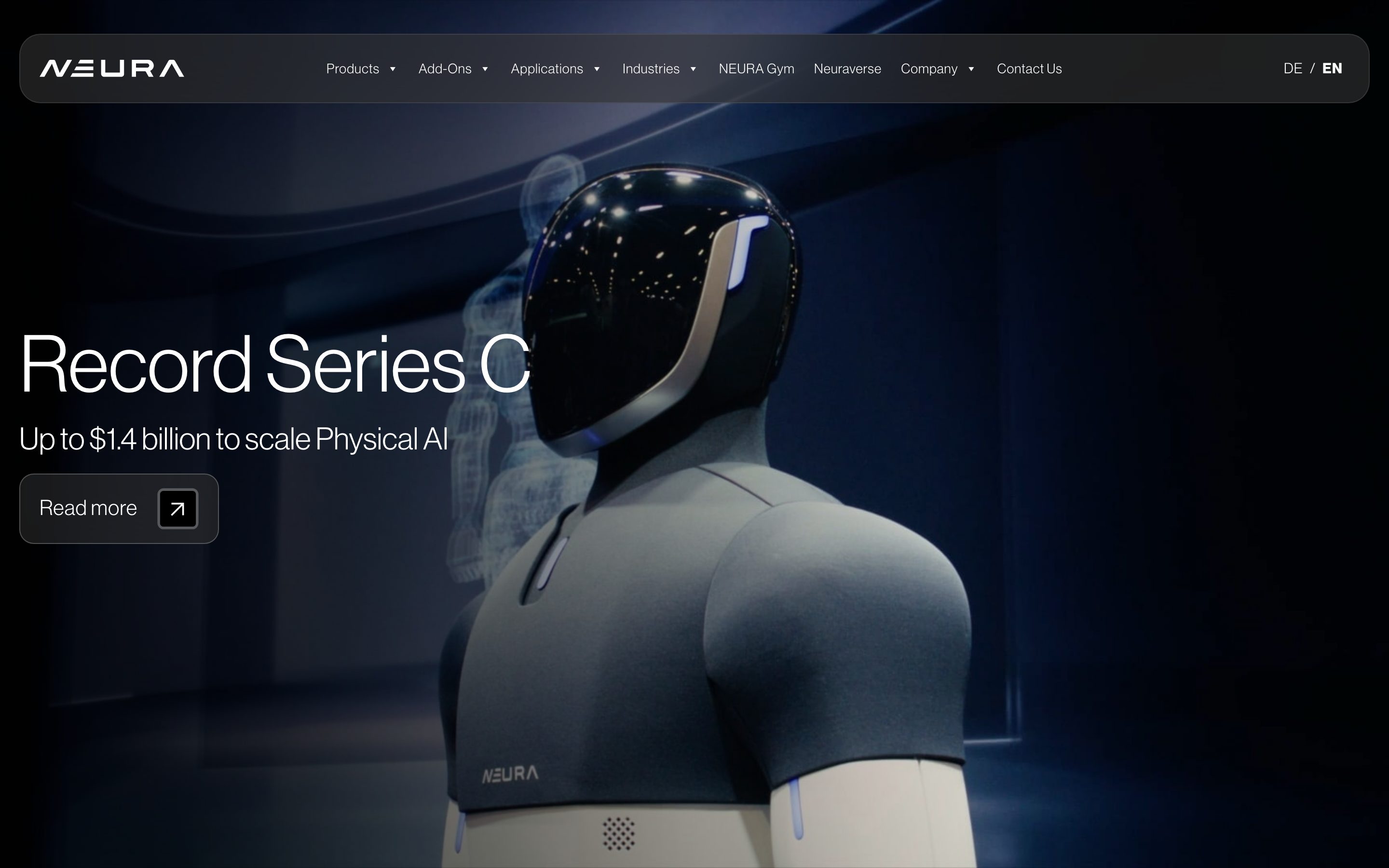
- Series C of up to $1.4B, led by Tether with Qualcomm, Amazon, NVIDIA, imec.xpand, Bosch, Schaeffler, the European Investment Bank, Lingotto Horizon and InterAlpen; orderbook and deployment pipeline above $1 billion ↗
- CNBC: the full amount depends on undisclosed performance milestones, and a person familiar puts the valuation near $7 billion – which NEURA declines to confirm ↗
- Homepage: “Record Series C – Up to $1.4 billion to scale Physical AI”, over the 4NE1 humanoid ↗
- NEURA Robotics Moonrock Cap Ltd, a pooled vehicle in the British Virgin Islands, files a Form D: $938K sold, first sale 15 January 2026 ↗
- Buys the ACTIVE Shuttle line from Bosch Rexroth, hardware, software and service, effective 1 October – Bosch having joined the Series C nine weeks earlier ↗
- Neura Mobile Robots takes 100% of Adlatus Robotics of Ulm, twenty years of autonomous cleaning machines with hundreds of systems in the field ↗