Raised $100M ·
Published
Technology: GenAI
Model: Selling Shovels
#ai · #video · #infrastructure · #agents
For four years it sold the ingredient, then started selling the meal
Four years selling video search by the API call; in 2026 it shipped its own apps and raised $100M.
The product
TwelveLabs makes software that watches video so that a person does not have to. Point it at an archive and ask in ordinary words for the thing you want – the touchdown, the person in the red shirt, the shot that will fail a compliance check – and it returns the seconds where that happens, with a description of them. Its customers are the people who own a great deal of footage: NFL Media, the Toronto sports group MLSE, the South Korean city of Sejong, and software companies that build on it.
How it works
Video goes in first and is read once. The platform indexes it at about sixty times real time – an hour of footage in a minute – and keeps what it found, so later questions are answered from the index rather than by watching the film again. Then there are four things to do with it: search, which finds the moment from a description of the scene; analyse, which writes summaries, chapters and highlights, and since Pegasus 1.5 will cut a whole video into labelled segments with timestamps against a schema you define, up to two hours in one request; embed, which hands back the vectors; and applications built on all three. Two models sit underneath – Marengo for retrieval, Pegasus for language about video.
There are now two ways in. A developer takes the API; the platform's own figure is more than ten thousand hours of video a day passing through it. Everyone else gets a product: Rodeo, for editors and producers who want to find and assemble footage by describing it; Jockey, an agent that answers questions across a whole library; and a compliance reviewer.
Business model
The free tier covers ten hours of indexing and six hundred minutes a month with no card. After that a developer pays as they go: $2.50 for each hour of video indexed, once; $4 per thousand searches; $1.75 per hour of video analysed plus $7.50 per million tokens of text out; and embeddings by the million tokens, priced by what is being embedded – $0.260 for video, $0.065 for audio, $0.200 for text. The shape follows the cost. The expensive act is reading the video the first time, so that is charged by the hour of footage and charged once, and every question afterwards is cheap. When Marengo 3.5 arrived, embedding moved off duration and onto tokens per modality, and the four-hour ceiling on a single ingest came off.
The other half is sold by hand. "Talk to Sales" is one of the two buttons on the homepage, enterprise plans are custom and can be deployed air-gapped, the intelligence community's venture arm In-Q-Tel is an investor and a city government is a reference customer.
The spike
The five founders met doing military service in South Korea's Cyber Operations Command, reading papers together in the barracks, and left with an argument rather than a product: that a machine would have to learn the world the way a person does. "We felt like the road to generally useful artificial intelligence would need to be able to mimic the learning process that we go through," Jae Lee told NEA later. His example was fire: nobody reads a book about why it is hot.
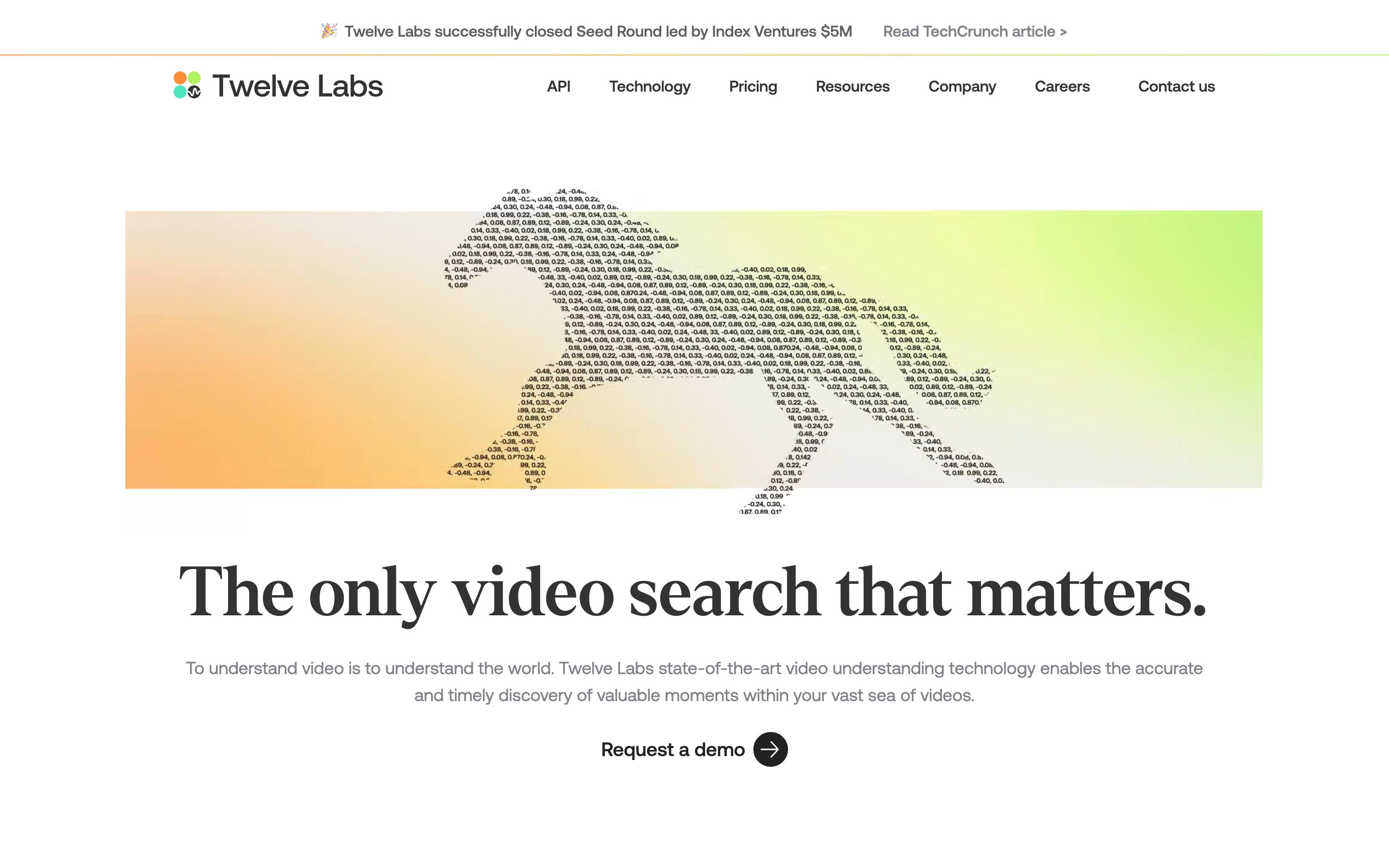
What they put on sale was much smaller than that. On 16 March 2022 the homepage said "The only video search that matters." and offered one thing to do about it, request a demo; the announcement that day described "a cloud-native suite of APIs" that found a moment inside video in under a second, and a $5M seed. The mission Lee gave was a supplier's: "to help developers build programs that can see, listen, and understand the world as we do by giving them the most powerful video understanding infrastructure." The models were trained on Oracle's cloud. The rest of the argument arrived piece by piece over the next four years – Marengo, Pegasus and Search, as the company puts it, "released on their own timelines" – and every piece was sold the same way, by the call, to somebody who would put it inside their own product.
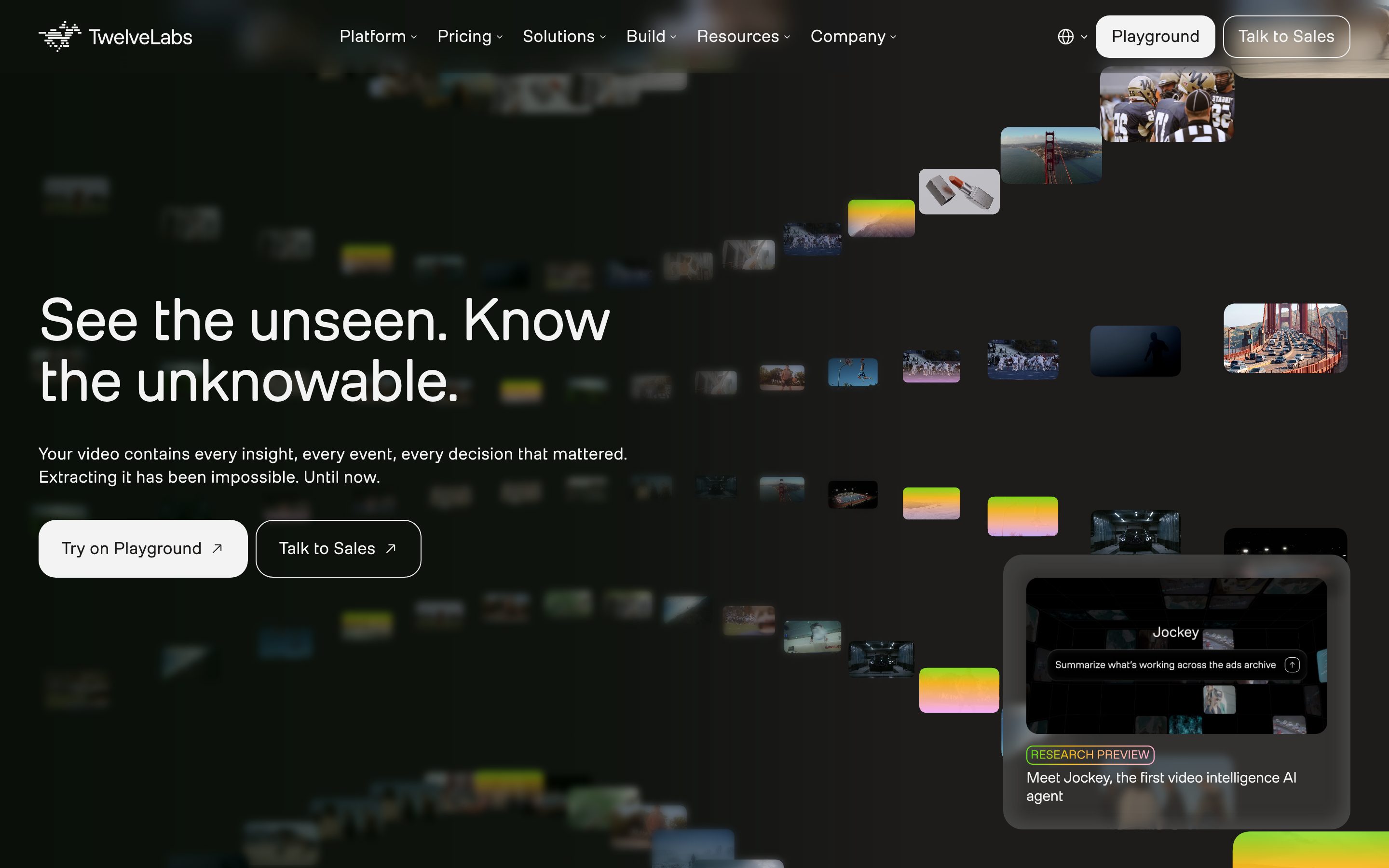
Then, in 2026, the company began selling the work itself. At NAB in April, Lee said TwelveLabs was "transitioning from understanding video to operationalizing it at scale". On 1 June came Rodeo, "TwelveLabs' first application-layer product", for producers and editors rather than developers: "Video is inherently a creative medium, so we wanted to deliver all of the foundation model power and innovation directly into creative workflows without any technical barriers." Jockey, which had been an open-source project, "has since been rebuilt and relaunched as a first-party TwelveLabs product". A compliance reviewer followed in September. The Series B on 1 July came with the sentence that explains the order: "Models commoditize. The intelligence layer that composes them does not."
Lee's own account allows no turn at all. "Five years ago, we made a contrarian bet: the substrate of machine intelligence is recorded reality in motion, not language," he wrote with the round; the models have been going in one direction since. That is true of the research and beside the point for the business. For four years the company was a part in other people's products, paid by the call and invisible to the person doing the work; from 2026 it stands in front of that person and charges for the finished job. What also changed is who carries the cost: the early models trained on Oracle's cloud, and AWS is now the preferred one under a multiyear commitment, inference is being tuned for its Trainium chips, new models land there first, and Amazon is in the round.
Why it matters
The footage was always searchable in principle; someone just had to watch it first. TwelveLabs' own account of a broadcast archive describes rooms full of tape where "the only person who can say what's actually on any given tape is the person who wrote those notes by hand", compliance that meant "watching every asset start to finish", and a clip request that meant a ticket to the archive team. Keyword search over that metadata can only return what a person already typed: as Lee put it about the NFL, finding a specific touchdown "is currently not possible with metadata-based search". Video analytics was already sold by Google, Microsoft and Amazon; the company's objection to those is structural rather than competitive – a language model samples a few frames and re-reads the video from scratch for every new question, where the point of an index is that the watching happens once.
The step that disappeared has a stopwatch on it. Through Mimir, an hour of content takes three to four minutes to index and produce metadata for, and on live news a team can start building clips within seconds of the recording starting. More than thirty thousand developers were on the platform by December 2024, when the company had seventy-three employees. On its own published evaluations, Pegasus 1.5 scores 0.4279 against Gemini 3.1 Pro's 0.3370 for segmentation quality, and Marengo 3.5 scores 67.38 on an eight-group aggregate at 512 dimensions against Gemini Embedding 2's 62.35 and Amazon Nova's 50.34 at 3,072.
The clearest evidence is who put it inside their own products. The companies that sell the shelf stocked it: Mimir, iconik and Quickplay run it inside their archives, and Autodesk Flow Capture ships it in its dailies software. At the end of 2024 Databricks Ventures and Snowflake Ventures both invested while their own platforms were being wired to it.
The playbook
Charge once for the expensive act, reading the material the first time, and little for each question afterwards. That price fits any archive whose contents nobody knows without watching, where keyword search returns only what a person once typed. Through Mimir, an hour of footage is indexed in three to four minutes, and more than thirty thousand developers had joined by December 2024. Once three suppliers offer a close index, the price stops being scarce.
The lesson
The founders had an argument that would take a decade and a product that answered one question, and they sold the question. What went on the price list in 2022 was finding a moment in an hour of footage, charged by the hour, and bought mostly by firms who buried it in software of their own. They got the users; TwelveLabs got an invoice it could send monthly while the rest was still research. Anyone with a long plan can do this: find the piece of it that already finishes a job inside somebody else's product, sell that piece, and let those buyers fund the years the rest needs. The bill is four years of anonymity: the people doing the work never hear your name. Which piece of your unfinished plan would another company put inside its product this quarter, and what would they pay each time it runs?
The second decision is when to stop being the piece. Nothing broke; the company still publishes tables where its models beat Google's and Amazon's. What changed is the argument to a buyer: models commoditize, the layer composing them does not. A component is worth its scarcity, and once a buyer can get something close from three suppliers, the money moves to whoever turns it into finished work. Exa, which built the same kind of retrieval for the open web, still sells it the first way, by the request, with no subscription. The cost is that you now compete with the customers who built you in. What in your product could a competitor match within a year, and who is still doing by hand the work it only helps them with?
Where else it could work · our reasoning, not a finding
Battery state of health
Reading a pack's remaining life from charge data is the hard part, and leasing firms, fleets and second-life buyers each need it inside software they already run.
Shop-floor metrology
A measurement good enough to sign off a part is expensive to build and every machine-tool and factory-software vendor needs one it can embed rather than write.
Clinical genome interpretation
Reading a genome is bought by the sample from several vendors at comparable quality; turning one into a report a clinician can act on is still someone's afternoon.
Earth observation
Operators sell imagery by the square kilometre, and the insurer, the port and the farm still pay an analyst to turn it into a claim, a berth plan or a spray schedule.
Track record
TwelveLabs · twelvelabs.io ↗
- Earliest archived capture of twelvelabs.io ↗
- Launch: a suite of APIs that search inside video in under a second, with a $5M seed led by Index Ventures ↗
- Homepage on twelvelabs.io: “The only video search that matters.”, “Request a demo” ↗
- $12M seed extension led by Radical Ventures, and a multiyear contract to train the models on Oracle's cloud ↗
- Form D, $10.1M sold, first sale 20 July 2023 – no announcement found for this raise ↗
- Series A, $50M, co-led by NEA and NVIDIA's NVentures ↗
- $30M from Databricks Ventures, Snowflake Ventures, SK Telecom, HubSpot Ventures and In-Q-Tel; $107.1M raised in all ↗
- TwelveLabs launches on Product Hunt, 222 upvotes ↗
- At NAB: Pegasus 1.5, a preview of Rodeo, and TwelveLabs inside Autodesk Flow Capture ↗
- Rodeo, the company's first application-layer product, for editors and producers ↗
- Series B, $100M, co-led by NEA and NAVER Ventures, with Amazon; AWS becomes the preferred cloud ↗
- Jockey relaunched as a first-party product rather than an open-source project, 185 upvotes ↗
- Compliance by TwelveLabs, a second application, 266 upvotes ↗