Raised $6.5B ·
Published
Technology: Fintech rails
Model: Selling Certainty
#payments · #infrastructure · #saas
With no listing to cash out in, the payments company priced itself and bought staff shares
Stripe raised $6.5B at half its 2021 price to buy employees' shares, then ran a tender offer every February since.
The product
Stripe sells the machinery a business uses to take money and account for it: card payments online and in a shop, subscriptions and invoices, sales-tax filing, fraud screening, payouts to third parties, cards it issues on a customer's behalf, company incorporation, and lately stablecoin wallets and rails built for AI agents to pay with. This summer it agreed to buy two more pieces: OpenRouter, which routes AI requests across hundreds of models, and Parafin, which lends to small businesses through the platforms they sell on. Patrick and John Collison founded it in 2010 and opened it to everyone in September 2011; it is run from San Francisco and Dublin.
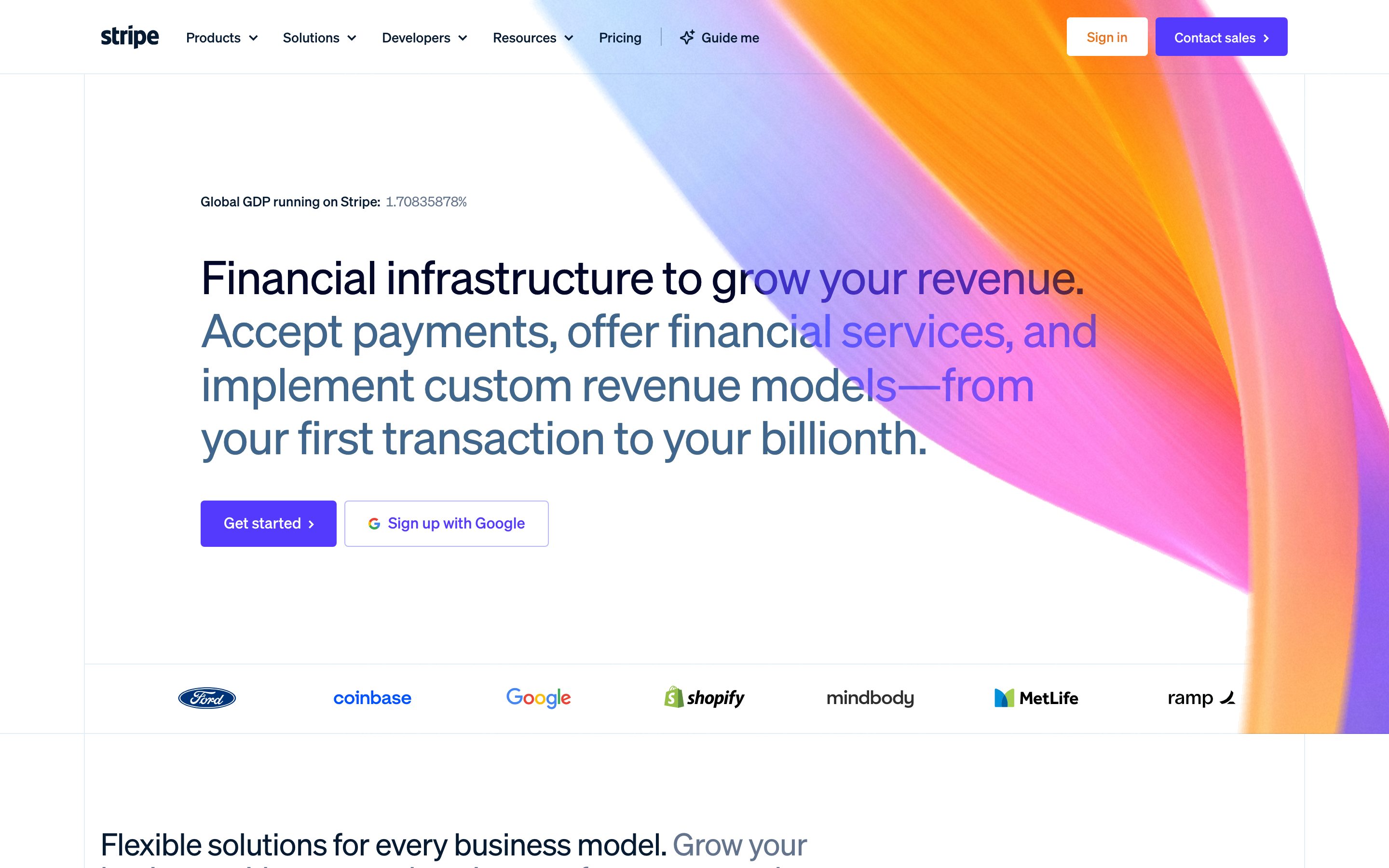
Its own 2025 annual letter puts businesses on Stripe at $1.9 trillion of total volume for the year, up 34%, "equivalent to roughly 1.6% of global GDP", spread over more than five million businesses directly or through platforms – among them 90% of the Dow Jones Industrial Average and 80% of the Nasdaq 100, and a quarter of all new Delaware corporations, which are now created through Stripe Atlas. Link, its accelerated checkout, is used by more than 200 million people. Fifteen years in, the company has never listed, and says it stayed robustly profitable through 2025.
How it works
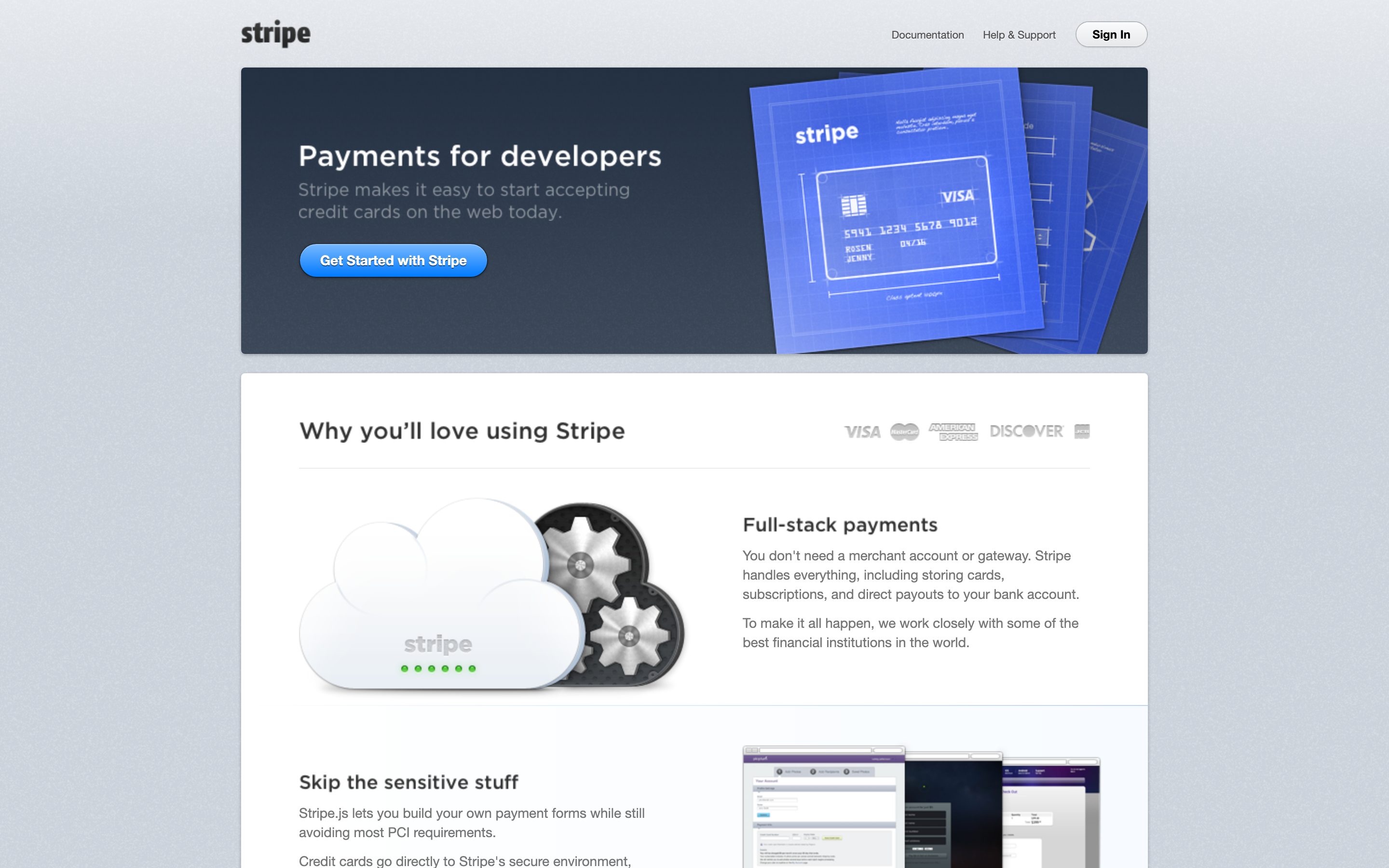
The page a stranger meets offers "Get started" next to "Contact sales", which is the business in miniature: sign-up at one end, a negotiated contract at the other. Nobody applies to a bank on the way in – Stripe holds those relationships itself, as it has since 2011. What arrives out of the box, by the pricing page's count: 195 countries, more than 135 currencies and over 100 payment methods behind a single integration, with fraud screening running by default and "no integration required".
Everything else is switched on from the same account. Billing and Invoicing for recurring charges, Tax for filings, Radar for fraud, Connect for platforms that have to pay their own sellers, Issuing for cards, Terminal for the shop floor, Atlas to incorporate a company in the first place. A business that would rather Stripe be the seller of record uses Managed Payments and pays 3.5% on top of the payment fee. Metronome, bought in January 2026, meters usage-based billing – the shape AI companies charge in; the letter names OpenAI, Anthropic, Confluent and NVIDIA among the companies whose billing it powers.
Business model
The list price is 2.9% + 30¢ per successful domestic card transaction, with "no setup fees, monthly fees, or hidden fees". It is the same headline number Stripe printed in 2011, when the page explained the point of it: "you only get charged when you earn money." Large customers leave the list – "Design a custom package", with IC+ pricing, volume discounts and country-specific rates, through sales.
Around the payment sit separate meters: Invoicing at 0.4% of each paid invoice, capped at $2; Billing plans from $10 a month; Terminal at 2.7% + 5¢ in person. That software is becoming a business in its own right – the Revenue suite is on track for a $1 billion annual run rate this year, by the company's count.
How thin the main slice is was visible once, in 2023, when Bloomberg read an investor document: $14.3 billion of revenue on $816 billion of volume in 2022, and transaction margin before losses of $3.17 billion – 0.38% of volume, against 17 basis points at Adyen. Stripe earns when its customers earn, and close to nothing when they do not.
The spike
The product has never turned. A week after the public launch, in October 2011, the homepage read "Payments for developers" and, under it, "You don't need a merchant account or gateway". Fifteen years later the catalogue covers billing, tax, fraud, cards and incorporation, and the sign-up still asks nobody to apply to a bank. The one thing of note Stripe has dropped is Bitcoin payments, wound down in January 2018 because, the company wrote, the currency "has evolved to become better-suited to being an asset than being a means of exchange" and "we've seen the desire from our customers to accept Bitcoin decrease".
The change of course was in the ownership. Stripe had paid its people in double-trigger restricted stock units – shares that vest, and then need a liquidity event, normally a public listing, before anyone can sell them or pay the tax they set off. By early 2023 the earliest employees' units were close to expiring, and waiving that second condition would have handed those people a tax bill with nothing to sell against it. Bloomberg, reading an investor document that March, reported a bill of roughly $3.5 billion, $2.3 billion of it falling in the first quarter, and that Stripe had hired Goldman Sachs and JPMorgan in January "as it evaluated options to raise cash or go public".
It took the cash. On 15 March 2023 the company announced a Series I of more than $6.5 billion at a $50 billion valuation – about half the $95 billion it had been given two years before – and said the money "will be used to provide liquidity to current and former employees and address employee withholding tax obligations related to equity awards". The release added a line few companies ever have to write: "Stripe does not need this capital to run its business."
Since then the buy-back has been a fixture of every February, priced by whoever is willing to pay. A tender offer at $65 billion in 2024, of which Reuters reported $694.2 million actually drawn and a Form D records the sale on 8 April; $91.5 billion in 2025; $159 billion in 2026, with Thrive Capital, Coatue and a16z providing most of the money and Stripe repurchasing shares with some of its own. In September 2025, Axios reported it in talks to buy shares back from its venture investors too, at the $106.7 billion its own 409A valuation had reached.
Stripe explains this as not needing anything the public markets offer. "For us right now, an IPO would be a solution in search of a problem," John Collison told CNBC in February; the business is self-funding, and going public is not "one of our top five or ten or twenty priorities". The reading we take from the dates is narrower than that. A listing had exactly one job at Stripe that nothing else could do – turning its employees' paper into money – and in 2023 the company bought that job outright, for $6.5 billion and half its valuation, then put it on a standing order. Everything else a listing would have brought was optional, and has stayed optional ever since.
Why it matters
Anyone could take card payments in 2011. What they could not do was start. A merchant account had to be applied for and underwritten, with a gateway bought separately and PCI compliance on top, and the answer was often no. In the launch thread, a developer described what Braintree – then the friendliest of them – had required of him: a business licence, $60 and a few hours between City Hall and the courthouse, then a couple of days of underwriting. Another, who had gone the traditional route, said the process "took at least a week – with LOTS of paperwork back and forth being printed out, scanned, emailed", before adding: "Little did I know...I didn't NEED a merchant account." A third had been turned down more than once and had fallen back on PayPal; a fourth put the pattern plainly – merchant accounts were headaches, "especially if you're young – nobody trusts you".
Stripe removed the application by holding the accounts itself. "We're abstracting away the problem of having a merchant account, because we generally believe there are too many complex moving parts," one of its people wrote in the thread; another named the machinery – "we are partnering with Wells Fargo and First Data to set up whatever accounts are necessary". Asked why it was so painful everywhere else, Patrick Collison blamed underwriting's "shotgun approach to information requirements" and an industry that copies the standard "without much consideration". The risk came across with the paperwork, and people said so at the time: one commenter warned that processors putting many merchants behind one account "sooner or later go bust", another that the fraudsters would arrive the moment cards were this easy to take.
They moved anyway. The launch post reached 1,249 points; ten weeks later "Why we ditched PayPal for Stripe" reached 382, with two more migration write-ups in the month after that. Volume followed the same line for a decade and a half: $816 billion in 2022, $1.4 trillion in 2024, $1.9 trillion in 2025. Depth followed too – by the company's count in 2023, three quarters of the businesses running more than $1 billion a year through Stripe used it for more than payments. And the step it removed has now vanished in the other direction: new companies are incorporated through Atlas before they have a customer, and in 2025 a fifth of them charged one within 30 days, against 8% in 2020. Lovable, one of the products the annual letter names as having launched worldwide on day one, is among the customer logos on Stripe's homepage today.
The playbook
Where a customer must apply, wait and be underwritten before using a service, a firm that holds the licensed account itself can let them start in minutes and charge only when they earn. It suits trades that turn young businesses away for lack of history: insurance, lending, payroll. Stripe's volume reached $1.9 trillion in 2025 on that founding promise. The price is the risk once screened at the door, fraud included, which now lands on you.
The lesson
The decision worth copying is not on the product side. In January 2023 Stripe hired bankers to weigh two options, raising cash or going public, and took the one that cost it both money and price: $6.5 billion at half its previous valuation, spent on its own employees' taxes and shares. Every February since, it has done a smaller version of the same thing, letting outside investors set the number and paying part of the bill from its own profits.
Underneath the payments, this has nothing to do with payments. The company asked what the event it was being pushed toward would actually deliver, found that the only part it owed anyone was cash for shares those people already held, and bought that part on a schedule of its own. Anyone can do that: when something you owe your own people can be settled only by an event you do not want, price the obligation, pay it yourself, and repeat it often enough that nobody is left waiting. The event turns back into a choice.
It is not free. Stripe took a valuation half its last one, in public, to do it, and every round of buying needs someone willing to buy; in a year when nobody is, the debt to your people falls due regardless. So: which promise to your own people are you postponing to a single future event, and what would settling it yourself this year cost?
Where else it could work · our reasoning, not a finding
Partner-owned engineering and architecture practices
A partner's stake turns into money only when the practice is sold or merged into a larger one; a firm with steady fees could buy a fixed slice back each year at an outside appraiser's price, and keep the partners who want out from having to sell the whole.
Third-generation family manufacturers
Cousins who inherited shares want cash and the only buyer on offer is a trade sale of the entire business; dependable cash flow plus one outside co-investor can retire one branch's holding a year instead.
Clinician-owned medical groups
Doctors' stakes usually convert only when a roll-up buys the group; a group with reliable margins could price itself annually and buy out the partners who retire, rather than selling to the first bidder who offers everyone liquidity at once.
Track record
Stripe · stripe.com ↗
- Public launch: “Stripe: instant payment processing for developers” reaches 1,249 points on Hacker News after more than a year of invite-only beta ↗
- Homepage: “Payments for developers” – “You don't need a merchant account or gateway”, at 2.9% + 30 cents per successful charge, no setup or monthly fees ↗
- Form D: $141M sold, first sale 22 November 2016 ↗
- “Ending Bitcoin support”: the currency has become “better-suited to being an asset than being a means of exchange”; processing stops on 23 April 2018 ↗
- Series H, $600M at a $95B valuation, with Allianz X, Axa, Baillie Gifford, Fidelity, Sequoia and Ireland's NTMA ↗
- Form D: $598M sold, first sale 15 March 2021 ↗
- Bloomberg, reading an investor document: a tax bill of roughly $3.5B as early employees' restricted stock units near expiry; bankers hired in January to weigh raising cash against going public ↗
- Series I, more than $6.5B at a $50B valuation, to fund employee liquidity and withholding tax: “Stripe does not need this capital to run its business” ↗
- Amended Form D for the Series I: $6.87B sold, first sale 15 March 2023 ↗
- Tender offer for current and former employees at a $65B valuation, most of it investors' money, part Stripe's own repurchase ↗
- Form D: $694M sold, first sale 8 April 2024 – the money behind the February tender, which Reuters reported at $694.2M ↗
- Tender offer at a $91.5B valuation; $1.4 trillion of payment volume in 2024, up 38% ↗
- Reported by Axios: talks to repurchase shares from venture backers at a $106.7B valuation, Stripe's latest 409A ↗
- Tender offer at a $159B valuation, funded by Thrive Capital, Coatue, a16z and Stripe itself; 2025 annual letter reports $1.9 trillion of volume and a robustly profitable year ↗
- Sessions 2026: 288 new products and features, among them streaming payments that charge per token on the Tempo blockchain ↗
- Eileen O'Mara, chief revenue officer, becomes vice chair; Tyler Bryson, from Microsoft by way of Stripe's Americas revenue team, takes over as chief revenue officer ↗
- Agreement to acquire OpenRouter, a router across more than 400 AI models from more than 80 providers; terms not disclosed – Bloomberg had reported a price above $7B ↗
- Agreement to acquire Parafin, which offers credit to small businesses through platforms such as DoorDash and Gusto; new businesses launched on Stripe up 86% in the second quarter ↗
- Stripe Treasury for agents: AI agents such as ChatGPT and Claude can check balances, pay invoices and move money for a business ↗