Raised $400M ·
Published
Technology: Agents
Model: Democratizing Craft
#artificial-intelligence · #design-tools · #developer-tools
It gave the code generator to developers and sold a managed version that asked for nothing
An open-source code generator drew 55,000 GitHub stars; its managed successor, Lovable, reached $100M ARR in eight months.
The product
Lovable builds websites and web apps from a chat. A person describes what they want; Lovable writes the code, shows it running, adds login and a database, and hosts the result. The company, based in Stockholm and run by Anton Osika and Fabian Hedin, says more than 60 million projects have been created since its launch in November 2024, that apps built on it see over 900 million visits a month, and that employees at nearly two-thirds of the Fortune 500 use it.
How it works
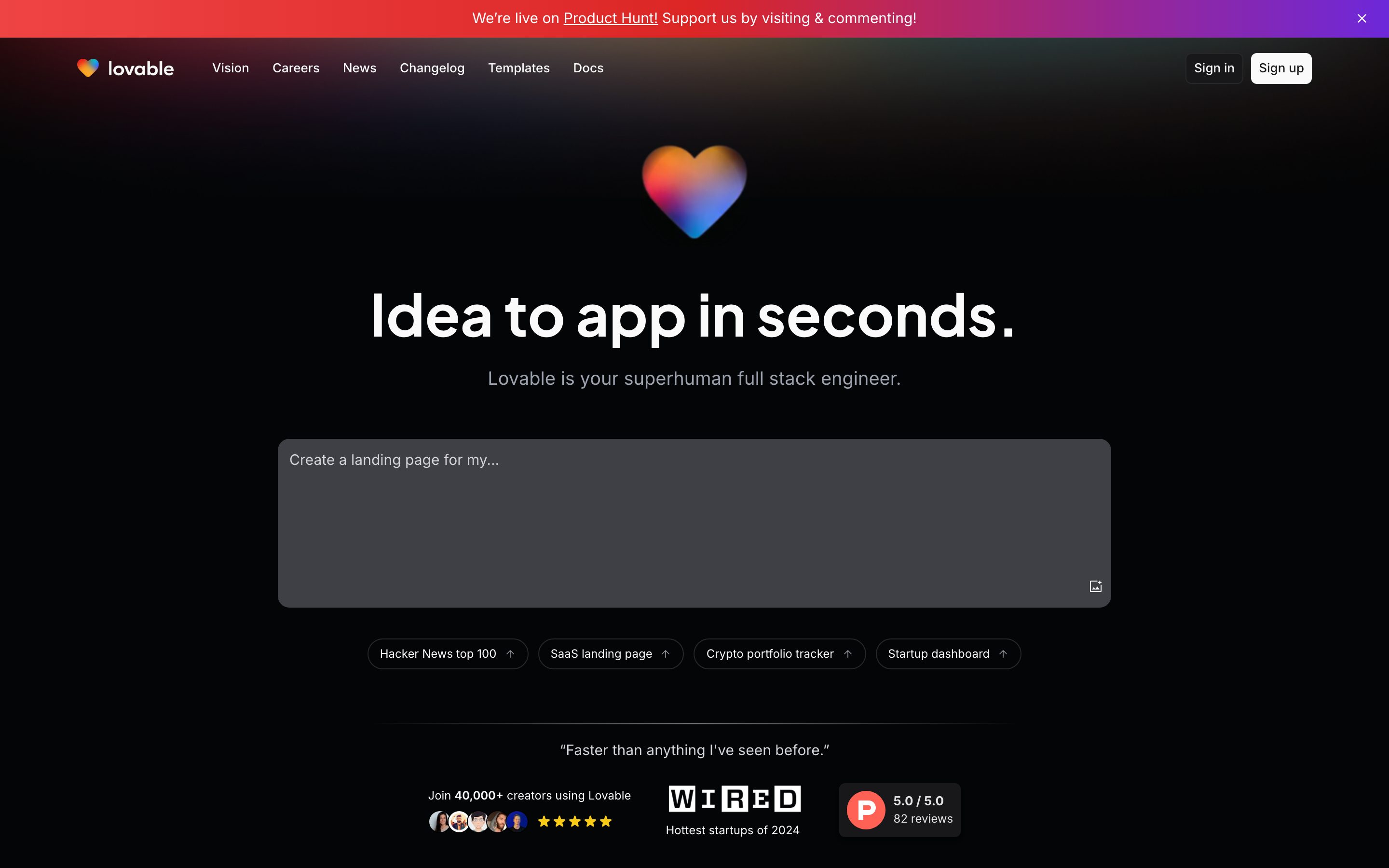
The homepage is a prompt box: "Create apps and websites by chatting with AI." A user types what they need, and Lovable answers with a running preview. Plan mode talks the idea through without touching the code; Build mode makes the change. To adjust a button or a line of text, the user selects it on the page and says what to change.
What makes it an app rather than a mock-up is underneath. Since September 2025 Lovable Cloud "automatically takes care of login, databases, file uploads" – before that, a built-in Supabase integration did the same job. The app is published on Lovable's hosting, the code can sync to GitHub, and the user owns it. Connections to Linear, Notion, Jira, Stripe and Shopify let a ticket, a document or a store become the starting point.
Business model
Starting is free: five build credits a day, up to 30 a month. Paid plans – Pro, Business and Enterprise – are priced by the credits they include, not by seats, and a workspace can have unlimited members. One balance pays for building, for running the app, and for any AI features the app offers its own users. The pricing page gives examples: "Make the button gray" costs 0.50 credits, adding sign-up and login 1.20.
That shape comes from who the user is. Someone who cannot code will not bring a model key, a server or a database, so Lovable brings them and charges for the work done. Credits let a team share one pool, and the price rises with what is built.
The spike
Lovable began as a proof. In spring 2023 Anton Osika, a former CERN physicist then CTO of Depict.ai, wrote gpt-engineer over "one main weekend": give it a prompt and it asked questions, then generated "an entire codebase". He says he built it to "prove a point" that an agent could already write code. To run it, a developer installed Python packages and exported an OpenAI key "that has GPT4 access". The Show HN on 21 June 2023 called it a "platform for devs to tinker with AI programming tools". Ten days later the repository showed 34.8k stars; it has 55,093 today.
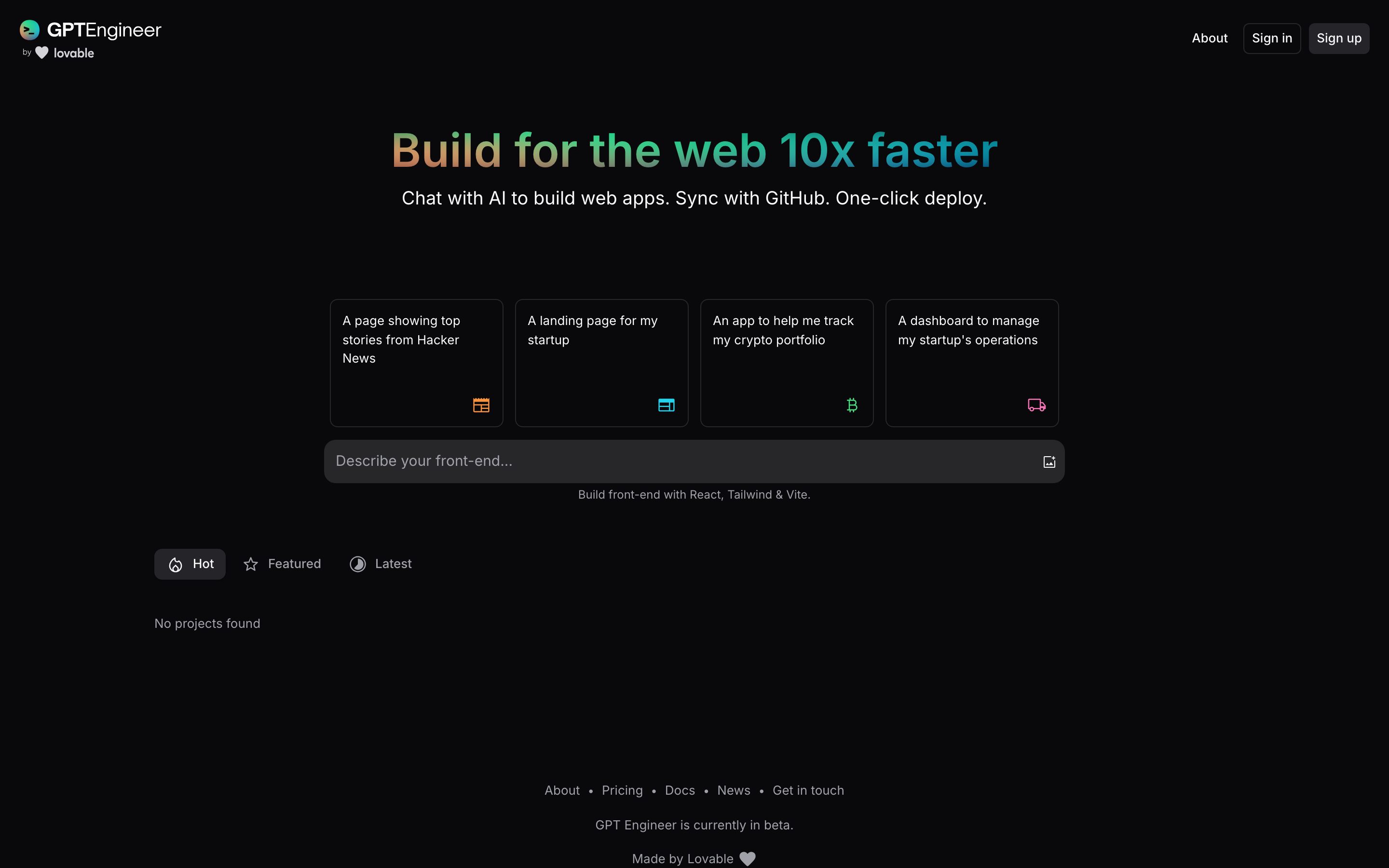
By his account, "it wasn't clear to me that I would build a business on this at all." He brought in Fabian Hedin, and in December 2023 the README announced gptengineer.app, "a commercial project for automatic generation of web-apps". It went to Hacker News twice under that name. Hedin's post that December pitched prototypes that human developers would then take over; the beta of August 2024 offered GitHub sync and Supabase for data "owned by the user", and the homepage asked visitors to "describe your front-end". The company's own account is that these launches "failed to gain significant traction": users saw "a 'fun tool'", and the name "felt gimmicky". Osika puts it as "the aha moments didn't click for sufficiently many people." Looking back in 2025, he dated the idea to the first days: "I woke up a few days after building GPT Engineer and I realized, look, we're going to reimagine how you build software."
On 17 November 2024 the open-source README changed. People who wanted "a well maintained hackable CLI" were sent to aider; the rest, to "the evolution that is an opinionated, managed service". Four days later the product relaunched as Lovable, "since it's such a big change", with a native back end: "auth, db, storage, edge functions" without leaving the editor.
What was dropped, then, was the hackable tool for developers who brought their own key and picked their own stack – and, with it, the name everyone knew. What was kept was the loop that had made the name: describe it, and the AI builds all of it. What we read in the move is not simply coders giving way to non-coders; the August beta already courted both. What changed in November is that the product stopped asking its user to bring anything – a key, a back end, a host, a developer to finish the job. Three months later the company reported $17 million in annual recurring revenue and more than 30,000 paying customers.
Why it matters
None of this was new in 2024. Developers had Cursor, Copilot and aider. For turning a sentence into an app there were Vercel's v0, WebSim, Townie, Claude Artifacts, bolt and Replit; a commenter under the August beta said the flow had been "doable in many instant text-to-app services for at least a year." Anyone patient enough also had the no-code editors.
Everything after the first screen was left to the user. Osika's launch post named it: "AI writing code typically make small mistakes and then get stuck." A tester of the beta ran out of free credits "still arguing with the AI about stuff it was doing wrong". A developer can fix the error and wire up a database; a person who cannot code is left with a front end that goes nowhere. Lovable took on both – errors picked up and fixed automatically, a back end built in – so the user never had to become a developer to finish.
Every figure here comes from the company. Paying customers kept paying: about 85% were still there after a month, Osika said three months after launch, and net dollar retention later ran above 100%. Annual recurring revenue went from $17 million at three months to $100 million at eight, $200 million at a year, and $500 million by June 2026, with most traction, TechCrunch wrote, from non-technical users. At Zendesk, going from idea to working prototype went from six weeks to three hours, its product director said. Not every sign pointed up: Barclays analysts, as reported by TechCrunch, found traffic to Lovable down 40% by September 2025.
The playbook
When a tool stops at a first draft, the money is in a version that finishes for people who cannot: it fixes its own errors, brings the back end, hosts the result and bills in credits rather than seats. Beginners stuck after the first screen, with an expert the only way out, mark the same opening elsewhere. By June 2026 Lovable reported $500 million in yearly recurring revenue. If traffic falls, as Barclays analysts found it did by 40%, credits dry up.
The lesson
An open-source success tells you who will not pay. gpt-engineer's fans were developers with their own OpenAI keys, happy to install, tinker and fix; they starred it by the tens of thousands and used it for free. The company did not fight for them. It sent the hackers to another project and built what the README called "an opinionated, managed service": one stack chosen in advance, the model paid for, the database and the hosting included. The rule, for anyone with an open tool: sell the version of it that brings everything the tool asked its user to bring and makes every choice it left open.
Another rule concerns patience with the core. The same generator launched three times, twice as gptengineer.app to little effect, and the company's own account blames the package, not the generator – the name, and a product that stopped at the front end. Only the third launch, with the back end built in, took. A launch that falls flat can be a verdict on the missing piece rather than on the idea.
For your own work: what does your free or open tool ask a user to bring or decide before it works, and would someone pay for a version where you bring and decide all of it? And which of your launches that did not take left the user one piece short of a finished result?
Where else it could work · our reasoning, not a finding
Open-source agent frameworks
They collect stars from developers who wire in their own model keys, tools and servers; a team without those developers would pay for a version that brings all three and makes the choices.
Home automation
Open hubs work once a hobbyist has picked the hardware, the integrations and a machine to run them on; the household that wants the lights to just work never gets that far.
Bookkeeping for freelancers
Tools that sort transactions stop short of the tax return, and the missing piece is the one the freelancer dreads.
AI tutoring
A chat tutor keeps the conversation going but leaves the learner unsure whether they improved; the missing piece is a result someone else recognises, such as a tested level.
Track record
Lovable · lovable.dev ↗
- First commit of gpt-engineer, Anton Osika's open-source code generator ↗
- Show HN: gpt-engineer – platform for devs to tinker with AI programming tools ↗
- The repository on GitHub, archived: 34.8k stars ten days after the Show HN ↗
- Show HN: gptengineer.app, web app prototypes by chat, open over Christmas ↗
- Show HN: gptengineer.app in beta – “Claude Artifacts but creating real web apps” ↗
- Homepage on gptengineer.app: “Build for the web 10x faster”, “Describe your front-end” ↗
- Pre-seed, €6.8M, led by Hummingbird and byFounders ↗
- gpt-engineer's README sends CLI users to aider and points to “an opinionated, managed service” ↗
- Show HN: relaunched as Lovable, with a native Supabase back end ↗
- Launched on Product Hunt – 1,485 upvotes ↗
- Homepage on lovable.dev: “Idea to app in seconds.” ↗
- Pre-Series A, $15M, led by Creandum; $17M ARR and 30,000 paying customers three months after launch ↗
- Series A, $200M at a $1.8B valuation, led by Accel ↗
- $100M ARR, eight months after launch ↗
- One year after launch: $200M ARR ↗
- Series B, $330M at a $6.6B valuation, led by CapitalG and Menlo Ventures ↗
- Multi-year Google Cloud deal, a fivefold increase in its footprint ↗
- Reported by Forbes, not closed: talks to raise at a $12B valuation ↗
- Series C, $400M at a $13.3B valuation, led by Menlo Ventures and the Scaleup Europe Fund ↗