SAP had already built its own tabular model; it still paid about €0.4bn in cash for the one everyone benchmarks against
One €9M pre-seed and no Series A: SAP paid about €0.4bn in cash 18 months after the company was founded.
The product
Prior Labs fills in a column. Give TabPFN a table where some rows carry the answer – this customer churned, this loan went bad, this bearing failed – and it predicts the answer for the rows that do not. Churn, fraud, credit decisions, next month's advertising spend, which patients will need intubation: the work that has belonged to a data scientist with a gradient boosting library.
What makes it unusual is that nothing is trained. TabPFN is a transformer pre-trained once on synthetic tables and never updated for your data; your rows go into the context, the way examples go into a prompt, and the prediction comes back in a single forward pass. The company that built it is a research lab in Freiburg with offices in Berlin and New York, run by Frank Hutter, Noah Hollmann and Sauraj Gambhir. Since 16 July 2026 it has belonged to SAP, and it still trades under its own name.
How it works
The first version most people meet is pip install tabpfn. The code is on
GitHub under Apache 2.0 with about eight thousand stars, and the calls are the
ones every data scientist already types – fit, then predict, then
predict_proba for the distribution. Raw pandas frames go straight in:
categorical strings, free text and missing values are handled inside the
model, so there is no encoding, no imputation, no scaling and no outlier pass.
The hosted version is the same calls against tabpfn_client, and it does two
things the download cannot. It reads text columns for their meaning rather than
as categories – a repair note saying "water ingress at the seal" carries what it
says, rather than becoming one more unlabelled category – and it runs Thinking
mode, where the model spends
more compute on a harder fit. TabPFN-3.5, released on 15 September 2026, comes
first on TabArena, the 51-dataset benchmark for this category, and on
BeyondArena, a 142-dataset one built for the grouped, temporal, high-cardinality
and text-heavy tables that real systems produce; on the second it finishes about
150 Elo points ahead of the previous leader.
From there it goes wherever the data already sits. One-click deployment landed on AWS SageMaker in December 2025, Databricks in March 2026 and Azure ML in April, there is a private-cloud build for companies whose rows cannot leave their own account, distilled models that run on CPUs for a bank that has to show a regulator what it deployed, and an MCP server so an agent can ask for a prediction mid-task.
Business model
Compute is the meter. API predictions and Thinking fits draw on daily and
monthly token budgets, where a token measures work rather than text: rows to
learn from, rows to predict, columns, how many estimators, how hard the model
thinks. Every billable TabPFN-3.5 operation costs at least ten thousand tokens
to cover the request itself, and a client-side estimate_cost call sends the
shape of your data without the data.
The free tier is real and the paid tiers have no prices. Pro and Max both end in "Contact Sales" and are described as sized to what you are running; the private-cloud licence is free for non-commercial use and commercial only by agreement. The line between what is given and what is sold moved in public on 14 September 2026, when the code was relicensed from Prior Labs' own licence to plain Apache 2.0 while the 2.5, 2.6 and 3 model weights stayed non-commercial and the newest weights went behind an access form. Two months after that, SAP customers could reach TabPFN-3.5 Plus through SAP AI Core.
The spike
It began as a paper, and the paper belonged to a university. TabPFN went up on arXiv on 5 July 2022 from the Machine Learning Lab at the University of Freiburg: a transformer that matched tuned AutoML systems on tables of up to a thousand rows, 230 times faster, a hundred features, ten classes. The package followed in October, the AutoML.org write-up reached the Hacker News front page that month, and the line Hutter used for it, quoted back in that thread, was "This may revolutionize data science".
What the lab kept is written into the Nature paper itself. Under competing interests the authors record that the patent applications related to the earlier work were filed by Bosch, and that they "do not have any ownership rights to these patent applications". So the founders did not leave Freiburg with the intellectual property. They left with the code, which was already public, the citations, which are now past a thousand, the top of every public tabular benchmark, and the people who had produced all three. Hutter is still a full professor in Freiburg; the Nature paper carries the university's address and the company's on the same page.
The company was formed in late 2024, the paper appeared in Nature on 8 January 2025, the Show HN went up the next day and reached 153 points, and a €9m pre-seed led by Balderton closed a month after that. It was the only round the company ever raised. In April 2025 the founders published a manifesto that named the businesses they expected to serve: "platforms like Snowflake, Databricks, SAP, and the broader ecosystem of companies building in the application layer".
SAP did not wait to be served. In June 2025 it put its own tabular model, SAP-RPT-1, on Hugging Face, and its CTO Philipp Herzig has been direct about why: "Early on, SAP recognized that the greatest untapped opportunity in enterprise AI wasn't large language models; it was AI built for the structured data that runs the world's businesses." Eleven months later SAP agreed to buy the company whose model its own was measured against, framing the purchase as accelerating "SAP's success in TFMs that started with SAP-RPT-1". The founders gave their reason on the same day: the frontier they wanted – models that reason about causation, integrate domain knowledge, combine tables with language – "can be reached much faster with SAP", which "moved early on tabular foundation models with RPT-1, before most of the enterprise software world had recognized the category existed".
Terms were not disclosed, and then they were. SAP's half-year report records that the acquisition of 100% of Prior Labs GmbH closed on 16 July 2026 and that "the consideration paid in cash amounts to approximately €0.4 billion and represents the majority of the consideration transferred", on top of the more than €1bn of investment promised over four years. The same note prices Dremio, the lakehouse company SAP announced on the same day, at about €0.5bn in cash. Eighteen months and €9m of outside money had bought a position of roughly that order.
Their account is about research velocity, and it is consistent: the lab kept its brand, its Freiburg headquarters, its open-source commitments and, a week after closing, split the chief executive's job in two so that neither the science nor the business shared a diary. What the price suggests is narrower. SAP could build the model and did. What it could not build was the thing against which every other tabular model, including its own, reported its numbers.
Why it matters
The alternative was free and everywhere. XGBoost, LightGBM, CatBoost, Prophet, AutoGluon: mature libraries that win tabular competitions and cost nothing, and a commenter on the TabPFN-2.5 thread named both the default and its price – "the challenge is always that you need to spend a lot of time feature engineering and tweaking the data representation before something like XGBoost can deliver good performance". That is the step the alternatives leave behind. Not the model: the week of work per problem, and then the retraining, the validation and the sign-off that follow it.
The claim is that the week is now a call. Hollmann puts the comparison at its strongest: TabPFN-2.5 on one forward pass matches AutoGluon 1.4 tuned for four hours, and AutoGluon stacks XGBoost, CatBoost and the previous TabPFN inside it. SAP repeats the same measure in its own press release.
The customers, in the case studies Prior Labs publishes, describe the disappearance rather than the accuracy. Exito, a German marketing agency, had tried linear extrapolation, Prophet, XGBoost and neural networks and kept hitting the same wall – "Manual model tuning per customer dataset", inconsistent accuracy, no generalisation across customers. It now runs nineteen parallel spend forecasts every two hours from eight in the morning to six in the evening, through the hosted API, inside its existing scikit-learn pipeline and with no GPU of its own; model development time went from hours to minutes. On Prior Labs' account of the Hitachi Rail deployment, track-sensor anomaly detection came out roughly 40% better on RMSE than the baselines it replaced. Taktile, working on account-opening fraud, found the gap widening as the data got sparser, and valued the absence of retraining for a reason that is not about accuracy at all: no retraining means no model validation, testing and sign-off cycle. Four million downloads say the point landed. Prior Labs has also been plain about the limits – its own write-up admitted relatively high inference latency and a ceiling on data size, which is what the 3.5-Fast checkpoint and the million-row scaling work have been aimed at since.
The playbook
A model pre-trained once can replace the per-problem tuning a specialist does by hand for every new dataset, sold by the compute each prediction uses rather than by the analyst's week. The opening is any routine data task where free libraries are excellent but each use still needs days of preparation and a sign-off. Exito, a marketing agency, cut model development from hours to minutes. Past the model's ceiling on data size, the old tools come back.
The lesson
Everything Prior Labs owned was in public: free code, a Nature paper past a thousand citations, downloadable weights. The one scarce thing it held was a position – a model series that, by the buyer's own description, had "set the state-of-the-art on tabular benchmarks across hundreds of independent academic studies". A position like that is a standard: a better tabular model meant one that beat this one, and the release announcing the purchase names TabPFN-2.6, not SAP's own model, as the top performer on TabArena. A company with no way to reach the buyers made itself the thing that market measures by, and left the company that could reach them unable to lead a standard somebody else owned. So: when the customers are out of reach and an incumbent already has them, make your work the public reference everyone reports against, and treat the day that incumbent ships its own version as the day it priced the category for you. What this costs is the moat: nothing is left to defend, and there is usually exactly one buyer – a reference implementation nobody big needs earns citations and a support contract. Ask it this way: who in your market publishes results against your work, and which of them has just built their own?
The earlier decision was made with even less in hand. The patent applications behind the first TabPFN were filed by Bosch, and the paper says outright that the authors hold no rights in them, so what walked out of the university was what an institution cannot register – the people who had made the thing and the public standing of having made it. Count what ownership does not cover before you decide you have nothing to leave with. If every right to your work stayed behind, would the next version of it still be yours to make?
Where else it could work · our reasoning, not a finding
Catastrophe models for insurance
Reinsurers, brokers and regulators argue hurricane and flood exposure against a handful of licensed models; whoever's model gets cited in the filings owns the number the market fights over, and the data giants who already sell to those buyers cannot take that position by writing their own.
Reference methods in clinical diagnostics
Every new assay has to report its agreement with an established comparison method, so the analyser makers who own the hospital relationship cannot claim the better test while the method it is judged by belongs to an outside laboratory.
Procedures worked out inside hospitals
The hospital keeps the trial data and the rights to any device, and the team that worked the protocol out is the only thing that can produce the version after it.
Process routes inside chemical companies
The compound and its patents stay with the employer, but the engineers who know why the route runs at one plant and not the next can leave, and a second producer needs them more than it needs the patent.
Track record
Prior Labs · priorlabs.ai ↗
- TabPFN posted to arXiv from the Machine Learning Lab at the University of Freiburg: a transformer that matches tuned AutoML systems on tables of up to 1,000 rows, with up to a 230× speedup ↗
- tabpfn 0.1 published to PyPI ↗
- The AutoML.org write-up reaches 60 points on Hacker News; one of the paper's authors answers questions in the thread ↗
- Prior Labs GmbH founded in Freiburg out of the ELLIS ecosystem by Frank Hutter, Noah Hollmann and Sauraj Gambhir, with Bernhard Schölkopf and Alex Diehl as founding advisers ↗
- “Accurate predictions on small data with a tabular foundation model” published in Nature 637, 319–326; the authors declare that the patent applications behind the earlier work were filed by Bosch and that they hold no ownership rights in them ↗
- Show HN: TabPFN v2 reaches 153 points; the founders answer on the four-hour tuning budget their benchmarks beat ↗
- Pre-seed, €9M, led by Balderton Capital with XTX Ventures, the Hector Foundation of SAP founder Hans-Werner Hector, Atlantic Labs and Galion.exe ↗
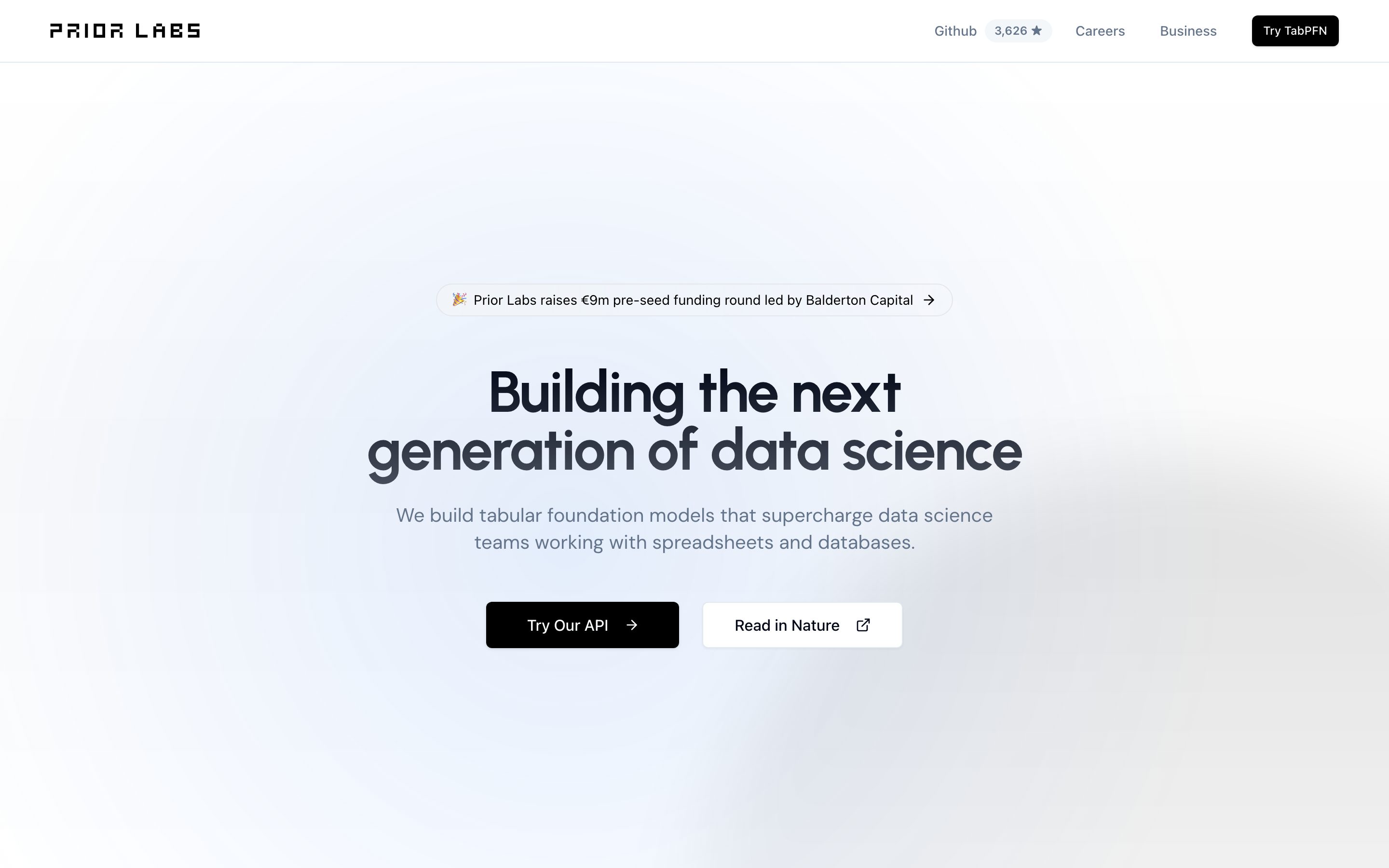
- Homepage: “Building the next generation of data science”, with Try Our API beside Read in Nature ↗
- Manifesto names the platforms tabular foundation models are meant to serve: “Snowflake, Databricks, SAP, and the broader ecosystem of companies building in the application layer” ↗
- SAP publishes its own tabular model, SAP-RPT-1, on Hugging Face ↗
- Hitachi Rail applies TabPFN to track-sensor data on Spain's railway network; roughly 40% better RMSE than the existing baselines in early deployment ↗
- One-click deployment on AWS SageMaker; Databricks follows in March 2026 and Azure ML in April ↗
- Creditplus Bank, part of Crédit Agricole, takes distilled TabPFN models that run on CPUs for car-loan decisioning ↗
- TD and its Layer 6 research centre begin exploring TabPFN for lending and mortgage forecasting ↗
- SAP signs a definitive agreement to acquire Prior Labs and commits more than €1bn of investment over four years; terms of the deal are not disclosed ↗
- Acquisition of 100% of Prior Labs GmbH closes; SAP's half-year report puts the cash consideration at approximately €0.4bn, “the majority of the consideration transferred” ↗
- Co-CEO structure: Sauraj Gambhir takes the business, Frank Hutter research, Noah Hollmann stays CTO ↗
- TabPFN's code relicensed from the Prior Labs License to Apache 2.0; the 2.5, 2.6 and 3 weights stay non-commercial ↗
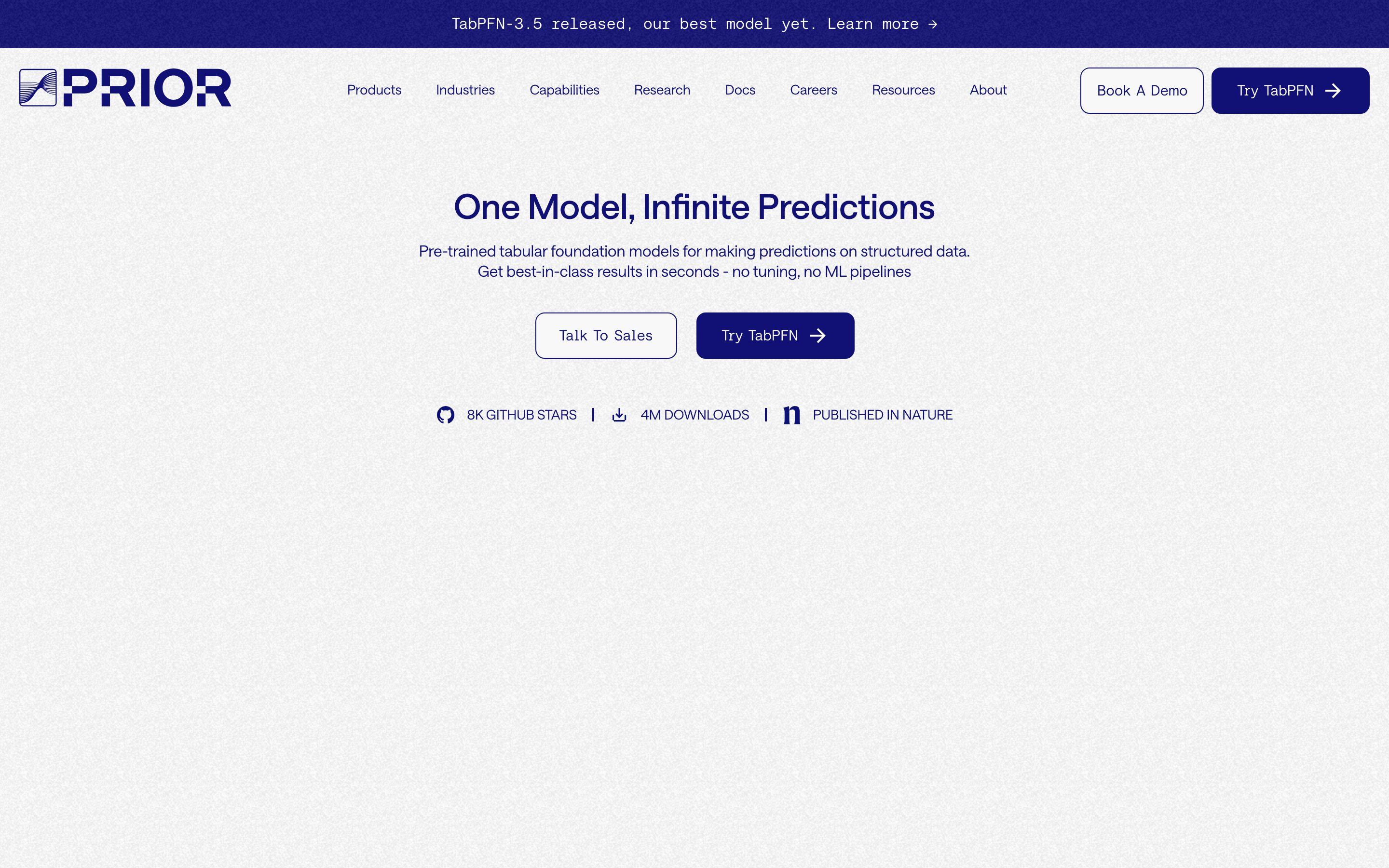
- TabPFN-3.5 released, first on both TabArena and BeyondArena; homepage: “One Model, Infinite Predictions” ↗