Every big company kept its data twice; making the cheap half answer moved the expensive half's budget
Databricks taught the cheap data lake to answer business questions in 2020; that product passed a $1.5B run-rate by 2026.
The product
Databricks sells the work done on a company's data without selling the place the data is kept. The files stay in the company's own cloud storage, in formats anyone can read; Databricks supplies the engines that run against them – pipelines, SQL and reporting, machine learning, and now applications and agents. It was founded in 2013 by the group that, in its own description, created Apache Spark, and by August 2026 it was past a $7 billion revenue run-rate, growing more than 80% year over year, with more than 20,000 organisations on it, among them adidas, AT&T, Bayer, Block, Mastercard, Rivian, Unilever and 70% of the Fortune 500.
How it works
Signing up takes no card: the free trial opens the platform, and some trials come with credits to spend on it. Configure Databricks against your own cloud account, as the pricing page assumes, and the cloud provider goes on billing you for the machines itself.
What sits on top has grown section by section. Data engineering handles the loading and the scheduling, for batches and for streams. The product now called Lakehouse is a serverless data warehouse for SQL analytics on that same open lake data. Unity Catalog governs who may see what, across clouds, formats and platforms. Then the newer floor: Agent Bricks for building agents, Lakebase – serverless Postgres – for the data an application reads and writes while it runs, Genie to answer questions in words, and Unity AI Gateway to route between models and cap what they cost. The homepage today opens not on the lakehouse at all but on Lakebase: "One database for AI, apps and agents."
Business model
Consumption, metered in DBUs – a Databricks Unit, the company's normalised unit of processing power. There are no named tiers. Accounts are pay-as-you-go, with no up-front cost and billing "at per second granularity", and customers who can commit to a volume sign a committed-use contract for a discount. The cloud bill is the customer's own and arrives from the cloud provider.
The shape follows from what Databricks does not own. It does not hold the asset, so it cannot charge rent on it; it can only charge for the work, and work is divisible. That lets one analyst's query and a bank's entire reporting stack be the same product at different volumes – by August 2026 more than 1,000 customers were consuming at over $1 million a year and more than 100 at over $10 million.
The spike
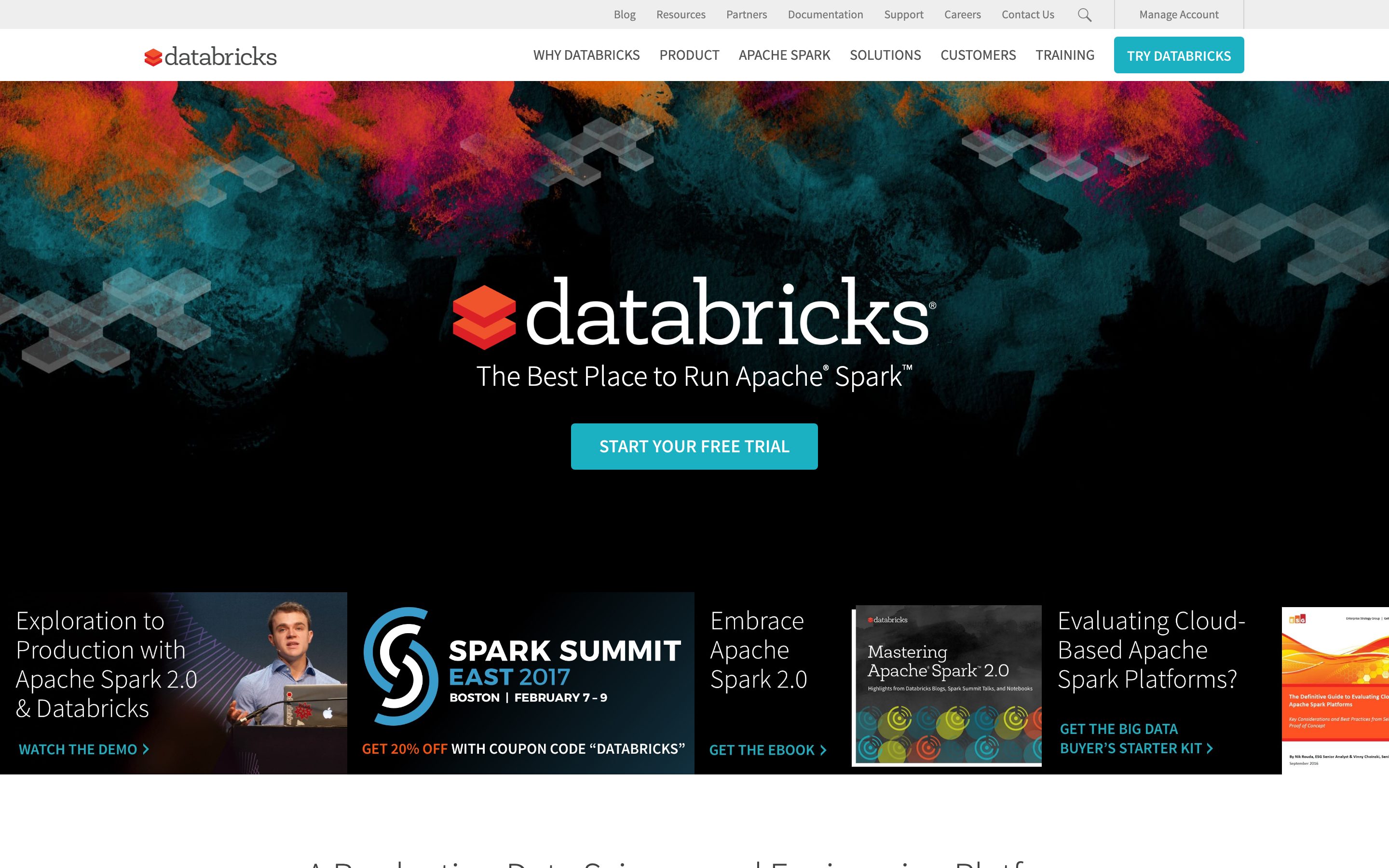
In January 2017 the homepage said plainly what the company was: "The Best Place to Run Apache® Spark™", with Apache Spark in the navigation bar. Two years later the release for its $250 million Series E named what it was meeting: "Explosive Growth and Global Demand for Unified Analytics". Both describe one business – the place where a company's data engineers and data scientists worked on the cheap heap of files in its cloud storage. The questions the business itself asked, the reports and the dashboards, were answered somewhere else: in a data warehouse holding a curated second copy, loaded out of the lake by pipelines somebody had to keep running.
Databricks' founders wrote down what they thought of that arrangement, in a paper at CIDR in January 2021. Data, they wrote, "is first ETLed into lakes, and then again ELTed into warehouses, creating complexity, delays, and new failure modes"; keeping the two consistent "is difficult and costly"; the warehouse copy is stale, "with new data frequently taking days to load"; and when someone wants to train a model, the warehouse vendors tell them to export files, "adding a third ETL step!" The two-tier pattern, they noted, was in use "at virtually all Fortune 500 enterprises". Their conclusion was not modest: the data warehouse "will wither in the coming years".
The turn was to stop being the cheaper half of that pair. Databricks gave up the complement's position – feeding a system it did not sell, for a budget that was not its own. The lake stayed, as it always had, the customer's. To the files already sitting in it Databricks added the two things the warehouse had been holding over them: transactions, shipped as Delta Lake in April 2019 and handed to the Linux Foundation that October, and speed. In November 2020 it put SQL Analytics on top. It meant, Ali Ghodsi told TechCrunch, that "SQL Analytics enables you to now do the data warehousing workloads directly, and concretely, the business intelligence and reporting workloads, directly on the data lake". A year later the same engine held the audited TPC-DS record at 100TB.
What the company describes is an architecture correcting itself. Read from the money, almost nothing about the product changed and everything about the buyer did: the same files, in the same storage, sold to the department that signs for reporting instead of the one that signs for data science. The hard part was not the migration, because there wasn't one. Even the word was borrowed rather than planned – "We've been saying Unified Data Analytics," Ghodsi said that month, "but no one picked that up. But 'lake house' caught on as a term."
Why it matters
Both alternatives were real and neither was free of a catch. The cloud data lake – S3, ADLS, GCS – was cheap, open and would hold anything, but, as the lakehouse post put it in January 2020, it did "not support transactions", did "not enforce data quality", and its "lack of consistency / isolation" made it "almost impossible to mix appends and reads". The warehouse – Teradata in the older generation, Redshift or Snowflake in the cloud – was fast and trustworthy and closed. So companies ran both, and the step neither of them removed was the one in between: choosing what to copy, building the load, and re-running it forever. The paper cites a Dimensional Research and Fivetran survey in which 86% of analysts were using out-of-date data and 62% reported waiting on engineering resources numerous times a month.
That the copying stopped shows up in what companies buy instead. Revenue run-rate went from over $200 million in the third quarter of 2019 to over $350 million a year later; ARR was $425 million in February 2021 and past $600 million by that August, as reported by TechCrunch on the two rounds. Data warehousing – the part that did not exist before November 2020 – passed a $1 billion revenue run-rate by December 2025 and $1.5 billion by August 2026, growing more than 100% year over year – faster, by then, than the company as a whole. Net retention has stayed above 140%: the same customers hand over more each year, which is what moving a second system's work onto the first one looks like on an invoice. By February 2026 CNBC could observe that Databricks was larger than Snowflake, which had reported $1.21 billion of revenue in its October quarter.
The playbook
When customers already keep an asset in cheap, open storage, a supplier can sell just the work done on it, metered by the second, so one analyst's query and a bank's reporting are one product at different volumes. The sign elsewhere: the asset sits in one place and a second vendor is paid to hold a working copy. Databricks has kept net retention above 140%, customers buying more work each year. The bet fails if the open store stays slower than the closed one.
The lesson
Databricks spent its first six years selling into a chain it did not control. Its customers were paying for their files twice: once to keep them, once more to keep a usable duplicate in a system that could actually answer a question. Rather than build a better version of that second system and ask everyone to move, it made the original answer – and the money that had been paying for the duplicate had nowhere else to go. The rule is available to anyone: when your customers pay to keep a thing and pay again for a duplicate that only somebody else can work with, make the thing itself work where it already lies. Framer, elsewhere on this site, reached the same rule by removing a different step.
The second decision is what made the first one acceptable. A company will only consolidate onto one supplier if leaving is cheap, and Databricks went out of its way to make leaving cheap: open file formats, Delta Lake given away to a foundation, the creators of the rival format bought and their work kept open, the governance layer open-sourced, and the data itself left in the customer's own account. Its own paper says why this matters to a buyer – an open format "means that they will always have direct access to the data without blocking on a vendor". Being easy to abandon is what persuades a cautious customer to give you everything.
Neither move is free: the first means proving yourself on an incumbent's own benchmark, the second that you own no lock and must win every renewal on merit. Which of your customers keeps a second copy of something they already hold, and who do they pay to hold it? And if one wanted to leave next month, what could they not take with them?
Where else it could work · our reasoning, not a finding
Shipping online orders from shop shelves
A chain already holds the goods in its stores and still rents a second pool of the same goods in a fulfilment warehouse, because only that warehouse can pick and pack; whoever makes the shop floor pickable is bidding for the fulfilment fee, not for shelf space.
Paying out from the bank balance
A business keeps its money at its bank and pre-funds a second balance at a payments provider because only that balance can send money out; let the payments leave the account where the money already sits and the float, and what it costs to hold it, is the budget in play.
Servicing heavy machinery
A fleet costs more over twenty years in service than it did to buy, and the buyer's real fear is being tied to one dealer network for all of it; a maker that publishes the interfaces so any workshop could take the work over is the one a cautious buyer standardises on.
Contract manufacturing
A brand that will not single-source keeps a second qualified factory it barely uses; a manufacturer that hands over the tooling and the process files, so the line could be moved out in a quarter, is the one that gets the whole volume.
Track record
Databricks · databricks.com ↗
- Form D for the first round: $13.9M sold, first sale 11 September 2013 ↗
- Databricks Cloud unveiled at Spark Summit – hosted Apache Spark on AWS – alongside a $33M Series B led by NEA ↗
- The hosted platform reaches general availability ↗
- Homepage: “The Best Place to Run Apache® Spark™”, with Apache Spark in the navigation ↗
- Series E, $250M led by Andreessen Horowitz at a $2.75B valuation, announced as funding “Global Demand for Unified Analytics” ↗
- Delta Lake open-sourced under Apache 2.0 – transactions on the files already in the lake ↗
- Delta Lake handed to the Linux Foundation, “to become the open standard for data lakes” ↗
- Series F, $400M at a $6.2B valuation ↗
- “What Is a Data Lakehouse?” – the company names the thing it is going to sell ↗
- SQL Analytics launched, “to enable cloud data warehousing on data lakes”, with Tableau and Power BI connecting to it; revenue run-rate then over $350M ↗
- The lakehouse paper at CIDR ’21, by Armbrust, Ghodsi, Xin and Zaharia: the warehouse “will wither in the coming years” ↗
- Series G, $1B led by Franklin Templeton at a $28B valuation, with AWS, CapitalG and Salesforce Ventures joining ↗
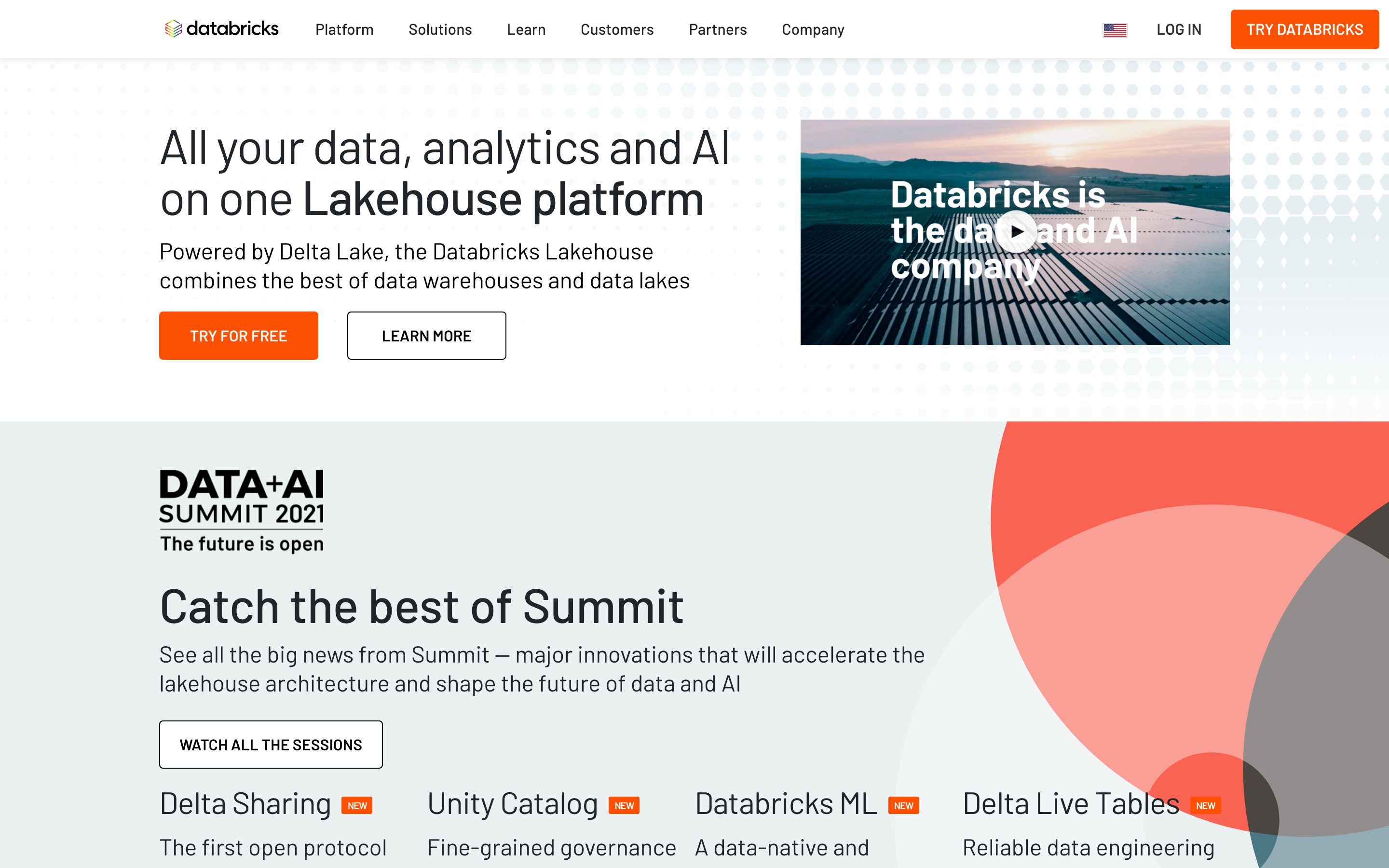
- Homepage: “All your data, analytics and AI on one Lakehouse platform” ↗
- Series H, $1.6B led by Counterpoint Global at a $38B valuation, “to accelerate innovation and adoption of the data lakehouse” ↗
- TPC-DS 100TB record audited by the Transaction Processing Performance Council: 32,941,245 QphDS, 2.2x the previous official result ↗
- MosaicML acquisition completed; price not disclosed ↗
- Series I, over $500M led by T. Rowe Price at a $43B valuation, with NVIDIA among the new investors ↗
- Agrees to acquire Tabular, founded by the original creators of Apache Iceberg ↗
- Unity Catalog open-sourced, reading Delta Lake, Apache Iceberg and Apache Hudi tables ↗
- Series J, $10B at a $62B valuation, led by Thrive Capital ↗
- Form D for the Series K: $1.07B offered, $955M sold, first sale 8 September 2025 ↗
- Series L announced at a $134B valuation; data warehousing passes a $1B revenue run-rate, AI products the same ↗
- Series L completed: about $5B of equity at $134B plus about $2B of debt capacity; revenue run-rate $5.4B ↗
- $5B at a $190B valuation, led by Coatue; revenue run-rate past $7B, and the data warehousing product past $1.5B ↗
- Form D for that round: $5B offered and $5B sold, first sale 12 August 2026 ↗