It shipped a model it called glitchy to people who enjoyed that, then sold the same one to robots
Backpack cameras and a Hollywood pitch in 2024; in 2026, $310M for world models sold to robots and cars.
The product
Odyssey makes world models: software that takes what is on the screen and what you just did, and predicts the next frame of the world. Run that forward and you get video you act inside rather than watch, or a place to put a robot before you put it in a room. The homepage promises "foundation world models" for "robotics, autonomous driving, science, healthcare, education, gaming, defense, energy, and beyond"; the September 2026 model, Odyssey-3, is offered as one system "that can power robots, drive cars, train AIs, pilot drones, and even play video games". The company is 55 people across Palo Alto, London and Zurich.
How it works
A visitor meets it as a game. Agora-2, released as a playable preview this month, drops up to twenty humans and AI agents into one shared simulation trained on captures from Diablo II; nothing renders the scene, because the model is, in Odyssey's phrase, "a learned game engine". A company with machines meets it differently. Odyssey-3 is trained once on a large collection of video, then frozen, and a small policy is fitted on top with an action decoder that turns the model's internal representation into whatever the machine takes – a gripper's movement, a waypoint ahead of a car, a flight path for a drone. Tens of hours of demonstrations stand in for the large amounts of narrow, task-specific experience such systems usually need. Everything else on the site is a button marked "Get API Access".
Business model
Nothing has a price. The playable models are free previews, the API has been "coming soon" since October 2025, and Odyssey-3 was announced with a promise to release it "in the coming weeks". The only money figure the company has ever published is a cost: one to two dollars per user-hour to serve interactive video in May 2025, falling. What pays for the work is equity – $337M in all by TechCrunch's count at the Series B – and partners who supply the expensive part, with AWS as preferred cloud and Amazon's Annapurna Labs tuning the models for Amazon's own Trainium chips. Odyssey's own name for what it will eventually sell is experience-as-a-service: hours of simulated consequence for buyers whose alternative is to gather that experience in the world, which Odyssey calls "complex, slow, and expensive". TwelveLabs, which sells models that read video rather than generate it, publishes a rate for every part of that – $2.50 to index an hour of video, $4 per thousand searches. Odyssey has shipped four generations of model without naming a price for any of them.
The spike
The company's first public sentence was about films. Cameron announced it in July 2024 as "Hollywood-grade visual AI, where beautiful scenery, characters, lighting, and motion can be both generated and directed", with a mission "to deliver a better way to create movies, TV shows, and video games". Thirteen people were building four models – geometry, materials, motion, lighting – and, rather than scrape the internet for training footage, an operation that put six cameras, two lidar sensors and an inertial unit into a 25-pound backpack and walked California in 3.5K. The $18M raised in November 2024 was for taking that walk to more states and countries. In December, Ed Catmull, who co-founded Pixar, joined the board and Explorer shipped: type a sentence, wait about ten minutes, receive a three-dimensional scene you could open in Blender or Unreal and fix by hand.
Five months later none of it was on the front page. Odyssey-1 arrived instead – a stream of frames generated forty milliseconds apart, with no file at the end and nothing to hand-edit – and the company was blunt about the state of it: the experience "feels like exploring a glitchy dream – raw, unstable, but undeniably new", its "utility is limited for now". The reason it gave for leaving the old pipeline was one sentence long: improvements "won't be driven by hand-built game engines, but rather by models and data".
What went was the customer and the thing handed to them, the filmmaker and the file. What stayed was the prediction underneath, and the footage the backpacks had gathered, which became the narrow, dense set that Odyssey-1 was post-trained on to keep it stable. The editing pipeline had always been scaffolding around that; the prediction was the part that stood up alone. Our own reading of the choice is about where a company can afford to be wrong in public. A broken simulation shown to someone playing with it on a laptop is a strange video. The same breakage inside a car is an incident report, and the founders had spent more than a decade in the industry that writes them.
None of this is presented by Odyssey as a change of course. Its history, in the Series B announcement, runs from self-driving straight to world models with no film in it: a decade "teaching cars to navigate the world at superhuman performance" convinced the founders "that the same underlying idea could be generalized far beyond autonomous systems", they founded the company in 2023 to pursue it, and "three years later, we have proven that thesis".
Why it matters
A robotics team that wants to try something dangerous has had three options for years, and Odyssey's argument is about what each leaves undone. Build a simulator and you get one domain and a fixed set of assumptions – the company's own example is that a rigid-body physics engine tells you nothing about weather. Go and collect the experience instead and you are back in the world, which is where the cost was. Or use one of the video models that generate beautiful footage on demand, and inherit a subtler failure: they give you one future.
Odyssey built a benchmark to show it. CaliBench puts six frontier image-to-video models – among them Veo 3.1, Runway Gen-4.5 and Cosmos3-Super – in front of nine physical scenes whose outcome distribution is known exactly: a Galton board, a die, a roulette wheel. Thirty-two generations each. Most of them pile their answers onto a handful of outcomes; on the Galton boards they over-concentrate on the central bin well past its true 24.6%; Veo 3.1 returned the same die face on every random seed. A simulator that collapses to the likely case, as Odyssey puts it, "will hide precisely the rare, dangerous tail events you built the simulation to surface".
Whether buyers have stopped collecting their own experience rests on figures Odyssey publishes about itself, and they should be read that way. Twenty hours of simulated driving, the company says, produced a policy that drove about 77% as far between safety-driver interventions as one trained on real footage. Tens of hours of robot demonstrations produced recovery behaviours nobody had demonstrated, among them reorienting a gripper after a missed grasp. Humanoid policies built on the model by Flexion kept working under lighting changes that broke the baselines they were tested against. The strangest number is the cheapest: roughly two hours of footage from one video game produced horseback riding in another the model had never been trained on.
The lesson
Cameron and Hawke had spent more than a decade teaching cars to read a road, and the thing they wanted to build sat closest to that work. They took it to film. For two years what they shipped was judged only on whether it was interesting – a preview they themselves called raw and unstable went out to anyone with a keyboard – and only in 2026 did the same model go to buyers who count what it gets wrong, against numbers a robotics team can accept or refuse.
The decision underneath is which customer to have first. When what you are making does not work reliably yet, take the years of correction in a market where a failure is merely odd, and go to the buyers who measure you only once the system can survive being measured. The price is the first market's trust – the filmmakers told a product was coming soon are nowhere on the page now – and the constant risk of getting very good at being enjoyable. Where would your product's mistakes be entertaining rather than expensive, and what single number would the buyer who cannot afford mistakes ask you for?
There is a second choice here, about what the company buys rather than what it sells. Nvidia's venture arm put money in during February 2026. Four months later the round held Amazon and AMD Ventures, AWS was the preferred cloud, and the models were being tuned for Amazon's own silicon. Money from the firm that sells you your largest input is money, not a marriage: take it, and spend some of it on being able to run without them. If your biggest supplier asked for exclusivity tomorrow, how many months until you could run on a rival's – and can you name the rival?
Where else it could work · our reasoning, not a finding
Officiating in amateur sport
A vision system that misjudges a Sunday-league offside is a story in the pub; the same system in a professional league decides a title, and leagues publish the error rate it has to beat.
Sleep and heart sensing worn by consumers
A wrong sleep score annoys someone at breakfast, while the same sensor sold for diagnosis has to be read against a hospital's own measurement before anyone will buy it.
Launch for satellite operators
One provider holds most of the ride-share capacity and takes equity in the operators it carries; qualifying a second rocket takes about a year and has to be paid for before it is needed.
Active pharmaceutical ingredients
A single contract manufacturer often makes the molecule and is willing to invest in the firm that depends on it, and the filings name the site, so an alternative has to be qualified years ahead.
Track record
Odyssey · odyssey.systems ↗
- Out of stealth as “Hollywood-grade visual AI”, with a $9M seed from GV, DCVC and Air Street Capital and 13 employees ↗
- Homepage on odyssey.ml: “The future belongs to the dreamers – Introducing Odyssey, Hollywood-grade visual AI”, “Coming soon” ↗
- Series A, $18M led by EQT Ventures, to scale a 25-pound backpack of six cameras and two lidars capturing California ↗
- Explorer, an image-to-world model exporting gaussian splats to Blender and Unreal, ~10 minutes a generation; Ed Catmull joins the board ↗
- Odyssey-1, a research preview of a playable world model: a frame every 40ms, nothing to export ↗
- Product Hunt launch, “AI video you can both watch and interact with in real-time”, 301 votes ↗
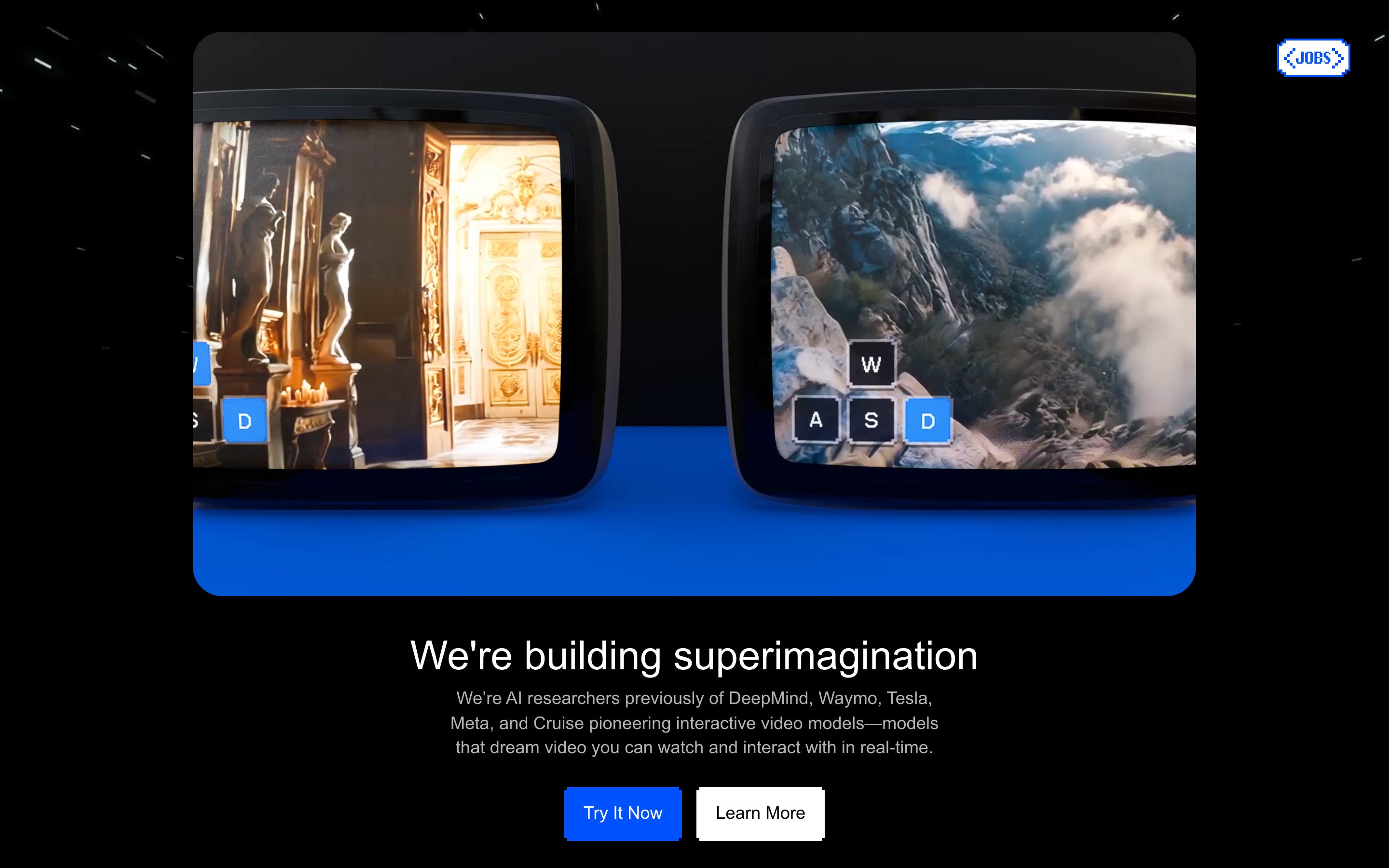
- Homepage on odyssey.world: “We're building superimagination”, credited to researchers from DeepMind, Waymo, Tesla, Meta and Cruise ↗
- Odyssey-2, a frame every 50ms against video models that take one to two minutes for five seconds of footage ↗
- “The Dawn of a World Simulator”: the pitch becomes simulation, and the industries named are robotics, science and healthcare ↗
- Investment from NVentures, Nvidia's venture arm, and Samsung Next – no amount or round name given ↗
- Agora-1, a multi-agent world model trained on GoldenEye; 128 points on Hacker News ↗
- Series B, $310M at a $1.45B valuation led by Natural Capital, with Amazon, AMD Ventures, GV, EQT and IQT; AWS becomes the preferred cloud ↗
- CaliBench: six frontier video models tested for whether they reproduce the right spread of physical outcomes, and mostly do not ↗
- Odyssey-3, sold as a foundation for robots, cars, drones and game-playing agents ↗
Raised in total: $337M