Raised $200M ·
Published
Technology: Hardware
Model: Outsourcing Non-Core
#hardware · #manufacturing · #defense
It sold every test on the road to a Mach 5 airliner, then dropped the airliner
The passenger jet left Hermeus's site in August 2025; shares in its $200M Series C were first sold that month.
The product
Hermeus builds fast military jets with nobody on board. They take off from an ordinary runway on a fighter engine, the Pratt & Whitney F100, fitted with a precooler of Hermeus's own that chills the incoming air so the engine can run faster than it was built to; later aircraft are meant to switch to a ramjet and reach hypersonic speed. Four engineers who had built a hypersonic rocket plane together at Generation Orbit founded the company in Atlanta in 2018. It now works from Los Angeles, Atlanta, Jacksonville and Washington, and calls itself "a venture-backed defense aviation company".
How it works
The aircraft come in a numbered series, Quarterhorse, each one built to settle a single question before the next. Mk 0 only taxied. Mk 1, a subsonic delta wing on a GE J85, flew at Edwards Air Force Base in May 2025. Mk 2.1, roughly the size of an F-16 and flown remotely from a flight deck on the ground, first flew from Spaceport America in March 2026 and reached Mach 1.21 in May. Mk 2.2 and 2.3 are to push towards Mach 3, and a "Mission Plane" with hardpoints for releasing payloads at speed is due in 2028.
A military customer meets the company through a test campaign. Under the Defense Innovation Unit contract, Hermeus flies its aircraft with the Air Force and Navy, carries and releases payloads at high speed, and hands over the flight data to "inform service experimentation and future acquisition decisions". From 2027 an expendable ramjet vehicle, Ramjet-X, is to be launched from Quarterhorse with customers' sensors, materials or software on board.
Business model
The Pentagon pays by the campaign, not by the aircraft. An AFWERX award in 2020, a $60 million Air Force partnership in 2021, a DIU contract in 2023 whose ceiling a $159 million modification raised to $219 million in May 2026: each buys development flights and the data from them. On top of that sit test services – the Jacksonville engine test cells, offered for military and commercial testing, and Ramjet-X's flights – and, later, aircraft for sale and F100 engines built under licence for "the broader defense industrial base".
Private money builds the hardware in between. Of the $350 million announced in April 2026, $150 million was debt, because, as AJ Piplica told TechCrunch, "if we can finance a large portion of our spend non-dilutively, it's absolutely the way to do it." Contracts that pay for steps suit a company whose product is a sequence of aircraft rather than one.
The spike
For its first seven years Hermeus said it existed to fly passengers. Its 2019 debut promised New York to London in 90 minutes; Piplica spoke of taking the world's transport network "from the equivalent of dialup into the broadband era". Its early "our story" page opened on Hermes, the Greek god of travel, transport and commerce. Every military product was, in the company's telling, a way to pay for that airliner, called Halcyon. "You're not just going to raise billions of dollars to develop a passenger aircraft," Piplica told Forbes in 2023, and the plan was a fleet of hypersonic drones "earning solid revenue performing Defense Department missions" until Hermeus could make "the transition to Halcyon without a ridiculous amount of private capital". As late as February 2025 he called starting with the passenger plane "almost like financial suicide".
So the founders cut the road into saleable pieces. The first Air Force award, in 2020, studied a Mach 5 aircraft for the presidential airlift fleet. The 2021 contract paid to build and fly Quarterhorse. In 2023 the Defense Innovation Unit bought it as "high-speed flight test as a service", which Piplica called "our bridge across the valley of death".
In August 2025 the destination went. The homepage archived on 2 August still listed Halcyon and invited visitors to "Imagine, New York to Paris in 90 minutes"; on 14 August both were gone, with nothing else on the page touched. Fifteen days after that capture, on 29 August, the first shares of the Series C were sold. By December the homepage built aircraft "for the American warfighter", and the company page today tells the founding without a passenger in it.
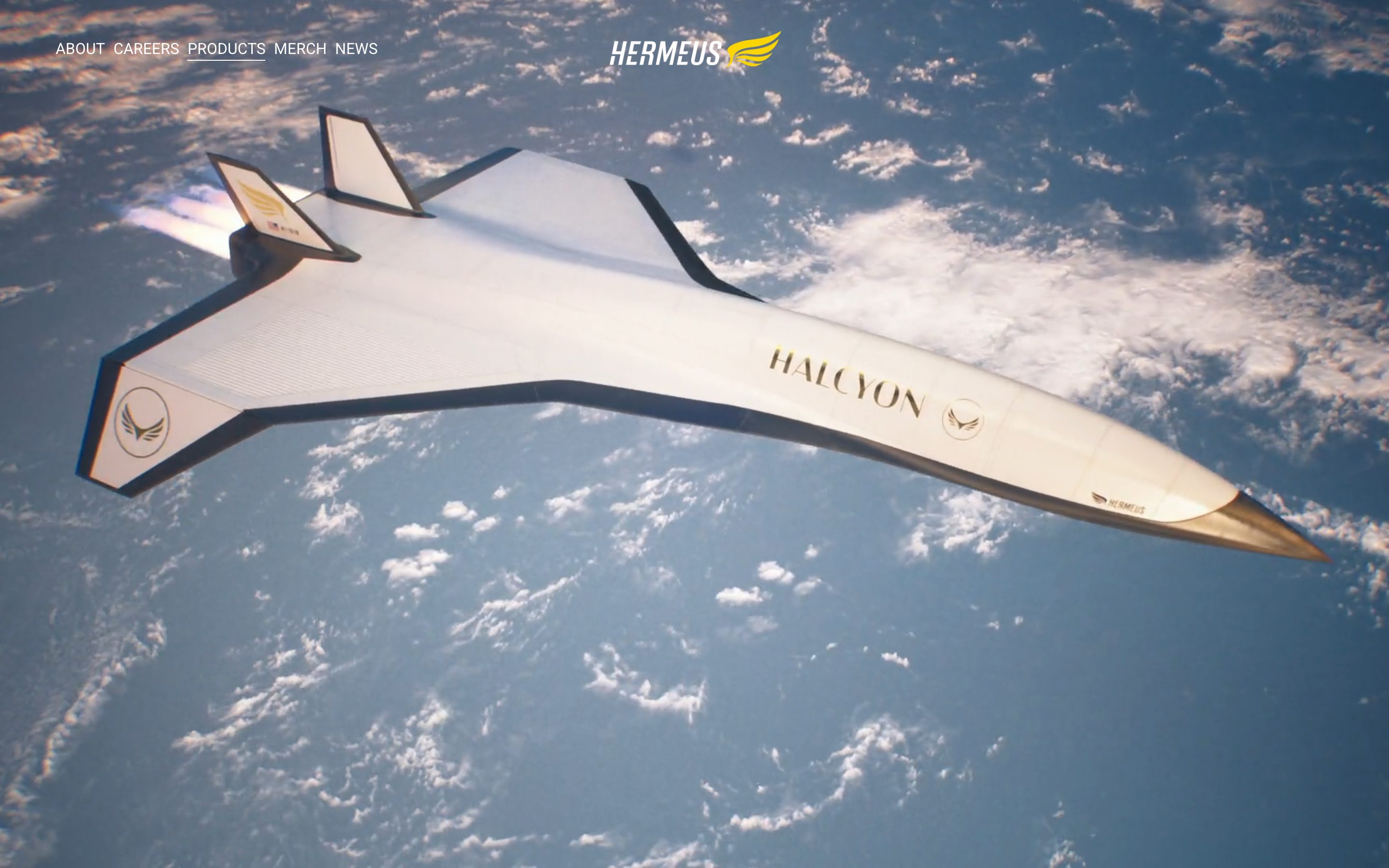
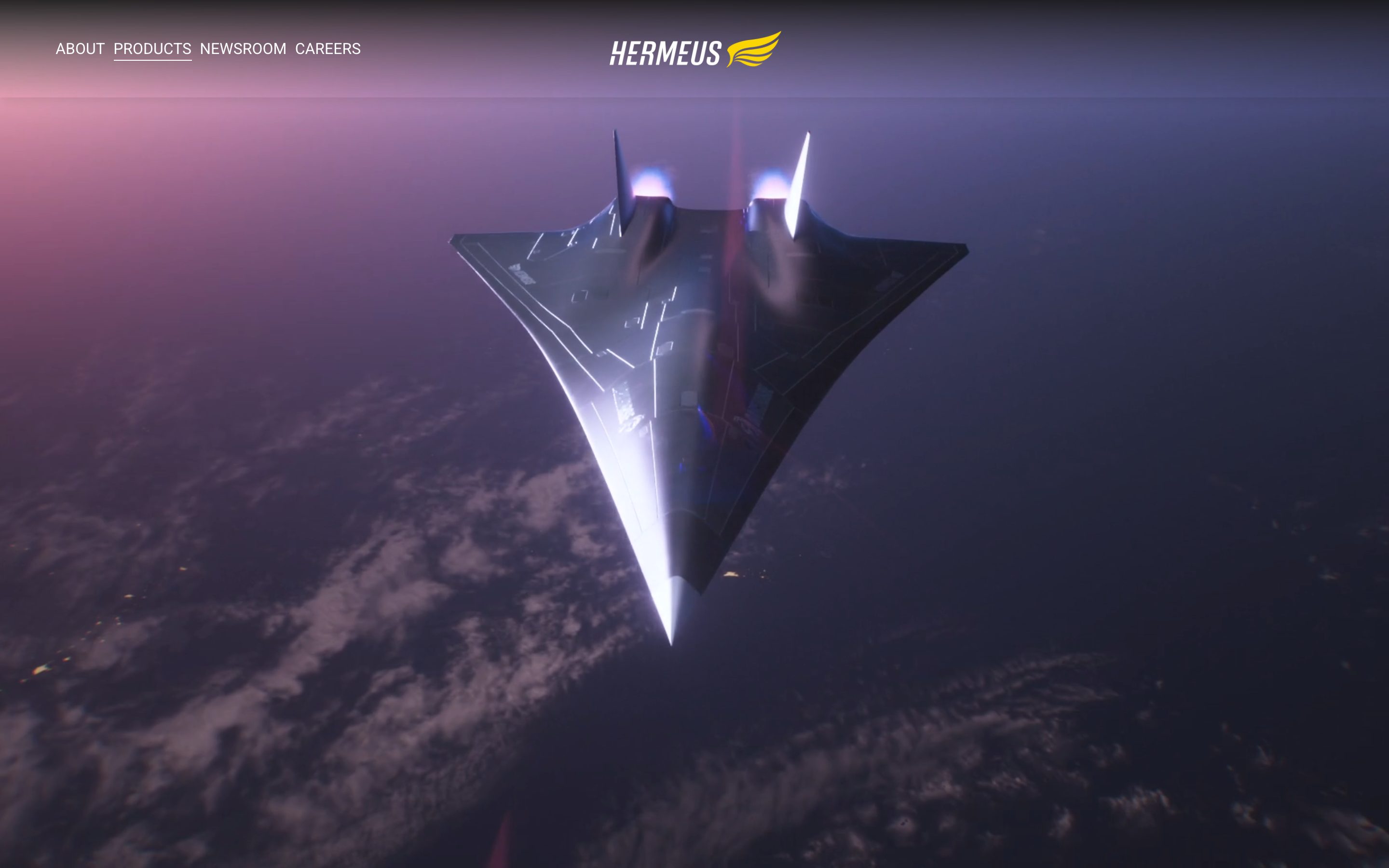
Hermeus never announced the change, and no release or interview found gives a reason. What the records show is narrower than a pivot: the steps it had been selling were never replaced by the thing they led to. By the time the passenger plane left, the buyer of the steps was the whole business. The site was rewritten around it, the Series C announced as "a mandate to build, fly, and deliver products for our customer", and the next chief executive came from that side of the house: Zach Shore, who had "spearheaded the acquisition of defense contracts".
Why it matters
A defence programme that wanted to try something at several times the speed of sound had poor options. Ground facilities, in Piplica's words, "are booked a year or more in advance and are prohibitively expensive"; Forbes counted too few wind tunnels and programmes "only managing a couple of flight trials a year". A flight test meant a one-off vehicle on "a large, expensive, expendable booster for every test", as the Ramjet-X announcement puts it. Other firms were building test vehicles too – Stratolaunch was developing a rocket-powered one to launch from its giant aircraft – and behind them stood the large contractors.
What each option left the buyer to do was build a vehicle and a test programme around every experiment. Hermeus offered a reusable aircraft that takes off from a runway and comes back for the next one. Its own figures are about speed and cost of the steps: the Chimera engine designed, built and tested in 21 months for $18 million, the Jacksonville test cells brought online in "one-eighth the time and at one-tenth the cost" of comparable projects, and supersonic flight 364 days after its first aircraft flew. The buyer's answer is the contract: DIU raised it by $159 million in May 2026, which the company calls "one of the largest ever awarded by the DIU". The passenger rivals, as Forbes summed up Piplica's argument in 2023, had no intermediate products to sell.
The playbook
The intermediate steps of a long hardware programme can be sold, one by one, to a buyer short of exactly those steps. Signs of the same opening are test facilities booked a year ahead, trials limited to a couple a year and expendable rigs built for each experiment, in energy or space as much as in defence. The DIU raised the Hermeus contract by $159 million in May 2026, to a $219 million ceiling. The road ends where the buyer stops needing it, perhaps short of the destination.
The lesson
Hermeus began with a destination no investor would fund up front. Rather than raise for the airliner, the founders cut the road into prototypes – an engine, a taxiing airframe, a subsonic jet, a supersonic one – and sold each to a buyer who lacked it in its own right: a defence department whose test sites were booked a year ahead and whose programmes flew a couple of times a year. The Air Force paid for the first flights, the DIU for a test service, and the engine test cells are offered to outsiders too.
The decision underneath: when what you mean to make cannot be financed before it exists, list the experiments you must run on the way, find who is short of exactly those, and sell each one as you finish it. The road then pays for itself, and each sale is evidence.
The price is the destination. Whoever buys the steps pays for the steps it wants, and after seven years the airliner left the site weeks before the largest round's first shares were sold. Reflex Aerospace ran the other order, selling to civil buyers while building to the defence buyer's rules; Hermeus let the defence buyer pay for the road, and the road ended where that buyer needed it.
Which experiment on the way to your finished product is someone already queuing to pay for, and could you sell it to them before the whole exists?
Where else it could work · our reasoning, not a finding
Gene-therapy developers with their own vector plants
A developer that has to build its own viral-vector production to reach its therapy can sell runs on that line to other biotechs that queue for contract manufacturing; the runs pay for the plant years before the therapy is approved.
Fusion machines on the way to power
Each intermediate machine makes neutrons long before it makes electricity, and materials labs and isotope producers compete for time on a few research reactors; irradiation hours on the machine can be sold while the power plant is still a plan.
Solid-state battery pilot lines
A pilot line turns out sample cells years before a factory exists, and carmakers run their own qualification programmes and pay for samples; each generation of the line can be sold as test material rather than carried as cost.
Track record
Hermeus · hermeus.com ↗
- Hermeus announces itself and a seed round led by Khosla Ventures, amount undisclosed: a Mach 5 airliner, New York to London in 90 minutes ↗
- AFWERX award with the Presidential and Executive Airlift Directorate, after a Mach 5 engine prototype was tested in February ↗
- $16M Series A led by Canaan Partners; Form D equity first sold 26 October 2020 ↗
- $60M Air Force partnership under AFWERX's STRATFI programme to build and flight-test Quarterhorse – a contract, not a round ↗
- $100M Series B led by Sam Altman, with Founders Fund and In-Q-Tel; Form D equity first sold 4 March 2022. Forbes later reported a $400M valuation ↗
- Chimera engine switches from turbojet to ramjet on the ground; built in 21 months for $18M ↗
- Defense Innovation Unit contract under its high-cadence flight-test initiative: Quarterhorse to deliver “high-speed flight test as a service” ↗
- Form D: $40M of equity sold, first sale 21 June 2024 – no announcement found ↗
- HEAT engine test facility opens in Jacksonville, offered for military and commercial engine testing ↗
- Quarterhorse Mk 1, the first aircraft, flies at Edwards Air Force Base ↗
- Archived Halcyon page, the last the archive holds: a passenger aircraft for “125+ trans-oceanic routes” ↗
- Archived homepage: Halcyon still in the products menu, “Imagine, New York to Paris in 90 minutes” ↗
- Archived homepage: Halcyon and the passenger section gone ↗
- First sale of the Series C equity, per the Form D filed in April 2026 ↗
- Archived homepage: aircraft “for the American warfighter”, “working directly with the Department of War” ↗
- $350M announced: $200M of Series C equity led by Khosla Ventures and $150M of debt, at a $1B post-money valuation ↗
- Zach Shore, who led the company's defence contracts, named chief executive; co-founder AJ Piplica becomes executive chairman ↗
- Quarterhorse Mk 2.1 goes supersonic, Mach 1.21, on its third flight ↗
- $159M modification lifts the DIU contract ceiling to $219M, for high-Mach flight and payload release – a contract, not a round ↗
- Ramjet-X announced: an expendable test vehicle launched from Quarterhorse, sold as flight test as a service ↗
- Licence from Pratt & Whitney to manufacture F100-PW-229 fighter engines ↗