Raised €50M ·
Published
Technology: Hardware
Model: Selling Certainty
#hardware · #manufacturing · #infrastructure
He left shoebox satellites for the made-to-order middle, and defence money found him there
The founder of Germany's first nanosatellite maker moved to 500 kg satellites built to order; €50M Series A followed.
The product
Reflex Aerospace builds satellites of 75 to 500 kilograms for low Earth orbit, each one shaped around the instrument it has to carry. A customer brings a camera, a radar or a radio receiver – or asks Reflex to find one – and the company designs the craft around it, assembles and tests it, delivers it to the rocket and switches it on in orbit. Then it hands the satellite over: Reflex does not operate missions. It has a design centre in Berlin, a MicroFactory near Munich and, by May 2026, 129 employees.
How it works
The buyer starts with a mission form, not a catalogue. "We Don't Have Products, We Have Solutions," one page says; every configuration on the site "is a guideline, not a limit." The platforms have names – Shift as the starting point, Vision for optical cameras, Wave for signals intelligence – but each is a starting point to be reshaped, with up to 250 kilograms of payload on board.
The promise is time. The company quotes 12 to 18 months for the first satellite and eight to ten for each one after it, against the years a classic manufacturer takes. Its first satellite, SIGI, a 109 kg craft for the German operator Media Broadcast Satellite, went from order in June 2023 to flight readiness in August 2024, and was launched on SpaceX's Transporter-12 in January 2025. How it gets there is a small factory built for low volume and high variety: reconfigurable cells, digital models of each satellite, 3D-printed structures, key components made in house, and only parts free of US export controls.
Business model
Customers pay per satellite, on a custom quote, and the site publishes no prices. The 2024 site said the fee covered "all non-recurring costs for adaptation & tailoring", so the design work sits inside the satellite's price rather than being billed as a separate study. Launch procurement and the radio licence can be added.
Who pays has changed more than how. The first buyers were a satellite operator and a start-up, Marble Imaging, whose first satellite was funded by a German Space Agency award it had won. The newer ones are defence-facing: a European Defence Fund project, a radar agreement with Umbra, a place among the partners of Rheinmetall ICEYE Space Solutions, and a constellation co-funded with Rafael. State customers bring their own terms. In a September 2026 interview Ballheimer described a project paid fully in advance, at a discount, that Reflex still had to finance itself because the buyer required the money to sit in a security account: "Dafür musste ich Geld bei Investoren raisen" – he had to raise it from investors, and some control went with it.
The spike
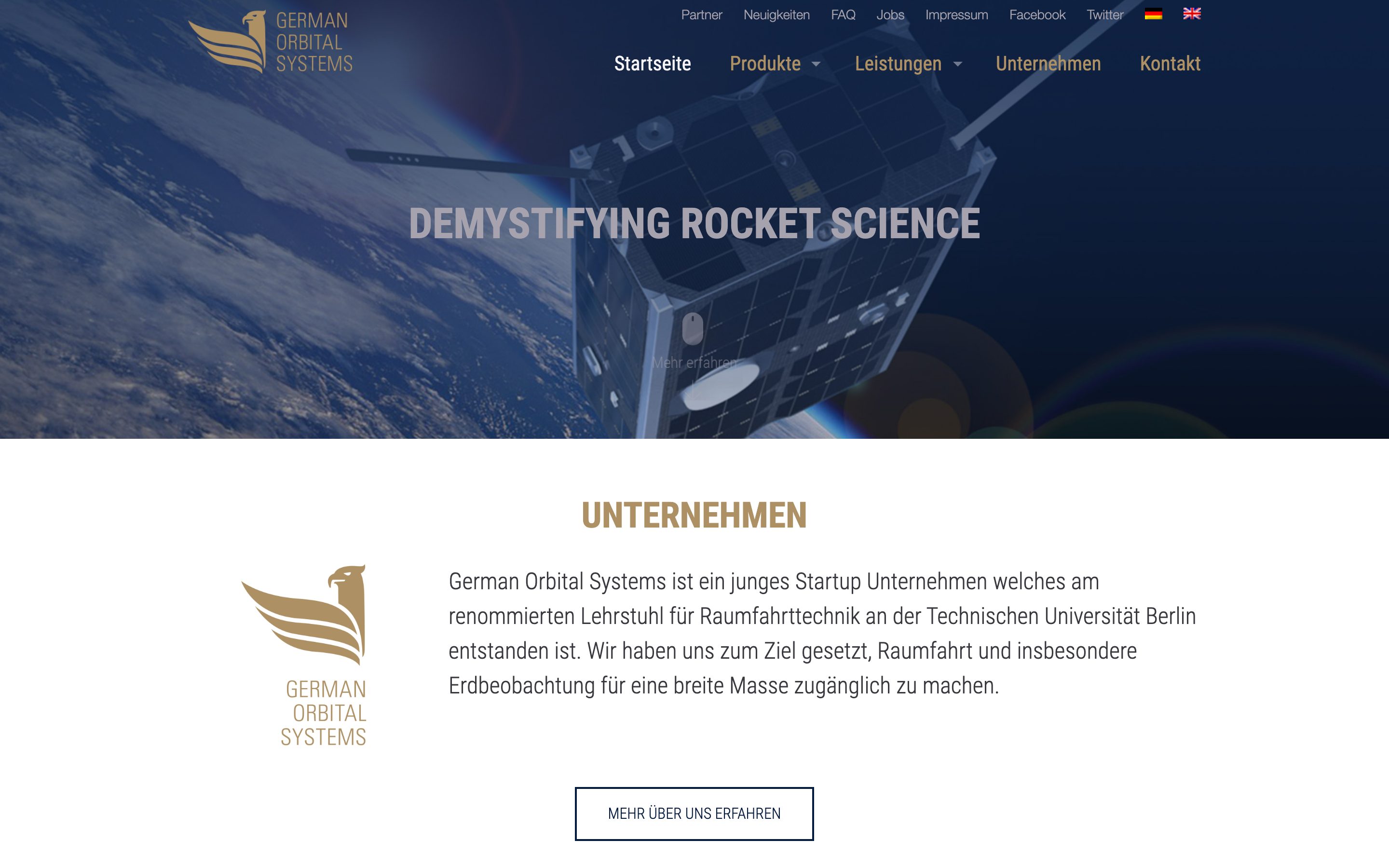
The decision that made Reflex was taken at another company. Walter Ballheimer had founded German Orbital Systems out of TU Berlin in 2014, the first commercial maker of nanosatellites in Germany – shoebox-sized CubeSats and their parts. It started on a €100,000 order from a university in Kazakhstan and was bootstrapped to 19 employees. By 2019 he was telling an interviewer that growing on its own had hit a limit, and that in Europe older firms such as GomSpace and ISISpace were ahead of it.
He left the small end. In his words to the founders' magazine StartingUp (our translation), nanosatellites "have a limited range of uses" and are "simple products that can hardly be made competitively in Germany," while the heavy, complex satellites belonged to a handful of giants such as Airbus, Lockheed Martin and Northrop Grumman. "The most exciting market for us is in the middle." In 2021 he started Reflex with two co-founders to build satellites of up to 500 kilograms, each made to order, in nine months rather than the usual four or five years. He carried over the thing German Orbital Systems had sold all along: a complete mission built for someone else's payload.

The first satellite shows the same instinct. In May 2023 Reflex booked a Falcon 9 slot for a demonstrator it meant to fly to prove its technology. A month later MBS ordered it, and in the company's own account the demo mission "elevated" into a commercial one – the proof flew as a paid delivery.
Then the buyer changed. The early pitch spoke of space infrastructure becoming "a commodity" that "everyone will have access" to, of broadband constellations and Earth observation for sustainability. By November 2025 the new round was raised for intelligence, surveillance and reconnaissance satellites, and Ballheimer denies that anything turned: "Reflex has positioned itself, always, from the very beginning, as the partner for the challenging, tricky missions in the defense context [and] responsive space." There is support for that in the record – a 2022 concept with the Bavarian State Chancellery for replacing satellites lost "in the event of a crisis or war", encryption and jamming resistance listed on the 2024 homepage. We would put the weight elsewhere. The satellite did not change; the buyer who could pay for it arrived, and the platform already met what that buyer asked for.
Why it matters
A European buyer who wanted a satellite in 2021 could turn to three kinds of maker, and each made them give something up. The primes built anything, over years. The standard-bus makers built quickly, but in the company's words "mass manufacturing requires standardized and rigid satellite platforms", so the instrument had to be cut down to fit the bus. And the cheap small satellites were, as the founders put it, moving to non-European countries, while buyers tied to their governments increasingly want their satellites made at home. Whichever they chose, the buyer had to trade away one of time, performance or origin to get the other two.
What Reflex sells is not having to make that trade, and the evidence is in the order book rather than in revenue, which it does not publish. By December 2024, before its first satellite had flown, it had signed four commercial contracts. SIGI took 13 months from order to flight readiness; Reflex says it has since worked through more than a year in orbit. After it came LiveEO's two satellites, the Umbra and Rafael systems and, in September 2026, its first American customer, Orbital, whose founder says it works with specialists at every layer rather than building everything in-house. Headcount went from 25 in February 2023 to 129 by May 2026, and planned capacity from ten satellites a year to 60 or 70.
The round sits in a wave. In the four months before it, Aerospacelab, ReOrbit and EnduroSat also raised large sums to build satellites, and European Spaceflight noted that all four named defence demand as the reason.
The playbook
Markets split between cheap standard units made abroad and slow custom builds from a few primes leave a middle for made-to-order work near the buyer. It shows where a buyer, often a state, now insists on domestic origin and cannot wait years, in drones, radar or secure radios. Reflex signed four contracts before any satellite had flown, and SIGI took 13 months from order to flight readiness. Without buyers bound to buy at home, imports win on price.
The lesson
Ballheimer's first company taught him where not to stand. Tiny satellites were simple, European rivals were older, and the cheap version was being made elsewhere; the big satellites belonged to a handful of giants. He did not try to win either end. He built the middle size to each buyer's instrument and sold the months saved. The rule: when the simple version of what you make can be made more cheaply somewhere else and the complex version belongs to a few giants, build the middle size to each buyer's specification, close to them, and charge for the time you save them. Its cost is that little is repeated: every new mission carries its own design work, and Reflex answers it by pricing that work into each satellite and building a factory for variety instead of volume. The test: which size of what you make is too particular to import and too small for the giants, and how long do its buyers wait for it today?
The second decision is about which buyer to build for. Reflex designed encryption, jamming resistance and replacement at short notice into a product it first sold to a satellite operator and an imaging start-up. When the strict buyer's budget opened, it had a flown satellite rather than a plan, and it keeps the civil work on purpose. Build to the requirements of the buyer whose budget has not opened yet, and sell meanwhile to the ones who need less. The test: which buyer in your market asks for more than your customers do today, and would your product pass their requirements without a redesign?
Where else it could work · our reasoning, not a finding
Clinical-trial batches of biologic drugs
Generic molecules come cheaply from a few distant plants and blockbusters from big pharma's own lines, while a biotech with one candidate needs a small batch made to its own process, near its regulator, and waits months in a queue for it.
Mid-sized transformers and switchgear
Small standard units ship cheaply from abroad and the largest are built by a handful of giants, but a solar park or a factory grid connection needs one unit made to its own specification, and the wait for it decides when the project earns anything.
Collaboration software for law firms and ministries
A tool built from the start to pass a government accreditation can sell to law firms, which need less, while the accreditation runs; the ministry buys only what has already been certified and used.
Ingredients made to pharmaceutical grade
A supplement maker pays for a clean, documented ingredient today; a drug maker qualifies a supplier only after years of batches on record, and the producer who kept those records from the first batch is the one already qualified.
Track record
Reflex Aerospace · reflexaerospace.com ↗
- German Orbital Systems, Walter Ballheimer's first company, founded in 2014 out of TU Berlin: CubeSat missions, components and ground stations, bootstrapped to 19 employees ↗
- Reflex Aerospace founded in Munich by Walter Ballheimer, Christian Lindener and Alexander Genzel ↗
- Stealth homepage: “Satellites. Reinvented.” – tailored systems, “but their delivery time is a no-go” ↗
- Selected by the European Commission to lead the study that became IRIS², coordinating 14 European entities ↗
- Seed first close, about €7M, from Alpine Space Ventures, HTGF and a Bavarian family office; a 'Rapid Response' concept with the Bavarian State Chancellery ↗
- Seed extended by €1.75M to nearly €9M, with Bayern Kapital and Starburst; launch slot booked for a 120 kg demo satellite on a Falcon 9 ↗
- Media Broadcast Satellite orders the satellite: the demo mission becomes the first commercial one ↗
- Second contract: MIRI for Marble Imaging, the first of a planned 200-satellite constellation, paid through a German Space Agency award ↗
- SIGI, 109 kg, shipped to Vandenberg: 13 months from order to flight readiness; four commercial contracts signed; over €16M raised ↗
- SIGI launched on SpaceX Transporter-12 ↗
- OPTIMAS begins: a European Defence Fund laser-communications project led by Navantia's monodon, with Reflex on the space segment ↗
- Agreement with Umbra: its SAR payload on a Reflex bus, integrated in Germany, first launch targeted for 2027 ↗
- Series A, €50M, led by Human Element with Alpine Space Ventures, Bayern Kapital and HTGF, for ISR and communications satellites and more capacity in Bavaria ↗
- Homepage: “We Design & Build Custom Satellites. Fast.” ↗
- Selected to build two satellite platforms for LiveEO's Twinspector constellation ↗
- Rafael and Reflex present a co-funded, co-developed very-high-resolution imaging constellation at ILA Berlin ↗
- Named among the first partners of Rheinmetall ICEYE Space Solutions ↗
- First US customer: Orbital picks Reflex as exclusive platform partner for its planned orbital data-centre constellation ↗