Raised $100M ·
Published
Technology: Software
Model: Democratizing Craft
#design · #no-code · #websites
Framer cut the rebuild out of web design
Prototyping revenue peaked at $4M in 2019. Then Framer cut the rebuild between design and site – $2B by 2025.
The product
Framer is a website builder for the people who design websites. You lay the page out on a canvas, as in a design tool, then click publish, and Framer hosts the result as a live site. Startups and brands run their marketing sites on it – Perplexity, Miro, Scale AI and Zapier among them.
How it works
You design on a freeform canvas: breakpoints for each screen size, links, animations, scroll effects. You can paste a design in from Figma or start from a template. One click publishes it. The site then runs inside Framer, with a built-in CMS, analytics, A/B testing and funnel tracking, so the marketing team keeps working on it after launch without a developer.
Today the homepage leads with an AI design agent that works on the canvas "with every change visible, editable, and under your control", a second agent for the CMS, and hooks to change the site from Slack, a GitHub pull request or a coding agent.
Business model
Framer charges per site, and designing is free. A site on a Framer address costs nothing; your own domain starts at $10 a month on a yearly plan, and $30 buys staging, branching with previews and room for a growing company's site. Enterprise is priced on request, with single sign-on and an uptime guarantee. Extra editors are $20 a month, viewers are free, and pages, bandwidth and AI credits beyond the plan are paid as used. The shape is recent: five plans became three in October 2025; when agents arrived in June 2026, the Scale plan went, the editor seat fell from $40 to $20 and every plan got an allowance of AI credits. Our reading: the bill grows with the site – the same thing a developer used to be paid to look after.
The spike
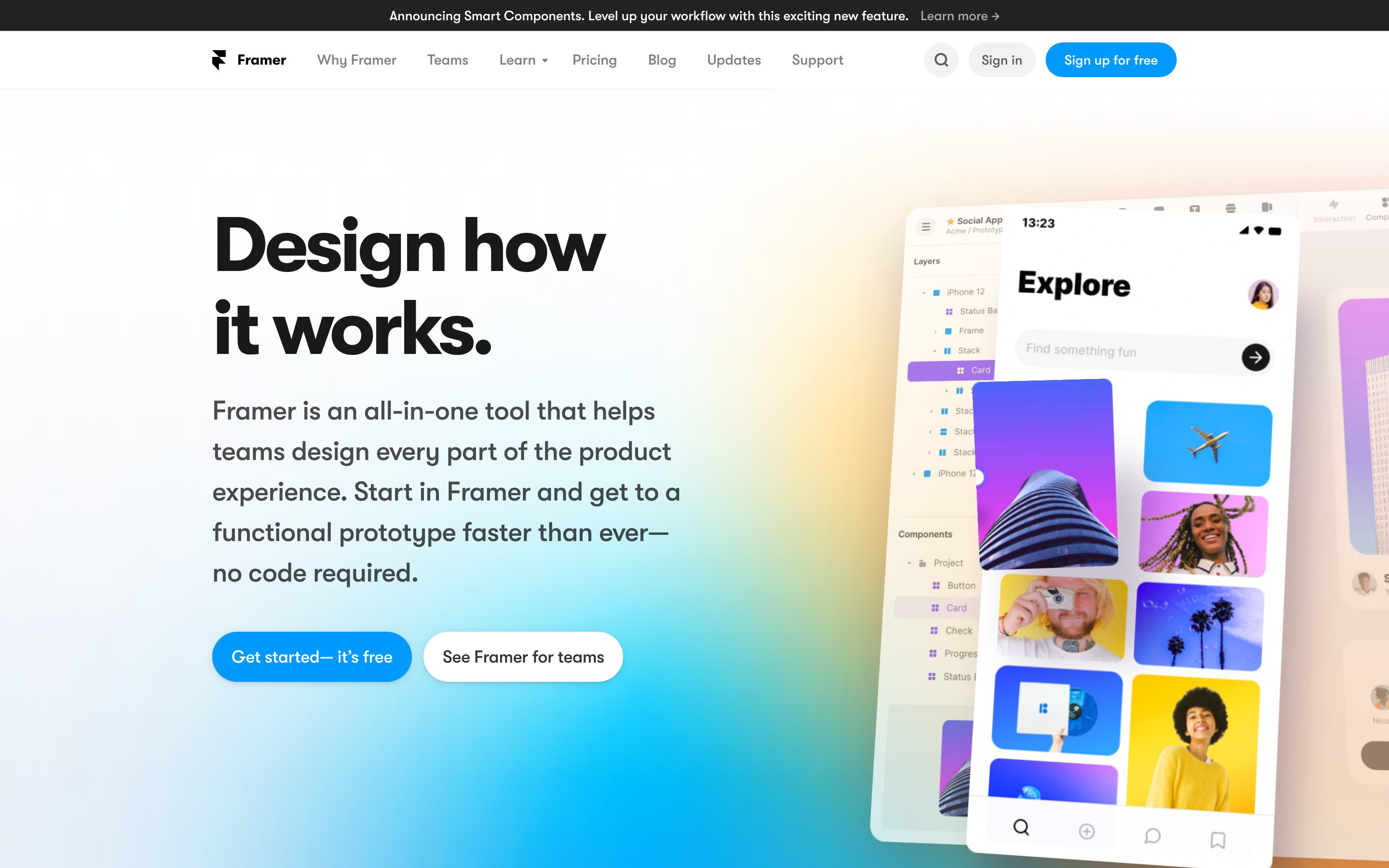
Framer started in 2015 to make prototypes. Its founders, Koen Bok and Jorn van Dijk, had sold their Mac app studio to Facebook and wanted "prototypes that are almost indistinguishable from the real thing". By 2018 the product was Framer X, sold as a design, prototyping and developer handoff tool, and it raised $24M on that pitch.
Then the market stopped growing under it. Revenue peaked at $4 million in late 2019 and slumped; in April 2021, van Dijk told Forbes, "I said, this wasn't working." The company's own explanation came later: "by 2021, we noticed a strong shift towards simpler methods. White-boarding tools and low-fidelity prototyping solutions were easier to use for a larger audience and won in popularity." Over lunch in Amsterdam they chose to let the software "build the web sites it mocks up".
They dropped the prototype as the thing they sold, and the handoff that came after it. They kept the canvas and, in their words, "all the technology investments we've made in the past", from smooth animations to elaborate scroll effects.
Taken as a whole, the move was bigger than a change of market. A prototype, however faithful, ended at a handoff, where someone rebuilt it as the real thing; the better the design, the more work the rebuild took. Framer stopped selling the step before the handoff and removed the one after it.
The traces follow. A beta went out in January 2022 – "Design real websites right on the canvas. Publish in seconds." – and Framer Sites was the top Product Hunt launch of 25 May 2022, with 881 upvotes.
Why it matters
Websites were not a gap in the market. Wix and Squarespace had served personal sites for over a decade, and Webflow had built a business with $100 million in revenue. But for a professional site the usual path was two tools: design in Figma, then rebuild the design from scratch in Webflow or by hand. Bok called it "a really big juicy problem": the design happens in one place and the building somewhere else. The step left to the user was the rebuild.
Framer took it out, and the numbers moved. In just under 18 months after the launch, revenue grew fourfold to over $10 million, Forbes reported, from a business that had been shrinking. The company measured more than 20% growth month over month. By August 2025, by its own figures, Framer had been break-even for a year, more than half a million people used it each month, and close to half of the latest Y Combinator batch launched their sites on it. By June 2026 it counted more than 188,000 companies and more than 4 million published sites, with about 364 million visitors a month.
Investors came in behind the numbers: $27M in 2023, then $100M at a $2 billion valuation in August 2025 – a round the company says it did not go looking for.
The playbook
Search trades where a finished design is handed on only to be rebuilt in another tool: a drawing redrawn for the workshop, a deck rebuilt as a report. That rebuild is a paid job, and a tool that makes the first output final can bill by what is published, as Framer bills per site. Forbes reported its revenue grew fourfold to over $10 million in just under 18 months. Where the rebuild adds judgement rather than copying, the second step survives, and so does its budget.
The lesson
Take the name away and the rule reads: remove a step from the chain, and the money that paid for the step can become yours. A professional site used to take two. A designer drew the page in one tool; a developer or an agency rebuilt it in another – Webflow, or code. Framer did not make either step better. It removed the second: what you assemble on the canvas, from your own layout or from templates and components, is the site, published and hosted. The rebuild was a job people were paid for, and that budget did not disappear. It moved to the tool that made the rebuild unnecessary, which is why Framer's bill grows with the site, and why its Series C investor put it as companies not wanting "to use expensive developer resources" on their websites.
Ask it of your own idea: which step in your user's work exists only to redo the output of the step before it, and who is paid for it today? If you can remove it, that budget is the market.
Where else it could work · our reasoning, not a finding
Mobile apps
A screen designed in Figma is rebuilt by engineers before anyone can use it.
Construction estimates
Quantities are taken off an architect's drawing by hand before anyone can price the job.
Contracts
Terms agreed in a document are typed again into the billing system that enforces them.
Track record
Framer · framer.com ↗
- Founded in Amsterdam to build high-fidelity prototypes ↗
- Series B, $24M, led by Atomico, for Framer X – design, prototyping and developer handoff (Form D: $26.5M, first sale 26 October) ↗
- Homepage: “Design how it works” – get to a functional prototype faster ↗
- Prototyping revenue down from its $4M peak; the founders decide to publish sites ↗
- Beta announced: “Design real websites right on the canvas. Publish in seconds.” ↗
- Framer Sites launches on Product Hunt, #1 of the day ↗
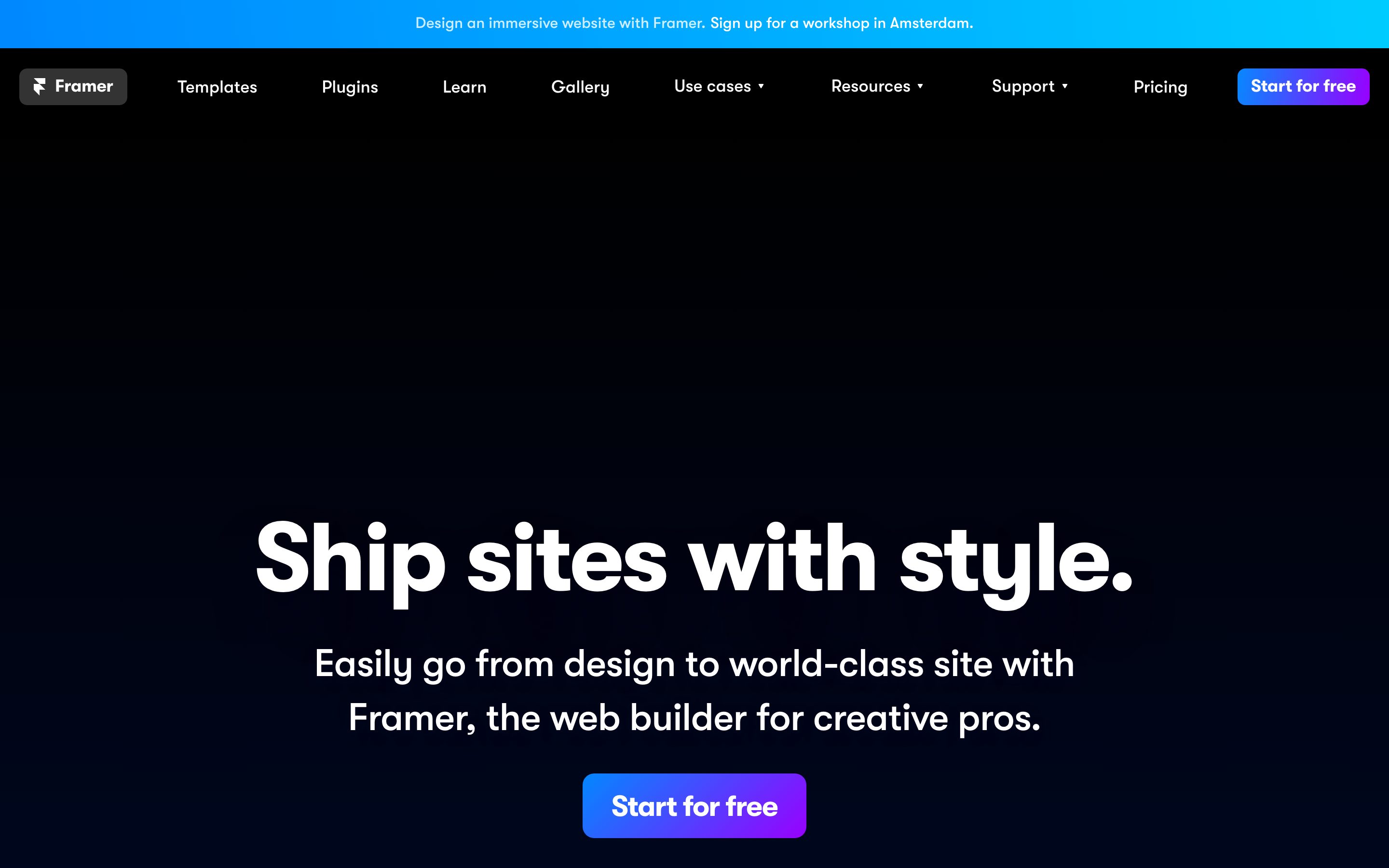
- Homepage: “Ship sites with style.” – the web builder for creative pros ↗
- Form D: $26.6M of $27M sold, first sale ↗
- Series C, $27M, led by Meritech Capital ↗
- Form D: $100M sold, first sale ↗
- Series D, $100M at a $2B valuation, led by Meritech and Atomico ↗
- Pricing cut from five plans to three – Basic $10, Pro $30, Scale $100, usage-based ↗
- Framer 3.0: AI agents on the canvas, Branching and a new Community; 188,000 companies build on Framer ↗
- AI credits on every plan; Scale plan retired, leaving Basic and Pro; editor seats halved from $40 to $20 ↗
- Archived homepage: “Design with agents. Refine on the canvas. Ship with your team.” ↗
- Archived homepage: “Framer is the design agent for every step from idea to launch” ↗