Monthly Brief · 5 October 2026 – 1 November 2026
October 2026
Executive Summary
Across the month, growth depends on turning change into operating capability: AI is spreading, yet returns require redesigned work, capable people and clear accountability, while broader transitions strain workforce and household resilience. Execution, rather than technology or structural change by itself, is the test of whether investment produces durable value. Companies must connect productivity and growth goals to human judgement, organisational readiness and the conditions in which people and markets can respond.
AI returns are strongest when departments redesign workflows, align people and leaders, and measure outcomes; dedicated leadership and common tools help turn scattered use into managed deployment. Yet polished outputs can obscure weak reasoning, and repeated delegation can erode skills, so workers need to evaluate AI rather than simply accept it. Deliberate practice and human-led handling of work requiring judgement, trust or accountability can preserve expertise while assigning routine tasks to AI. Boards should review value, threats, capability and acceptable risk regularly, while legal leaders clarify boundaries without becoming sole owners of every decision. Financial-services firms are moving beyond pilots, but technical debt, skills gaps, budget pressure, regulation and security still limit scale. Managers should treat AI as operating-model change, with controls for autonomous systems, rather than as a tool rollout or a technology-only programme.
The same execution gap appears in workforce change: transformations often miss intended value, and concurrent initiatives can overwhelm employees unless change is managed as a continuing capability. Reorganisation can ease leaders’ anxiety without solving performance problems or restoring collaboration, making structural intervention a poor substitute for diagnosis. Skills plans tied to business priorities, tested through pilots and coordinated across initiatives, build capacity to adapt. That capacity also depends on job design: autonomy, variety and relationships support satisfaction, while flexibility may not ease pressure when availability expectations persist. At household level, energy, healthcare and borrowing costs strain budgets; weak real wage growth has not yet stopped spending, but easing consumption is expected. Inflation credibility rests on lived experience, and local policy responses can shape whether political pressure creates enterprise, so leaders must plan for different conditions rather than assume a single recovery path.
On the radar
Energy transition is advancing faster than circularity, while electricity costs, LNG demand and uncertain emissions data make resilience and measurement part of investment decisions. Growth strategies can build from existing capabilities, but need a credible path to scale and a willingness to stop projects that do not progress. Capital routes, from listings and acquisitions to bank growth and private-equity succession, depend on readiness and the ability to sustain value beyond founders. Geopolitical shifts, shipping constraints, export controls and tariffs make supplier and route dependencies consequential, with effects that may emerge over time.
Sector growth is uneven: automotive margins and chemical demand remain pressured even as electric two-wheelers gain ground in India, so broad recovery assumptions can conceal divergent product and market economics. Customer preferences differ across regions and groups, and value alone may not secure demand; service feedback may also fail to reflect safety records. Digital platforms and data use can create value, but data extraction invites resistance and privacy must be reconciled with analytics; ecosystem participation needs a durable reason for partners and customers. Leaders also need to challenge comparisons and calibrate decisions under uncertainty, because rankings, premature role readiness and poor pacing can distort judgement.
Where attention went
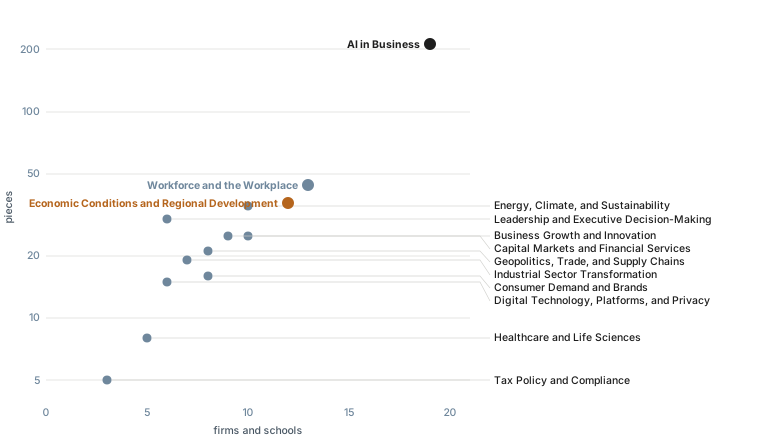
Each main theme of the month: how many firms and schools wrote on it (across) and how many pieces they published (up, log scale). Our count.
Opinions
Markel’s Simon Wilson and Prudential’s Pankaj Banerjee frame AI as a business-wide capability that requires scaled use, process redesign and data products, while KPMG’s Manish Madhavani sees scope to reshape products and customer experience. That ambition sits alongside continued human approval of agent tasks and concern that AI could displace jobs, even if many affected workers find new roles. Senior managers should pursue transformation while keeping people accountable for consequential decisions and preparing for changes in work.
The companies that put AI at the heart of the business—using it at scale and redesigning processes end to end—will be the winners in five years.
Simon Wilson
CEO, Markel Insurance1
…creating data products for AI execution is now a business activity rather than a tech activity.
Pankaj Banerjee
Group Chief Agency Officer, Prudential plc2
AI and advanced technologies are handing the financial sector the tools to completely reimagine product innovation and the customer experience.
Manish Madhavani
US Financial Services Leader, KPMG LLP3
Two-thirds of departments say they use AI agents, and only 17% let an agent complete a task without a person approving each step.
Brian Smith
Executive Vice President of the AI, Cloud & Enterprise Technology Practice, GBK Collective4
I think it’s very likely that there will be significant job losses from artificial intelligence in the coming couple of decades, but that most — not all, but most — of those people will be able to find new work.
Doug Elmendorf
Lucius N. Littauer Professor of Public Policy and a Harvard University Distinguished Service Professor at HKS, Harvard Kennedy School5
AI returns improve when firms redesign work, measure outcomes and preserve human judgement
AI in Business
Who wrote: BCG, Bain, CEIBS, Cambridge Judge, Chicago Booth Review, Deloitte, EY, HBS Working Knowledge, IESE, IMD, INSEAD, KPMG, Kellogg Insight, LBS, LSE Business Review, MIT Sloan, McKinsey, Roland Berger, Wharton; journals: California Management Review, Harvard Business Review, MIT Sloan Management Review.
Headliner: IMD, “AI and the Chief Legal Officer: Redefining legal leadership”, 5 October 2026.6
AI is entering routine professional work: 87% of surveyed general counsel say their teams use generative AI.6 Its use brings efficiency alongside new questions about liability, oversight and human review.6 Boards are being asked to connect AI strategy with risk, ethics and leadership oversight.7
Leaders increasingly see the design of human-AI interaction as important, but confidence in current practice is low.8 Meanwhile, AI can make polished work easier to produce while leaving underlying reasoning less visible to managers.9 Firms therefore face a capability challenge alongside decisions about accountability and control.9,7
Why do AI returns remain uneven?
Adoption alone does not explain returns: Wharton finds stronger outcomes where departments combine workflow transformation, people and leadership alignment, and outcome measurement.4 Dedicated AI leadership and standardised tools are also associated with stronger returns than decentralised or experimental use.4 Measuring growth as well as efficiency matters because AI value need not appear only as time saved.4
How should firms redesign work?
Deloitte advises designing interactions so workers retain active evaluation, using transparency, staged disclosure and pauses to curb overreliance.8 INSEAD argues that deliberate practice, AI-free work and parallel human-AI tasks help maintain expertise and show where each approach performs best.10 For routine tasks, Kellogg’s HUMAN framework supports delegation, while work requiring judgement, accountability or trust should remain human-led.11
Who should own AI accountability?
Boards should review value, threats, capability and acceptable risk as a recurring governance process, IESE argues.7 IMD finds that legal teams have new responsibilities but rarely own AI governance, and says CLOs should clarify accountability without taking every AI decision.6 Companies should assign clear oversight for autonomous systems while allowing business functions to deploy AI within those boundaries.6
Perspectives
- Leadership as multiplier. Wharton finds dedicated AI leadership and standardised tools are associated with stronger returns than decentralised or experimental use.4
- Board-level oversight. IESE argues that boards can support responsible adoption by regularly reviewing value, threats, organisational capability and acceptable risk.7
- Human capability risk. MIT Sloan warns that repeatedly outsourcing judgement and problem-solving to AI can weaken cognitive skills and talent pipelines.9
- Legal accountability. IMD argues that CLOs should help establish enterprise-wide accountability and governance while enabling innovation, rather than own every AI decision.6
What companies are doing
- Standardise AI leadership. Appoint dedicated AI leadership and standardise tools rather than leave use decentralised or experimental.4
- Protect independent reasoning. Use transparency, staged disclosure and pauses, and ask employees to form independent views before consulting AI.8
- Review AI at board level. Make board oversight a recurring review of value, threats, organisational ability and acceptable risk.7
- Clarify legal accountability. Build practical governance, develop AI skills in legal teams and make accountability for autonomous systems clear.6
In figures
- In departments meeting all three transformation measures, 67% of enterprise leaders report strongly positive ROI, compared with 19% where they do not.4
- 58% of organisations with a newly designated CAIO report strongly positive ROI, compared with 8% of those without one.4
- Only 8.7% of surveyed general counsel say legal owns AI governance, while 28.7% say it sits with IT or the CIO.6
- 66% of surveyed leaders consider intentional human-AI interaction design important to success, but only 6% believe their organisations are making great progress.8
- 35% of enterprise leaders tracking at least one growth measure report strongly positive ROI.4
- 87% of surveyed general counsel report generative AI use by their teams.6
Change creates value when firms build capability, not rely on repeated structural fixes
Workforce and the Workplace
Who wrote: BCG, Bain, Deloitte, HBS Working Knowledge, IMD, INSEAD, KPMG, Kellogg Insight, LBS, LSE Business Review, McKinsey, Stanford GSB, Wharton; journals: Harvard Business Review, MIT Sloan Management Review.
Headliner: Stanford GSB, “Career Advice: How to Break Through in a Tough Job Market”, 5 October 2026.12
Companies face concurrent transformations as business demands and talent needs shift, including the effects of automation.13,14 These changes increasingly overlap, putting pressure on employees and on leaders’ ability to coordinate initiatives.13 Workers’ experience also depends on how work is organised, including autonomy, relationships and pressure to remain available.15,16
A difficult job market raises the stakes for matching skills to roles, while employers consider skills-based planning and AI to anticipate future needs.12,14 Change also reaches beyond formal programmes: leaders’ responses to performance anxiety can reshape structures, and employees must adapt their own routines.17,18 The challenge is to build organisational capacity while maintaining conditions in which people can contribute.13,15
Why do transformations lose value?
Reorganising can ease leaders’ anxiety without correcting performance problems; at Recco, business continued to grow even as leaders changed structures, and control-seeking weakened collaboration.17 More broadly, many transformations miss their intended value, and initiatives often need major correction.13 When leaders use structural fixes instead of addressing underlying problems and coordinating change’s effects on staff, effort fails to translate into results.17,13
How can companies make change stick?
Companies can connect workforce plans to business priorities, use AI to anticipate how automation changes skill needs, and test initiatives through cross-functional pilots before scaling.14 They can also build change management as a continuing organisational capability rather than a one-off cost, coordinating concurrent demands on employees.13 At individual level, small, repeatable actions linked to established routines make behavioural change easier to sustain.18
What should companies protect during transition?
Companies need to preserve autonomy, meaningful relationships and variety in work, since tightly scripted, repetitive roles are associated with lower satisfaction.15 Flexibility alone may not restore wellbeing: high-skilled freelancers can turn unstructured time into more job-seeking and skill-building, while platform incentives reward constant availability.16 Managers should assess workload and availability norms alongside skills and delivery, rather than assume a shorter week or new arrangement will ease time pressure.15,16
Perspectives
- Defensive reorganisation. INSEAD’s Recco case suggests restructuring can become a way to manage leaders’ anxiety while leaving performance problems and collaboration issues unresolved.17
- Change as capability. Deloitte finds a strong reported return from change management alongside frequent failure to achieve intended transformation value, supporting investment in sustained capability.13
- Skills-led planning. KPMG argues that CHROs should connect skills planning to business priorities and use AI, cross-functional collaboration and pilots to prepare for changing capability needs.14
- Autonomy and time. Wharton links greater job satisfaction with varied work and autonomy, while LSE’s research suggests flexible arrangements may not relieve pressure when workers feel compelled to stay productive and available.15,16
- Proof of candidate value. Stanford’s career coaches advise candidates in a difficult market to show concrete outcomes and explain how their skills can deliver early impact in a role.12
What companies are doing
- Coordinate change as capability. Deloitte advises companies to manage change as an ongoing capability, with processes and authority to coordinate concurrent initiatives and their demands on employees.13
- Address anxiety before restructuring. INSEAD advises leaders to recognise organisational anxiety and address it directly, using outside intervention where it can interrupt a defensive cycle.17
- Pilot skills-based plans. KPMG recommends building executive support and testing skills initiatives through cross-functional pilots before scaling them.14
- Anchor small behaviour changes. IMD’s guidance is to make new behaviours specific and repeatable, link them to existing routines and support them with a helpful environment.18
In figures
- Deloitte found that 70% of surveyed leaders said their latest transformation did not deliver its intended business value.13
- Deloitte reports that 55% of leaders said their most recent initiative needed a major restart or course correction.13
- INSEAD states that Over 80% of firms’ restructuring efforts fail.17
- Recco was growing at 17% a year annually at the start of the INSEAD study, despite leaders’ performance anxiety.17
- Research cited by IMD estimates that up to 43% of daily behaviours are habitual.18
Persistent supply inflation strains households, while local institutions shape who gains from growth
Economic Conditions and Regional Development
Who wrote: BCG, Bain, CEIBS, Cambridge Judge, Chicago Booth Review, Deloitte, HBS Working Knowledge, KPMG, Kellogg Insight, LBS, LSE Business Review, McKinsey; journals: Harvard Business Review.
Headliner: Chicago Booth Review, “Inflation Anchoring Could Be a Myth”, 5 October 2026.19
The US economy continues to grow, but inflation, borrowing costs and unevenly shared AI gains are intensifying household and political strain.20 Energy and healthcare costs are sustaining price pressures that interest rates have limited power to remove.20 AI investment supports activity, while its productivity payoff and local resource demands remain uncertain.20
Central banks are tightening as energy price spikes fuel inflation, while manufacturing and services expand amid sparse growth in some economies.21 US consumers have kept spending resilient despite weak real wage growth, even as their use of credit changes.22 At local level, economic opportunity can turn on officials’ responses to political pressure, with outcomes varying between cities.23
Why does inflation resist rate rises?
KPMG links stubborn inflation to energy and healthcare costs, which interest rates have limited power to reduce.20 Chicago Booth argues that people’s expectations follow their experience of inflation more than Fed promises, making sustained low inflation the basis of credibility.19 KPMG expects further rate rises and higher long-term yields, leaving housing and indebted borrowers exposed.20
How does pressure reach households?
Households face energy and healthcare bills alongside costly borrowing, while weak real wage growth has not yet stopped spending.20,22 KPMG reports that revolving debt fell as borrowers faced high card rates, while car, student and personal borrowing continued to rise.22 This points to strain rather than an immediate collapse in consumption; KPMG expects spending to ease.22
What determines who gains locally?
LSE Business Review’s study links protests over non-economic issues to more new ventures when local officials respond with business lending or regulatory easing.23 The effect is stronger where mayors have better prospects for political advancement, so the same pressure does not produce the same outcome in every city.23 Companies therefore face local differences in economic opportunity, alongside potential tensions over the resources and political effects of AI investment.23,20
Perspectives
- Household strain. KPMG says consumers are managing high borrowing costs and weak real wage growth, but expects spending to ease rather than collapse.22
- Inflation credibility. Chicago Booth argues that central-bank promises do little to anchor expectations if people’s own inflation experience remains high; sustained low inflation matters more.19
- AI’s local costs. KPMG sees AI investment supporting growth, but warns that financing risks, local resource demands and uncertain productivity gains may deepen political tensions.20
- Local policy response. LSE Business Review links protests to entrepreneurship when officials expand business credit or ease regulation, with effects varying by mayors’ political prospects.23
- Weak deposit sorting. Cambridge Judge finds that deposits flow only weakly towards banks with better investment opportunities, and near-zero policy rates weaken that sorting further.24
In figures
- 5.5% is KPMG’s expected peak for the 10-year Treasury yield in early 2027.20
- Revolving debt fell 4.2% in August, as borrowers cut back on credit-card borrowing.22
- 21.2% was the credit-card interest rate KPMG cites as a factor in consumers’ borrowing caution.22
- 6 basis points is the average deposit-rate premium for a bank with a one-percentage-point investment-opportunity advantage over a rival.24
- Voters were expected to decide 35 data center referendums across eight states on November 3.20
- Protests were associated with 1,466 additional newly founded ventures on average in newly founded ventures.23
Flagship reports
Across sectors, AI is moving from experimentation towards operational use, but value depends on changing workflows and building data, skills and controls alongside it. Returns are emerging even as cost, security, regulation and workforce readiness constrain scale; family businesses also need to connect adoption with leadership succession and cyber governance. Senior managers should treat AI as an operating-model and governance programme, with clear outcome measures and safeguards for autonomous uses.
| Report | Publisher | Main finding |
|---|---|---|
| CEO Outlook | KPMG | KPMG finds that Asia Pacific family businesses need to link AI adoption with next-generation leadership and stronger cyber governance; managers should treat these as connected priorities for future readiness.25 |
| KPMG Global tech report 2026 | KPMG | KPMG finds that financial-services firms are moving AI beyond pilots, but technical debt, skills gaps, budget pressure, regulation and security risks make scaling dependent on stronger foundations. 89 percent of surveyed leaders describe their firms as innovators or fast followers, so managers need to build the data, infrastructure and controls that can turn adoption into lasting value.3 |
| AI Adoption Report | Wharton | Wharton finds that 67% of leaders in departments meeting all three measures of transformational success report strongly positive ROI, compared with 19% where departments do not meet all three. Managers should pair AI deployment with workflow redesign, aligned leadership and outcome measurement.4 |
| KPMG Quarterly AI Pulse Survey | KPMG | KPMG finds that 92% of technology leaders see tangible returns from AI, while cost reviews and CEO accountability are becoming routine. As firms scale, managers need to balance impact and model costs with security, governance and workforce readiness, and set safeguards for higher-risk autonomous-agent uses.26 |
On the radar
Across these themes, growth and resilience depend less on headline opportunity than on execution conditions such as energy costs, supply dependencies and organisational capabilities. Transition activity is advancing faster than circularity and reliable emissions measurement, while geopolitical shifts and trade constraints complicate sourcing and energy choices. For senior managers, this means testing investments against cost, evidence and readiness, while adapting choices to customer needs and market conditions.
Transition investment advances, while circularity and credible measurement lag
Energy, Climate, and Sustainability
Who wrote: BCG, Bain, Deloitte, IESE, KPMG, LBS, LSE Business Review, McKinsey, Roland Berger, Wharton; journals: Harvard Business Review, MIT Sloan Management Review.
Bain argues that energy transition activity is scaling faster than circularity, exposing an uneven pace of change across sustainability priorities.27 McKinsey points to pressure when electricity costs rise faster than growth, while Roland Berger says stronger Asian LNG demand makes LNG a strategic concern for oil and gas companies.28,29 LSE Business Review warns that supermarket emissions totals can rely on estimates as well as supplier data, making their reliability uncertain.30
Managers need to connect transition plans to energy costs and the resilience of supply, rather than treating sustainability as a reporting exercise alone.28,29 Emissions claims also depend on the quality and transparency of underlying data.30
Growth depends on scaling new ideas without discarding useful capabilities
Business Growth and Innovation
Who wrote: Cambridge Judge, Chicago Booth Review, EY, IESE, IMD, LBS, LSE Business Review, MIT Sloan, McKinsey, Stanford GSB; journals: Harvard Business Review.
Cambridge Judge argues that firms can build new strategies from capabilities already present in their businesses, rather than choosing between wholesale reinvention and protecting the status quo.31 IMD says scaling innovation requires teams to work through friction and uncertainty, and to stop projects when they no longer merit support.32 Stanford GSB points to a highly concentrated distribution of venture-capital profits, while McKinsey sees a growth opportunity in US–Latin America trade.33,34
Managers should test whether an innovation fits existing strengths and has a path to scale, while being willing to end work that does not progress.31,32 Expansion choices also need to account for where capabilities can travel across markets, not just where a large opportunity appears to exist.34
Capital access is available, but readiness and value creation still matter
Capital Markets and Financial Services
Who wrote: BCG, Bain, Deloitte, EY, IESE, KPMG, McKinsey, Roland Berger, Wharton.
BCG argues that corporate and investment banks have a growth opportunity, while McKinsey frames midsize banks’ profitability challenge around alternative routes to closing the return gap.35,36 EY tracks IPO-market trends, and KPMG stresses that going public requires capital-markets readiness.37,38 IESE presents search funds as a route for entrepreneurs to acquire and run companies, while Bain identifies leadership succession as a challenge and an opportunity for private-equity firms.39,40
Managers weighing a listing, acquisition or growth strategy should match the funding route to the organisation’s readiness and operating needs.38,39 In private equity, leadership succession can affect the ability to sustain value creation beyond the founder.40
Geopolitical volatility is reshaping resilience, sourcing and trade exposure
Geopolitics, Trade, and Supply Chains
Who wrote: BCG, Cambridge Judge, Deloitte, EY, HBS Working Knowledge, IMD, McKinsey, Roland Berger; journals: Harvard Business Review.
McKinsey argues that companies need to adapt their businesses to geopolitical shifts to build resilience and capture growth, while BCG emphasises the difficulty of making energy-sector decisions amid policy uncertainty.41,42 Deloitte links conflict to shipping constraints that strain supply chains, and IMD presents chip smuggling as evidence of how export controls and rivalry complicate supply-chain governance.43,44 HBS Working Knowledge finds that Canadian tariffs affected prices of targeted US imports gradually and temporarily, showing that trade measures can have effects that unfold over time.45
Managers should map dependencies across suppliers, routes and regulatory jurisdictions, then decide where flexibility is worth its cost.41,43,44 Pricing and sourcing plans should allow for trade measures whose effects may emerge gradually rather than all at once.45
Value matters, but distinct experiences and trust still shape consumer choice
Consumer Demand and Brands
Who wrote: Bain, Chicago Booth Review, Deloitte, IMD, LSE Business Review, McKinsey, Roland Berger, Wharton; journals: Harvard Business Review.
Deloitte says some snack brands are winning value-seeking consumers despite industry headwinds, while McKinsey notes that grocery retailers’ growth pressure limits opportunities for packaging suppliers.46,47 Bain finds that automotive customer priorities differ across regions, age groups and markets, making a uniform offer risky.48 Wharton points to nostalgia, community and experience as ways to attract consumers to screen-free entertainment, while LSE Business Review warns that service reviews may not align with official safety records.49,50
Managers need to make value clear without assuming that low price alone will secure demand; the right proposition may differ across customer groups.46,48 Where trust or safety matters, consumer feedback should be checked against more authoritative records rather than treated as a reliable proxy.50
Industrial recovery is uneven as margins, technology and structural choices diverge
Industrial Sector Transformation
Who wrote: BCG, Bain, Deloitte, KPMG, MIT Sloan, McKinsey, Roland Berger.
Bain says automotive profitability has reversed from its post-pandemic rise, while KPMG describes an industry facing several simultaneous shifts rather than one defining disruption.51,52 BCG sees electric two-wheelers moving into the Indian mainstream, pointing to a growth path within a pressured automotive sector.53 In chemicals, McKinsey reports uneven demand growth and continuing supply disruptions, while Deloitte argues that company performance may depend on structural strengths and strategic choices rather than a broad recovery.54,55
Managers should avoid relying on sector-wide recovery to restore performance and instead identify the specific capabilities, markets and products that can support their margins.51,55 Automotive strategies also need to account for variation between markets and technologies.52,53
Decision quality improves when leaders manage uncertainty and challenge
Leadership and Executive Decision-Making
Who wrote: BCG, Bain, IMD, INSEAD, KPMG, McKinsey; journals: California Management Review, Harvard Business Review, MIT Sloan Management Review.
Bain argues that strong decisions are a team effort, while KPMG points to CFOs navigating volatility alongside market headwinds.56,57 HBR warns that rankings can distort choices when options come from groups of different sizes, and IMD argues that leaders should be developed before they appear fully ready for a role.58,59 MIT Sloan recommends using a trusted person to help leaders adjust their pace, while INSEAD focuses on making high-stakes decisions well.60,61
Managers can improve decisions by testing comparisons, involving constructive challenge and matching decision pace to the situation.58,56,60 Succession planning should create opportunities for people to build judgement before a critical role becomes vacant.59
Digital value depends on combining data use with privacy and ecosystem capability
Digital Technology, Platforms, and Privacy
Who wrote: BCG, Deloitte, IMD, LSE Business Review, MIT Sloan, McKinsey; journals: California Management Review, Harvard Business Review.
MIT Sloan argues that privacy-preserving technologies can coexist with data analytics, while LSE Business Review describes data extraction as pervasive and notes signs of resistance.62,63 BCG presents platform-based business models as a route for progress in the energy industry, and IMD argues that firms need to orchestrate capabilities across ecosystems as products and services blur.64,65 Deloitte says streamers need to earn a continuing place in consumers’ entertainment choices, rather than assume that digital distribution alone secures loyalty.66
Managers should treat privacy and data use as design choices to reconcile, not as goals that must cancel each other out.62,63 Platform strategies also require a clear reason for partners and customers to participate, and a value proposition that holds up as alternatives evolve.64,65,66
Healthcare value hinges on resilient systems, discovery and customer experience
Healthcare and Life Sciences
Who wrote: BCG, Deloitte, IMD, McKinsey, Roland Berger.
BCG argues that the projected value of new drug modalities has levelled off, while IMD describes life sciences as facing a changing map of discovery and competition.67,68 McKinsey says medtech companies should build customer experience into products from the outset to create a durable advantage.69 Roland Berger focuses on healthcare-system resilience, and Deloitte links digital patient records to frontline productivity.70,71
Managers need to assess innovation not only by its scientific promise but also by its route to lasting value and adoption.67,68 In healthcare delivery and medtech, resilience, usable information and customer experience can affect whether technology improves everyday work and care.70,69,71
Tax policy must balance incentives, coordination and effective compliance
Tax Policy and Compliance
Who wrote: Chicago Booth Review, EY, KPMG.
KPMG argues that incentive policy must reconcile economic growth, fairness and international cooperation.72 EY says digital tax administration is changing how authorities manage disputes, raising the importance of companies’ approach to tax controversy.73 Chicago Booth Review frames the challenge of taxing legal sports betting as a question of how to raise revenue efficiently without distorting the market.74
Managers should assess tax incentives against both their commercial value and the policy conditions that sustain their legitimacy.72 Stronger digital enforcement makes consistent records and prepared dispute processes more important, while tax design can shape the economics of emerging legal markets.73,74
Ranked like the main themes, by how many firms and schools wrote on them. Read from headlines and announcements, so they show what was discussed, not what was proved.
Every source cited in this brief, numbered in order of first mention.
-
Bain. “Scaling AI in Specialty Insurance: A Conversation with”, 14 October 2026. https://www.bain.com/insights/scaling-ai-in-specialty-insurance-a-conversation-with-markels-simon-wilson ↩
-
Bain. “Driving AI Transformation From The C-Suite: A Conversation with Pankaj Banerjee”, 5 October 2026. https://www.bain.com/insights/driving-ai-transformation-from-the-csuite-a-conversation-with-pankaj-banerjee-video ↩
-
KPMG. “Can financial services outpace cyber complexity?”, 6 October 2026. https://kpmg.com/us/en/articles/2026/financial-services-global-tech-report-us-highlights.html ↩↩
-
Wharton. “2026 AI Adoption Report”, 13 October 2026. https://knowledge.wharton.upenn.edu/special-report/2026-ai-adoption-report ↩↩↩↩↩↩↩↩↩↩
-
HBS Working Knowledge. “AI Hasn’t Spurred Widespread Layoffs Yet. Why Not?”, 20 October 2026. https://www.library.hbs.edu/working-knowledge/ai-hasnt-spurred-widespread-layoffs-yet-why-not ↩
-
IMD. “AI and the Chief Legal Officer: Redefining legal leadership”, 5 October 2026. https://www.imd.org/ibyimd/artificial-intelligence/ai-and-the-chief-legal-officer-redefining-legal-leadership ↩↩↩↩↩↩↩↩↩
-
IESE. “How boards should govern artificial intelligence”, 7 October 2026. https://www.iese.edu/insight/articles/artificial-intelligence-boards-governance ↩↩↩↩↩
-
Deloitte. “4 lessons from behavioral economics that could help improve human-AI interaction”, 14 October 2026. https://www.deloitte.com/us/en/insights/topics/talent/improve-human-ai-interaction.html ↩↩↩↩
-
MIT Sloan. “‘The Collision: What AI Does to Us’”, 5 October 2026. https://mitsloan.mit.edu/ideas-made-to-matter/collision-what-ai-does-to-us ↩↩↩
-
INSEAD. “How to Use AI Without Eroding Critical Thinking”, 15 October 2026. https://knowledge.insead.edu/technology-innovation/how-use-ai-without-eroding-critical-thinking ↩
-
Kellogg Insight. “Is This a Job for a Human or AI?”, 8 October 2026. https://insight.kellogg.northwestern.edu/article/is-this-a-job-for-a-human-or-ai ↩↩
-
Stanford GSB. “Career Advice: How to Break Through in a Tough Job Market”, 5 October 2026. https://www.gsb.stanford.edu/insights/career-advice-how-break-through-tough-job-market ↩↩↩
-
Deloitte. “The 4:1 change management return most organizations are leaving on the table”, 18 October 2026. https://www.deloitte.com/us/en/insights/topics/business-strategy-growth/change-management-roi.html ↩↩↩↩↩↩↩↩↩↩↩
-
KPMG. “Rethinking Strategic Workforce Planning with AI Agents”, 15 October 2026. https://kpmg.com/us/en/articles/2025/chros-chart-course-skills-driven-workforce.html ↩↩↩↩↩
-
Wharton. “What Does It Mean to Be ‘Happy’ at Work?”, 13 October 2026. https://knowledge.wharton.upenn.edu/article/what-does-it-mean-to-be-happy-at-work ↩↩↩↩↩
-
LSE Business Review. “Is freelance work, or the four-day week, the best way to reclaim our time?”, 26 October 2026. https://blogs.lse.ac.uk/businessreview/2026/10/26/is-freelance-work-or-the-four-day-week-the-best-way-to-reclaim-our-time ↩↩↩↩
-
INSEAD. “The Perils of Defensive Organising”, 4 October 2026. https://knowledge.insead.edu/leadership-organisations/perils-defensive-organising ↩↩↩↩↩↩↩
-
IMD. “Time for a change? Begin here”, 6 October 2026. https://www.imd.org/ibyimd/brain-circuits/time-for-a-change-begin-here ↩↩↩↩
-
Chicago Booth Review. “Inflation Anchoring Could Be a Myth”, 5 October 2026. https://www.chicagobooth.edu/review/inflation-anchoring-could-be-myth ↩↩↩
-
KPMG. “Things that go bump in the night”, 5 October 2026. https://kpmg.com/us/en/articles/2026/october-2026-economic-compass.html ↩↩↩↩↩↩↩↩↩↩
-
McKinsey. “Global Economics Intelligence executive summary, September 2026”, 29 October 2026. https://www.mckinsey.com/capabilities/strategy-and-corporate-finance/our-insights/global-economics-intelligence ↩
-
KPMG. “Consumers take on more debt”, 7 October 2026. https://kpmg.com/us/en/articles/2026/august-2026-consumer-credit-outstanding.html ↩↩↩↩↩↩↩
-
LSE Business Review. “How street protests can spark entrepreneurship”, 22 October 2026. https://blogs.lse.ac.uk/businessreview/2026/10/22/how-street-protests-in-china-can-spark-entrepreneurship ↩↩↩↩↩↩
-
Cambridge Judge. “Monetary policy’s hidden conduit: who gets your deposits?”, 13 October 2026. https://www.jbs.cam.ac.uk/2026/monetary-policys-hidden-conduit-who-gets-your-deposits ↩↩↩
-
KPMG. “ASPAC Perspectives: Future-ready family businesses”, 6 October 2026. https://kpmg.com/xx/en/our-insights/value-creation/family-business-aspac-perspectives.html ↩
-
KPMG. “KPMG AI Quarterly Pulse Survey”, 16 October 2026. https://kpmg.com/us/en/articles/2026/kpmg-quarterly-ai-pulse-survey-technology.html ↩
-
Bain. “Why the Energy Transition Is Scaling and Circularity Isn’t—Yet”, 8 October 2026. https://www.bain.com/insights/why-the-energy-transition-is-scaling-and-circularity-isnt-yet-video ↩
-
McKinsey. “When electricity costs outpace growth”, 22 October 2026. https://www.mckinsey.com/featured-insights/charts/when-electricity-costs-outpace-growth ↩↩
-
Roland Berger. “The LNG imperative oil & gas cannot ignore”, 5 October 2026. https://www.rolandberger.com/en/Insights/Publications/The-LNG-imperative-oil-gas-cannot-ignore.html ↩↩
-
LSE Business Review. “The hidden uncertainty behind emissions data produced by British supermarkets”, 16 October 2026. https://blogs.lse.ac.uk/businessreview/2026/10/16/the-hidden-uncertainty-behind-emissions-data-produced-by-british-supermarkets ↩↩
-
Cambridge Judge. “How kernels of reinvention can help firms thrive”, 13 October 2026. https://www.jbs.cam.ac.uk/2026/how-kernels-of-reinvention-can-help-firms-thrive ↩↩
-
IMD. “Why scaling innovation is so damn hard”, 20 October 2026. https://www.imd.org/ibyimd/book-club/why-scaling-innovation-is-so-damn-hard ↩↩
-
Stanford GSB. “Just 5% of VCs Make Most of the Profits”, 8 October 2026. https://www.gsb.stanford.edu/insights/just-5-vcs-make-most-profits ↩
-
McKinsey. “The hidden opportunity in the next $2 trillion of US–Latin America trade”, 19 October 2026. https://www.mckinsey.com/institute-for-economic-mobility/our-insights/the-hidden-opportunity-in-the-next-2-trillion-of-us-latin-america-trade ↩↩
-
BCG. “Corporate & Investment Banking Growth Outlook 2026”, 9 October 2026. https://www.bcg.com/publications/2026/corporate-and-investment-banking-growth ↩
-
McKinsey. “Banking trends snapshot: Two paths to closing the 5 percent ROE gap for midsize banks”, 19 October 2026. https://www.mckinsey.com/industries/financial-services/our-insights/banking-matters/banking-trends-snapshot-two-paths-to-closing-the-5-percent-roe-gap-for-midsize-banks ↩
-
EY. “EY Global IPO Trends Q3 2026”, 13 October 2026. https://www.ey.com/en_gl/insights/ipo/trends ↩
-
KPMG. “IPO Insights 1Q 2026”, 13 October 2026. https://kpmg.com/us/en/articles/2026/ipo-insights-q1-2026.html ↩↩
-
IESE. “A record in new international search funds launched”, 14 October 2026. https://www.iese.edu/insight/articles/search-funds-record-expansion ↩↩
-
Bain. “Getting Leadership Transition Right in Private Equity”, 22 October 2026. https://www.bain.com/insights/getting-leadership-transition-right-in-private-equity ↩↩
-
McKinsey. “As the world order turns, leading companies are keeping pace. Here’s how”, 9 October 2026. https://www.mckinsey.com/west-coast/our-insights/as-the-world-order-turns-leading-companies-are-keeping-pace-heres-how ↩↩
-
BCG. “How Energy Companies Navigate Policy Uncertainty”, 26 October 2026. https://www.bcg.com/publications/2026/navigate-energy-policy-uncertainty ↩
-
Deloitte. “Shipping constraints impact global supply chains”, 26 October 2026. https://www.deloitte.com/us/en/insights/topics/economy/spotlight/middle-east-shipping-routes-and-global-energy-exports.html ↩↩
-
IMD. “The long way to China: What chip smuggling reveals about trade today”, 9 October 2026. https://www.imd.org/ibyimd/geopolitics/the-long-way-to-china-what-chip-smuggling-reveals-about-trade-today ↩↩
-
HBS Working Knowledge. “Trade Wars: How Tariffs Hit Prices Differently in Canada”, 9 October 2026. https://www.library.hbs.edu/working-knowledge/trade-wars-how-tariffs-hit-prices-differently-in-canada ↩↩
-
Deloitte. “Even little snacks can deliver big value”, 5 October 2026. https://www.deloitte.com/us/en/insights/industry/retail-distribution/sweet-savory-snacks-value-seeking-consumers.html ↩↩
-
McKinsey. “The State of Grocery Retail Europe: Implications for packaging players”, 22 October 2026. https://www.mckinsey.com/industries/packaging-and-paper/our-insights/the-state-of-grocery-retail-europe-implications-for-packaging-players ↩
-
Bain. “Global Auto Consumer Survey: Regional Trends in a Changing World”, 21 October 2026. https://www.bain.com/insights/global-auto-consumer-survey-regional-trends-in-a-changing-world ↩↩
-
Wharton. “How Lucky Strike Entertainment Is Betting on Screen-Free Experiences”, 8 October 2026. https://knowledge.wharton.upenn.edu/podcast/marketing-matters/how-lucky-strike-entertainment-is-betting-on-screen-free-experiences ↩
-
LSE Business Review. “Stop relying on reviews of services and start looking for records”, 15 October 2026. https://blogs.lse.ac.uk/businessreview/2026/10/15/stop-relying-on-reviews-of-services-and-start-looking-for-records ↩↩
-
Bain. “Automotive Profitability: How OEM and Supplier Margins Are Faring”, 5 October 2026. https://www.bain.com/insights/automotive-profitability-how-oem-and-supplier-margins-are-faring-interactive ↩↩
-
KPMG. “26th Global Automotive Executive Survey”, 23 October 2026. https://kpmg.com/xx/en/our-insights/transformation/global-automotive-executive-survey.html ↩↩
-
BCG. “Electric in Charge: How India’s E2Ws Are Moving into the Mainstream”, 26 October 2026. https://www.bcg.com/publications/2026/india-electric-two-wheeler-market ↩↩
-
McKinsey. “Chemicals in Q3 2026: Where the industry stands”, 16 October 2026. https://www.mckinsey.com/industries/energy-and-materials/our-insights/blog/chemicals-in-q3-2026-where-the-industry-stands ↩
-
Deloitte. “2027 Chemical Industry Outlook”, 27 October 2026. https://www.deloitte.com/us/en/insights/industry/chemicals-and-specialty-materials/chemical-industry-outlook.html ↩↩
-
Bain. “Great decisions—Not a solo performance”, 7 October 2026. https://www.bain.com/insights/decision-insights-10-great-decisions-not-a-solo-performance ↩↩
-
KPMG. “CFO’s navigate volatility while managing market headwinds”, 13 October 2026. https://kpmg.com/us/en/articles/2026/cfo-navigate-volatility-while-managing-market-headwinds.html ↩
-
Harvard Business Review. “Why Managers Misread Rankings”, 27 October 2026. https://hbr.org/2026/10/why-managers-misread-rankings ↩↩
-
IMD. “Leadership development: Why ready-enough beats ready-now”, 7 October 2026. https://www.imd.org/ibyimd/leadership/leadership-development-why-ready-enough-beats-ready-now ↩↩
-
MIT Sloan Management Review. “Why Every High-Performing Leader Needs a Pacer”, 14 October 2026. https://sloanreview.mit.edu/article/why-every-high-performing-leader-needs-a-pacer ↩↩
-
INSEAD. “Making High-Stakes Decisions Right”, 19 October 2026. https://knowledge.insead.edu/marketing/making-high-stakes-decisions-right ↩
-
MIT Sloan. “Data or privacy? Businesses can have both, MIT Sloan research finds”, 19 October 2026. https://mitsloan.mit.edu/ideas-made-to-matter/data-or-privacy-businesses-can-have-both-mit-sloan-research-finds ↩↩
-
LSE Business Review. “Is your phone listening to you? “Everything is organised around the assumption that you will give up this data.””, 7 October 2026. https://blogs.lse.ac.uk/businessreview/2026/10/07/is-your-phone-listening-to-you-everything-is-organised-around-the-assumption-that-you-will-give-up-this-data ↩↩
-
BCG. “Powering Energy Industry Progress with Platform-based Business Models”, 13 October 2026. https://www.bcg.com/publications/2025/powering-energy-industry-progress-with-platform-based-business-models ↩↩
-
IMD. “The view from the Moon: How to rethink your global strategy”, 13 October 2026. https://www.imd.org/ibyimd/strategy/the-view-from-the-moon-how-to-rethink-your-global-strategy ↩↩
-
Deloitte. “Streaming business strategy”, 14 October 2026. https://www.deloitte.com/us/en/insights/industry/technology/streaming-portfolio-strategy.html ↩↩
-
BCG. “New Drug Modalities 2026: Pipeline Value Plateaus”, 16 October 2026. https://www.bcg.com/publications/2026/new-drug-modalities-pipeline-plateau ↩↩
-
IMD. “The future of life sciences”, 28 October 2026. https://www.imd.org/ibyimd/innovation/the-future-of-life-sciences ↩↩
-
McKinsey. “Why medtechs can’t afford to overlook customer experience”, 13 October 2026. https://www.mckinsey.com/west-coast/our-insights/why-medtechs-cant-afford-to-overlook-customer-experience ↩↩
-
Roland Berger. “Healthcare system resilience: future of health 8”, 15 October 2026. https://www.rolandberger.com/en/Insights/Publications/Future-of-health-8-Resilience-of-healthcare-systems.html ↩↩
-
Deloitte. “Digital patient records for frontline productivity”, 15 October 2026. https://www.deloitte.com/us/en/insights/multimedia/podcasts/digital-patient-records-frontline-productivity.html ↩↩
-
KPMG. “Incentives and tax policy – kpmg.com”, 28 October 2026. https://kpmg.com/xx/en/our-insights/risk-and-regulation/incentives-and-tax-policy.html ↩↩
-
EY. “How tax authorities use digital tools to reshape controversy”, 13 October 2026. https://www.ey.com/en_gl/insights/tax/how-tax-authorities-use-digital-tools-to-reshape-controversy ↩↩
-
Chicago Booth Review. “The Most Efficient Way to Tax Sports Betting”, 19 October 2026. https://www.chicagobooth.edu/review/the-most-efficient-way-tax-sports-betting ↩↩