Raised $30M ·
Published
Technology: Software
Model: Collapsing Costs
#saas · #identity · #security · #marketplace
Paid by the check, it kept giving part of each check back
Paid per check, Yardstik shared revenue, cut its customers' screens, then made monitoring free weeks before a $30M Series B.
The product
Yardstik checks the people a company puts to work, before they start and after. It is a background screening firm in Minneapolis, licensed as a consumer reporting agency, that has added fraud detection, credential checks and monitoring around the check itself. The homepage puts the claim in two lines: "A background check shows who they were. We'll show you who they are." Its buyers are mostly businesses that hire many people, often contractors: gig marketplaces, staffing agencies, logistics, childcare, hospitality and healthcare. Customers named in August 2026 include Gopuff, Liveops, Sharetown, Task Rabbit and HUNGRY.
How it works
An employer either connects Yardstik to the hiring system it already runs – Bullhorn, Fountain, Greenhouse, Lever, Workday and others – or uses Yardstik's own dashboard. A marketplace or a software company can instead build it into its own product through the API, under its own brand, and fire a check on any event it chooses: a signup, an accepted job, a reactivation.
The candidate meets the fraud layer first. It verifies identity against a government ID and looks for signals such as SSN anomalies, device location and payment-card origin, which the company calls Detect AI. Then come the checks the role needs – criminal records, driving record, drug test, employment, education and licences – run in an order Yardstik calls Sequential Screening: the check most likely to disqualify, often the cheapest, goes first, and the rest stop if it fails. The company says customers using it with identity verification run 8.77% fewer screens.
Once someone is hired, they are enrolled in monitoring, and the employer gets an alert when a new record turns up. A fraud dashboard shows the employer the same signals across its whole workforce, such as one SSN appearing on several applications.
Business model
The employer pays per screen, and Yardstik publishes no price list. It sells the bill as much as the check: "Instead of paying for every check upfront, companies only pay for what they actually need", its blog said in 2025, and in April that year, "We've never raised prices on our customers."
Monitoring was sold separately until mid-2026; a 2024 post called it "a premium product for premium companies" and said it ran "at a tiny fraction of the cost of traditional background checks". By the end of July 2026 its pages called the basic level, which watches national and state sex-offender registries, "included with every plan", and an enhanced level that also watches criminal and arrest records remains an upgrade. The fraud dashboard comes with every account.
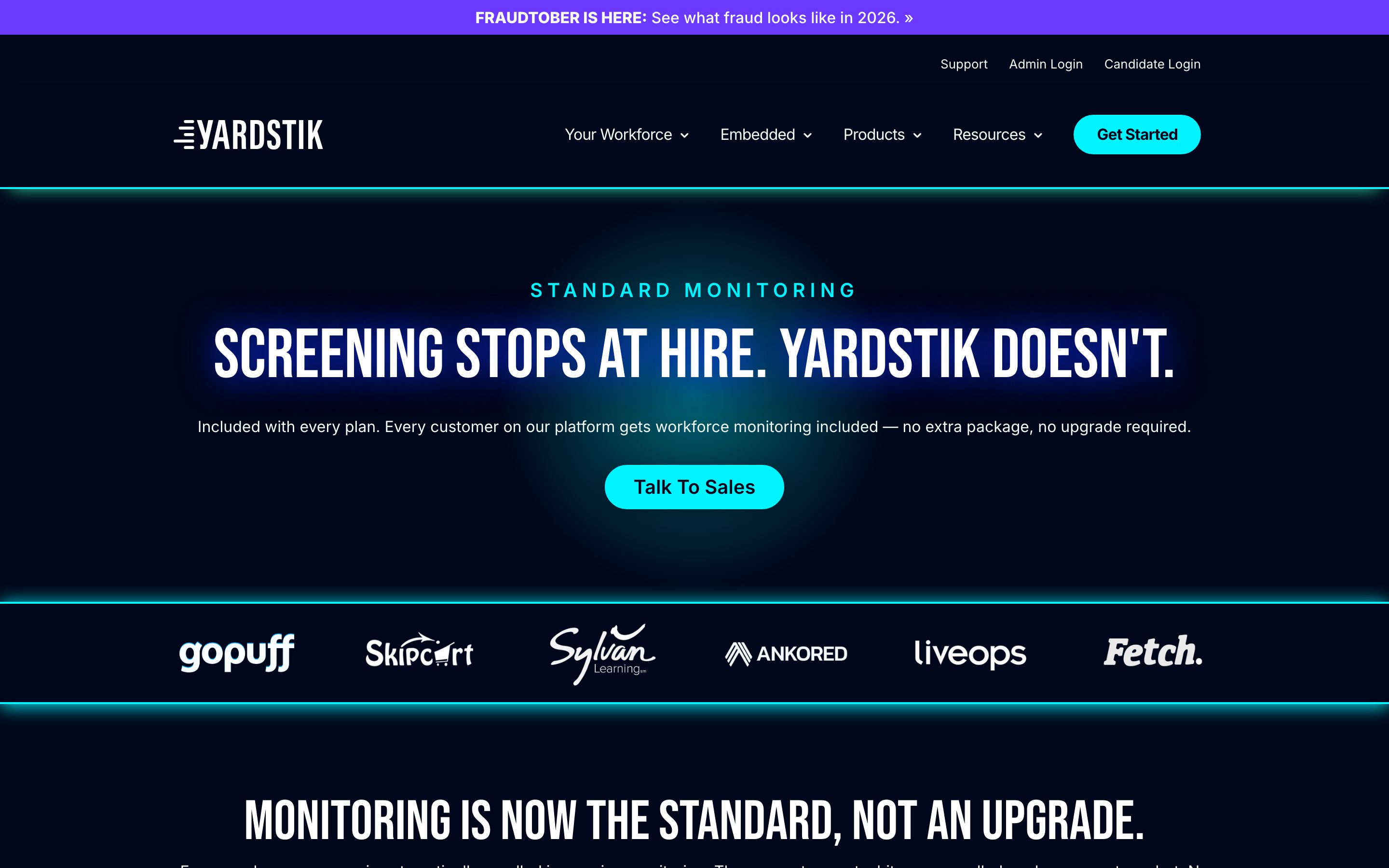
Marketplaces that embed Yardstik have their own arrangement. In 2021 the homepage offered them "sharing revenue from screens on your platform"; the delivery firm Dispatch, in its case study, "takes a cut of the monthly revenue generated from every screen run within their platform."
The spike
Yardstik raised a $4M seed in April 2020, co-led by Rally Ventures and Crosslink Capital, while still in what it called stealth mode; Matt Meents, a co-founder of Magnet360, was its chief executive. Its first buyer was not an employer but a platform. The "human security platform for platforms", generally available in March 2021, was white-label screening that a marketplace or a software company could sell as its own, with a share of every screen going back to it. Yardstik's SaaS page later pitched it the way payments are pitched: added revenue "at effectively 100% margin". The $8M Series A, led by Grotech Ventures in February 2022, was raised on 131 customers, up from 38.
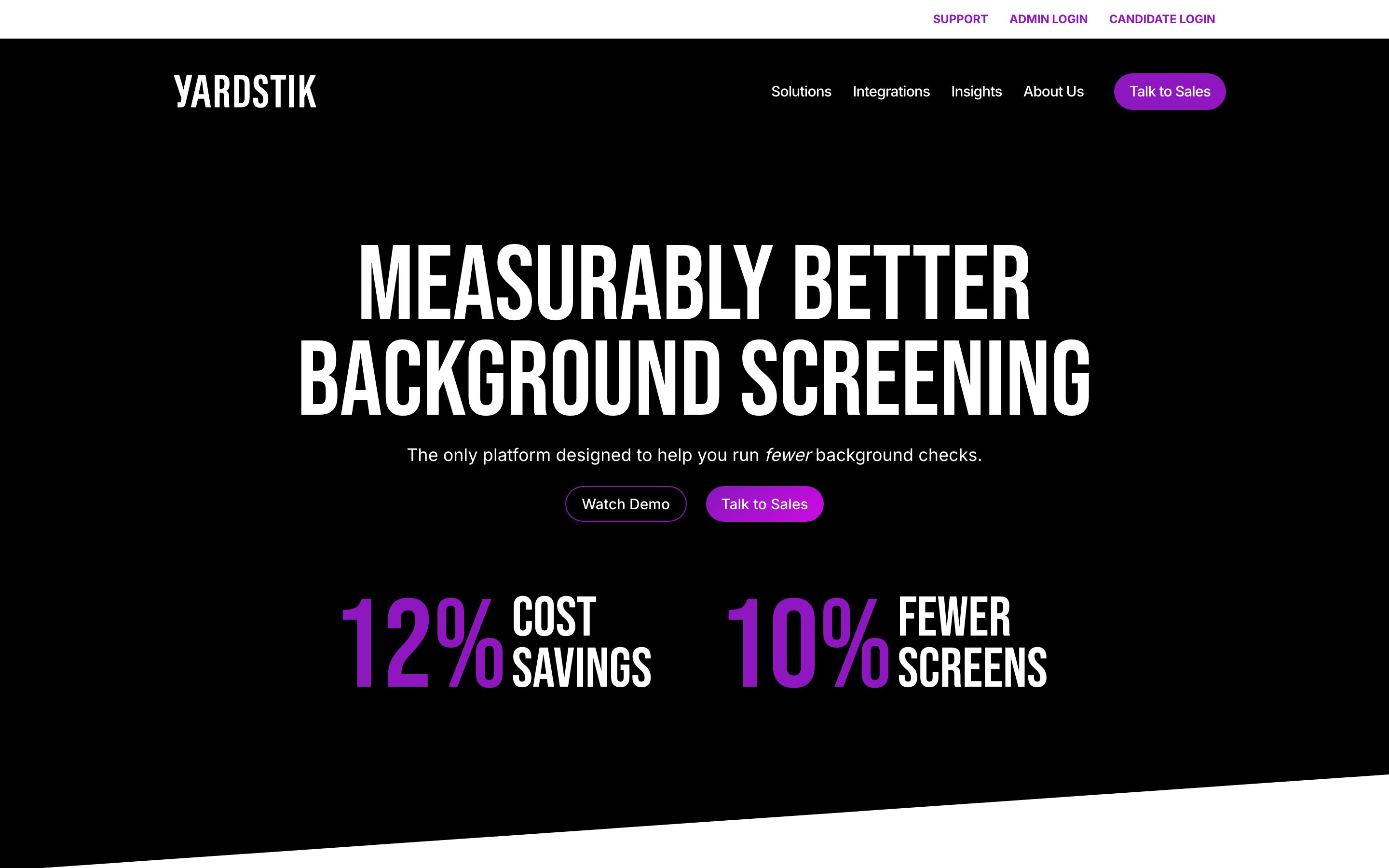
By 2023 the pitch was a "Trust & Safety Platform" for high-volume hiring businesses, and a $12M round led by MissionOG followed a year in which, the company said, its customer base grew by over 300%. In August 2024 the homepage spoke to employers instead: "Measurably Better Background Screening", "the only platform designed to help you run fewer background checks", against incumbents "desperately trying to charge more". In 2025 a landing page asked "Recent Checkr Price Hike?" and promised "ZERO annual price increases". Andrew Johnson, chief operating officer since 2022, took over from Meents that October, with "over a thousand customers".
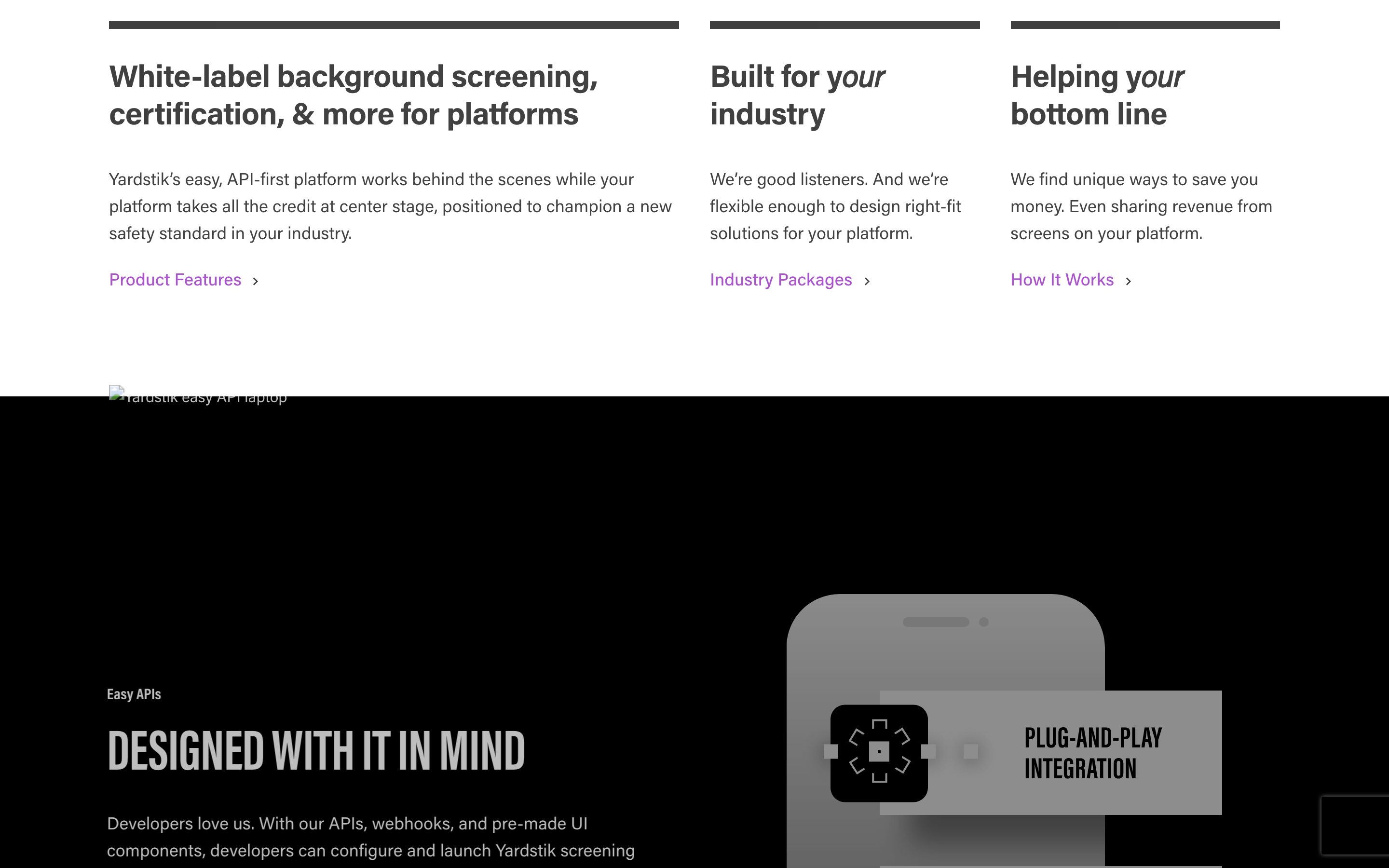
The second change came in February 2026. A release introduced the company as "formerly 'just a background screening company'" and launched what it calls a Human Trust Platform: fraud detection before the check, monitoring after the hire. "A single background check is no longer enough. Trust isn't static," Johnson said. By the end of July the monitoring and the fraud dashboard were free for every customer: they "should not be gated behind a paywall". On 27 August the $30M Series B, led by Harbert Growth Partners, was announced on exactly that – "Fraud signals before a check runs, monitoring after someone is hired and real-time credential visibility should not be premium add-ons." Its Form D records $16.5M of equity sold from 22 July; the release does not say how the $30M splits, and the filing does not explain the difference.
Yardstik tells this as a product story: from one check to the whole working life of a worker. The product did widen. What moved more was the bill. The screen stayed the unit it was paid in, and at each stage the company gave part of it back to whoever it was courting: a share of every screen to the platforms, fewer screens and a frozen price to employers leaving an incumbent, and in 2026 the follow-up it used to sell as an extra. The white-label route was kept as a second door, not closed.
Why it matters
The alternatives were the established screening firms – Yardstik names Checkr, First Advantage, Sterling and HireRight – selling checks priced one at a time, with anything after the hire, a rescreen or a continuous check, sold on top. Keeping a record current was left to the employer, who ordered and paid for each rescreen like a new check. "Rescreening feels like a logistical nightmare," Yardstik wrote in 2024, and the alternative to being billed more each year was the work of switching vendors with an integration in place. A blog post quoted its head of revenue: renewals arriving with prices "up by 50%" were "a pattern across the biggest legacy players".
Employers did switch, on the company's numbers. Customers went from 33 in March 2021 to over a thousand by October 2024, and in April 2025 it said 500 companies had joined in the previous year. It reported 100% year-over-year growth in 2024 and 149% revenue growth ahead of the Series B. HUNGRY, after a price rise from its previous vendor, cut its screening costs by half. The figure that bears on staying, rather than arriving, is the lead investor's: Harbert's Brian Carney cited "98% account retention rate over the past three years". How many employers now leave monitoring on, after it became free, is not public yet.
The playbook
A per-check service winning on the bill, not the check, needs a particular market. Signs of one: incumbents sending renewals up by half, follow-up work billed as a new purchase, and customers who stay only because an integration is in place. Yardstik went from 33 customers in March 2021 to over a thousand by October 2024, and its lead investor cites 98% account retention. Where switching costs nothing, incumbents cannot raise prices and no opening forms.
The lesson
Yardstik's money has always come in one unit, the screen, and at every stage of its path it handed part of that unit back. Platforms that sold its checks to their own users kept a cut of each one. Employers it signed directly were shown how to order fewer, at a price promised not to rise. In 2026 the monitoring it had sold as a premium became part of every account. Each concession cost revenue per customer and was paid for in customers: over a thousand by 2024, and 98% of accounts kept over the last three years, by the lead investor's count.
The decision applies to any business billed by the job, against incumbents who raise prices on customers too entangled to leave. Compete on the bill: return part of each job's value to the buyer – a share, fewer jobs, a price that holds, a free follow-up the rivals sell as an upgrade – and be paid in how many accounts arrive and how long they stay.
It holds only while what is given back costs little: monitoring, by Yardstik's account, runs at a fraction of a check's cost, and a paid tier sits above the free one. A giveaway as costly as the job gives the margin away for good.
What share of your price per job could you give back to customers, and would the accounts it keeps be worth more than the margin it costs?
Where else it could work · our reasoning, not a finding
Tax preparation for small firms
Preparers bill per return and raise the fee each season on clients whose records they already hold; one that holds the fee and answers tax-office letters all year at no charge, which others sell as audit protection, is paid in clients who stop shopping around.
Title and escrow
Title firms are paid per closing; watching the recorded deed for fraudulent transfers afterwards costs little per property and is sold elsewhere as a separate subscription, so a firm that includes it with every closing keeps the owner on its books for the next sale or refinance.
Instrument calibration
Labs bill per certificate and visit once a year; remote drift alerts between visits cost a fraction of a visit, and given with every certificate they make the plant's yearly re-tender a harder decision.
Commercial pest control
Contractors bill per visit and compete on price at every renewal; connected trap sensors cost little once fitted and are sold by others as a premium tier, so a contractor that includes them turns a renewal argued on price into one argued on a year of records.
Track record
Yardstik · yardstik.com ↗
- Form D: $4M sold of $4.25M offered, equity, first sale 15 April 2020 ↗
- $4M seed co-led by Rally Ventures and Crosslink Capital, raised in “stealth mode” ↗
- General availability of a white-label, API-first “human security platform” for marketplaces and SaaS platforms, with a revenue-sharing model; 33 customers ↗
- Archived homepage: “White-label background screening, certification, & more for platforms … Even sharing revenue from screens on your platform.” ↗
- $8M Series A led by Grotech Ventures; customers up from 38 in 2020 to 131 in 2021; no Form D found ↗
- Trust & Safety Platform launched, for high-volume hiring businesses, SaaS platforms and gig marketplaces ↗
- $12M expansion round led by MissionOG; customer base up over 300%; $24M raised in all, per Twin Cities Business; no Form D found ↗
- Archived homepage: “Measurably Better Background Screening – The only platform designed to help you run fewer background checks.” ↗
- COO Andrew Johnson succeeds co-founder Matt Meents as CEO; “over a thousand customers”, 100% year-over-year growth ↗
- Partnership with Persona: identity verification and background screening through one integration ↗
- “Human Trust Platform” launched with fraud detection, identity verification and continuous criminal monitoring; new brand ↗
- Launch page: workforce monitoring and the fraud dashboard “now included for all customers” at no extra cost ↗
- $30M Series B led by Harbert Growth Partners, $65M raised in all; 149% revenue growth; 98% account retention over three years, per Harbert ↗
- Form D: $16.5M of equity sold to 10 investors, first sale 22 July 2026 ↗
Raised in total: $65M