It sold a workspace by the seat, then kept only what no other tool could see
A $9-a-seat creative hub added untagged-video search to its enterprise plan in 2024; now it is the company.
The product
Plot finds a brand in social video even when nobody names it. A creator packs a box of crackers or holds up a Fenty Beauty product in a get-ready-with-me video and never tags the company; Plot's software reads the audio, the picture and the on-screen text of TikTok, Instagram and YouTube Shorts videos and puts that video in front of the brand. Its homepage line is "AI that watches social video 24/7 so you don't have to." It sells to the social, community, influencer and consumer-insights teams at large consumer companies – Visa, Mastercard, PepsiCo, Fenty Beauty, Benefit Cosmetics, CAVA and Canva among the names the company gives.
How it works
A team starts with a prompt – a brand, a product, a competitor, a topic – and gets back a feed of the videos that match, tagged or not, with views, engagement, earned media value and sentiment beside each one. Object detection finds a product that is only seen; transcription finds one that is only said. From that feed Plot builds the rest. A Community Hub turns the people who keep showing up into a list of superfans, with their past brand partnerships and every contact the company's teams have had with them. Campaign tracking, launched in January 2026, follows a gifting or influencer campaign through posts that never mention it – the example the company gives is every creator who posted after receiving a Benefit gifting package. Creator Intelligence, launched on 15 September, sends an AI agent through a creator's whole history before a brand signs them. Fenty Beauty had already used Plot to find creators with naturally curly hair for a launch.
Business model
Plot sells annual enterprise subscriptions and no longer shows a price: its pricing page says "Built for enterprise teams" and "Contact sales". In 2025 Adweek described the pricing as "dynamic pricing based on usage and consumption". The contract is meant to grow inside a company as more teams use it – social first, then community, insights, influencer and research – and Duong gives the net revenue retention of 132% as the sign that it does. She also says Plot does not ask a customer to drop Sprinklr or Meltwater; it sits beside them to cover what they miss. Almost all of the sales so far came inbound, helped along by her own posts on LinkedIn, with no outbound sales team.
The spike
For most of its life Plot sold something else. Megan Duong, who had built Apple's social team and then run her own agency, started the company with Ethan Phan in March 2022 to take the operational load off marketers: in her podcast account, she had spent years "doing the busy work of everything", in project management tools designed for product teams and pushed on marketers. The earliest archived homepage, in December 2022, was a waitlist for "Plot Workspace for Creatives", a place to manage projects, deliverables and approvals. By 2024 it had become "Your creative hub": a Creative Juicebox to save links and ideas by text message or iPhone, a content calendar, AI search over stored assets, a daily trends tab – a free plan, then $9 and $21 per user a month.
Somewhere between the April and June 2024 captures, a tile marked "New!" appeared among those tools: AI video social listening, "No tagging required." On the July pricing page it was in none of the self-serve plans; it came only with the Enterprise plan, through sales. Seven months after it launched, Duong wrote that Plot was growing about 50% a month and working with "the most iconic brands you can think of". The calendar and the Juicebox stayed on the homepage for more than a year after that. They left it in May 2026, the month before the $10M round, when the page was rebuilt around one sentence about watching video; the pricing page dropped every plan but the one that had carried listening.
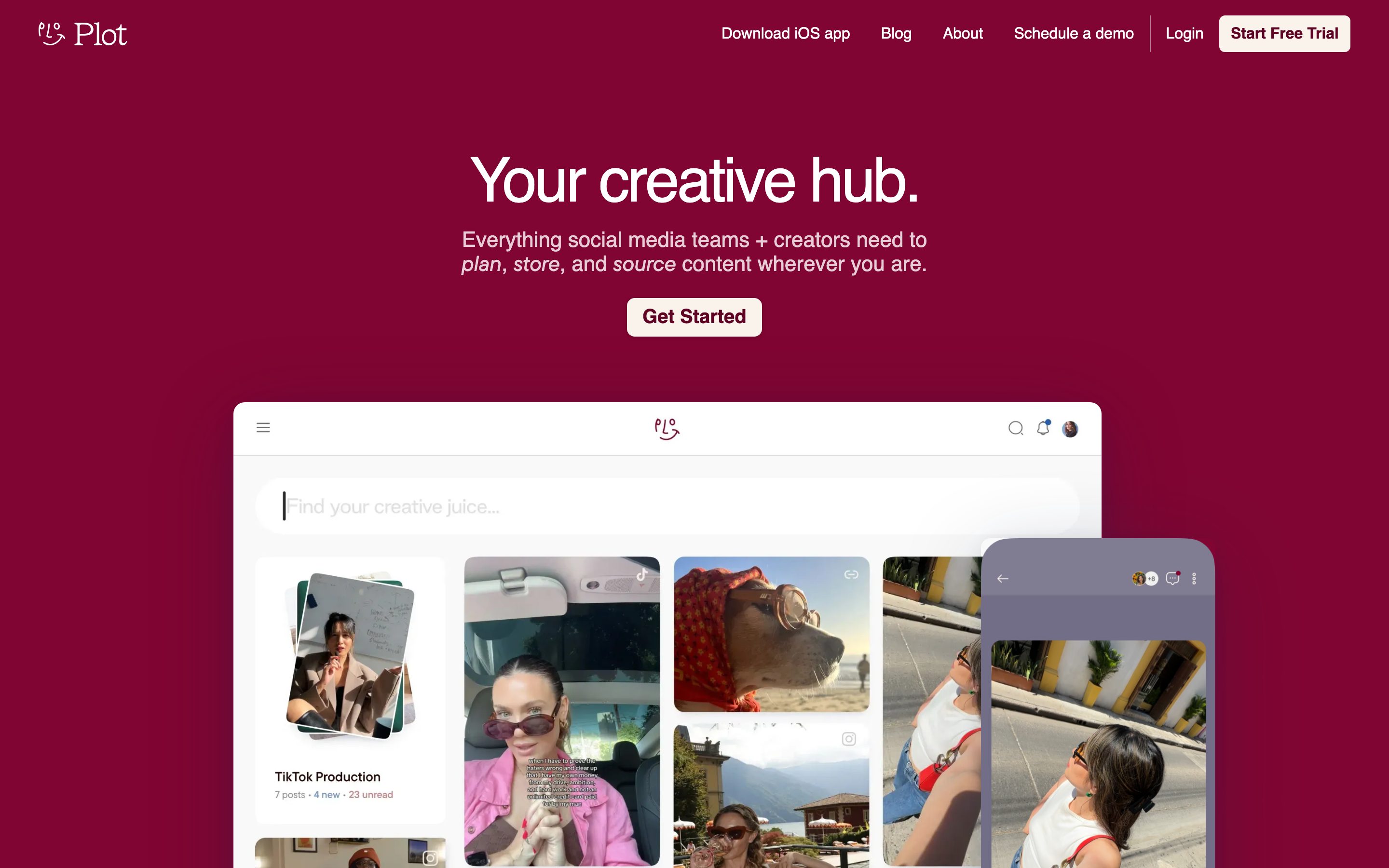
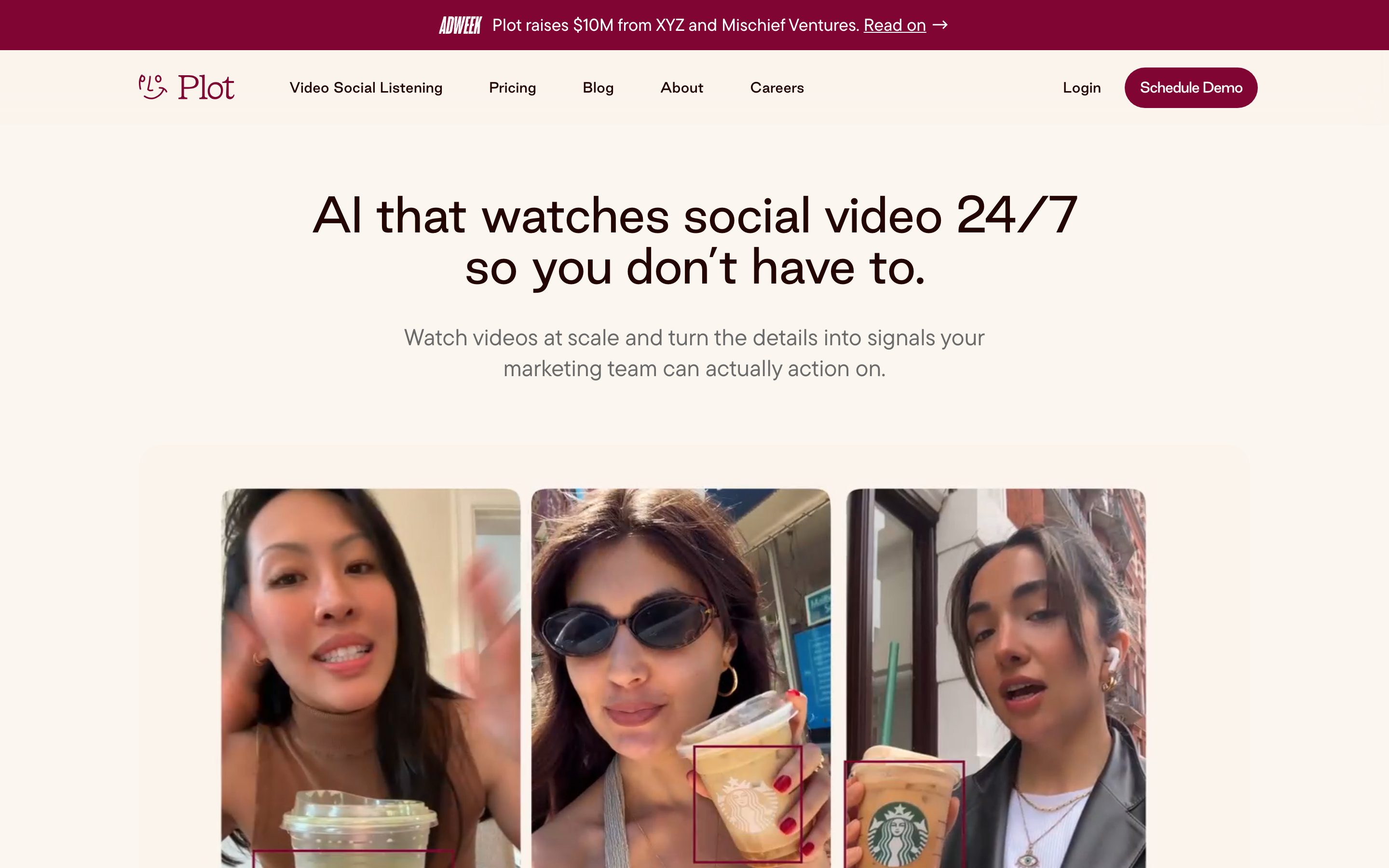
The company does not tell it as a turn. Duong said on a podcast in July 2025 that "we pivoted once", and gave no reason beyond the mission, which she says never changed: "how can I bring creativity back into the role that I really love?" Her post announcing Plot's debut in February 2025, the day after Adweek reported the $4.1M seed, begins the history elsewhere: "Plot started by rethinking social listening from the ground up." The funding post in June 2026 does the same – "We started with the hardest problem: the data itself was broken" – and describes eighteen months spent building the video layer.
Our account differs in one place. Duong's complaint about her old job had two halves, and she named both: the busywork, and time spent "proving value in my role instead of the work I love to do." The workspace answered the first, for one marketer at a time, at a seat price, against every other tool that saves a marketer time. Listening answered the second, and the proof went to the person who pays for social media, not to the one who does it. What Plot kept was not a better version of its first product; it was the part that showed a brand something it had no other way to see. And the first idea came back: the $10M is going into agents that take over the operational work – "agents doing the operational work so the humans can do the creative work" – now running on the video data rather than on a calendar.
Why it matters
Brands already paid for social listening. Sprinklr, Brandwatch and Meltwater track what is written – captions, hashtags, @-mentions – and Duong's own description of them is that they "require tagging, hashtags, or captions to surface a mention". Everything a creator shows or says without typing it, they miss, and the only way to find it was for someone on the team to scroll and watch. Duong remembers "so much time on manual reporting" in her own years doing the job; Plot's homepage promises "less doomscrolling".
Every figure showing that teams stopped doing it comes from Plot or from a customer quoted by Plot. Benefit Cosmetics' marketing head reports a 30 to 50% lift in videos featuring its products that do not tag it; CAVA's social director reports three times as much content as other tools found. Plot says about 80% of brand mentions in video carry no tag, and that brands find two to eight times more content than before. On the business side: ARR up 3.8 times year on year, 132% net revenue retention, and a customer list built "almost entirely" from inbound demand by a team of eleven or twelve. Plot publishes no revenue, no customer count and no retention by cohort, and its claim that no other tool does this is its own; we found no outside comparison with the text-based incumbents. The public record is four years and two seed rounds long.
The playbook
Monitoring tools that read only what people type miss whatever is shown or spoken, and models that watch video and hear audio can sell that gap to brands on annual contracts that spread team by team. Wherever incumbents track captions or tags while the substance sits in pictures, calls or footage, the gap is open. Plot puts its net revenue retention at 132%, with ARR up 3.8 times in a year. Once an incumbent adds the reading layer, it closes.
The lesson
Plot spent two years selling a faster way to do work its buyers already did, priced per seat against every other tool that promised the same. The feature that changed the company did not make anyone faster. It showed a brand videos of its own products that it had never known existed, and Plot put it only on the plan a company buys through sales. When that plan started to grow on its own, Plot dropped the plans beneath it – and is now rebuilding the time saving it began with as agents that run on what the listening sees.
The rule, stated for any trade: if what you sell makes familiar work faster, look for the one thing your product can show a customer that nothing else shows them, sell that alone, and let the faster work come back later as something that runs on it.
It has conditions. The thing seen has to be expensive to see – Plot says it spent eighteen months building the layer that reads video – or a rival adds it as a feature. And selling it moves the company from many small buyers to a few large ones, each won by a demo.
The check for a founder is one question. What does your product let a customer see that no other tool shows them, and would they pay for that alone if you took everything else away?
Where else it could work · our reasoning, not a finding
Construction site records
Apps that schedule crews and file site photos compete on convenience; the photos crews already take every day could show a developer progress and defects that nobody writes down.
Fleet dispatch
Dispatch software is a crowded way to save a planner time; the trips it already logs could show a fleet owner or its insurer how each driver actually drives.
Customer support desks
Help-desk tools are sold per agent seat to make answering faster; the calls and tickets they hold could show a product team which faults cause them, which that team cannot see today.
Track record
Plot · plot.so ↗
- Megan Duong and Ethan Phan, who met through Y Combinator's co-founder matching, start Plot ↗
- plot.so is a waitlist for "Plot Workspace for Creatives": "The simplest way to organize your creative workflow." ↗
- "Making content less chaotic": a place to source, store, collaborate on and organize content, still behind a waitlist ↗
- iOS app "Plot – your creative hub" released ↗
- "Your creative hub" with a free trial; "AI Video Social Listening" appears as a tile marked New! ↗
- Pricing: Starter $0, Basic from $9 and Business $21 per user a month; video social listening only on the Enterprise plan, through sales ↗
- Product Hunt launch, #4 of the day, still as the all-in-one platform to "plan, store, and source content" ↗
- Seed, $4.1M, from Seven Seven Six, XYZ and Sophia Amoruso's Trust Fund, reported by Adweek; no Form D found ↗
- Duong: growth of about 50% a month in the seven months since the listening launch, "100% inbound" ↗
- Campaign tracking launched ↗
- Seed, $10M, co-led by XYZ Venture Capital and Mischief Ventures with Seven Seven Six and Acme Capital; $14M raised in all; ARR up 3.8 times a year, net revenue retention 132% (company figures); no Form D found ↗
- Homepage now reads "AI that watches social video 24/7 so you don't have to"; pricing says only "Contact sales" ↗
- Creator Intelligence launched: AI agents that source and vet creators from what they show in their videos ↗
Raised in total: $14M