It sold governments the data from satellites it kept, even when a buyer wanted its own
HawkEye 360 kept its satellites and sold governments their data instead, reaching $117.7M revenue in 2025 before its IPO.
The product
HawkEye 360, of Herndon, Virginia, finds radio transmitters from orbit. Its satellites fly in formations of three, and when all three hear the same signal – a ship's radio, a radar, a jammer, a satellite phone – the company works out where it came from and what it is. It sells the result to governments: the U.S. National Reconnaissance Office, the National Geospatial-Intelligence Agency, the Space Force and allied ministries. It has more than 30 satellites in orbit and has traded on the NYSE as HAWK since May 2026.
It began in 2015 as a spin-out of Virginia Tech, built on signal-processing research by Charles Clancy and Bob McGwier, with Allied Minds as its first investor and John Serafini, an Allied Minds executive, as chief executive.
How it works
A customer usually starts with a discrete task: an area and the signals to collect there. The constellation collects, and the company delivers either the raw signal data or an answer – a dark vessel, the location of an air defence radar, the places where GPS is being jammed. Its satellites cover 30 MHz to 18 GHz and pass over any point on Earth in under 45 minutes, by the company's figures.
Customers who stay buy more. The bulk of revenue is from customers who pre-book collection capacity; others take a subscription to a busy area, such as vessels in the South China Sea; one partner has whole clusters reserved. The data is unclassified, so a customer can pass it to allies. Since December 2025 the company also owns ISA, a maker of signal-processing algorithms that run inside classified U.S. government systems.
Business model
Governments pay, mostly under fixed-price contracts. In 2025 revenue was $117.7 million, up from $30.5 million in 2022, with net income of $2.7 million. The National Reconnaissance Office alone paid 39%; the top three customers, 66%. U.S. customers made up 61%, customers in Japan 16%, and other countries 23%.
The price shape follows what is sold. A task is billed as a collection. A subscription is one collection the company tasks itself and sells "as a feed to multiple subscribed customers", which in its own words lets it offer "better customer pricing, and increase our margins". A dedicated cluster is sold as service levels, "ranging from fixed monitoring to reserved and on-demand tasking", while the company keeps "ownership and operational control of the sovereign asset". The constellation is bought ahead of the sales, with the company's own capital: "we commit capital and resources well in advance of user need and acquisition contracts".
The spike
For its first ten years HawkEye 360 told the public it served many kinds of buyer. Its earliest homepage, archived in January 2016, said it was "an allied minds company" and offered maritime tracking, emergency response and logistics monitoring; by October it added interference detection and spectrum mapping, "assisting wireless network users". Global Venturing's report of the $11 million Series A that November listed helping telecoms firms understand interference among its uses. In 2019 the homepage split its business into four tiles of equal size. Its $145 million Series D in 2021 was raised, by the release's own title, to "expand dominance of the commercial radio frequency GEOINT market", for customers "in the humanitarian, environmental, commercial and national security sectors"; Serafini called it "a unique dual-use technology".
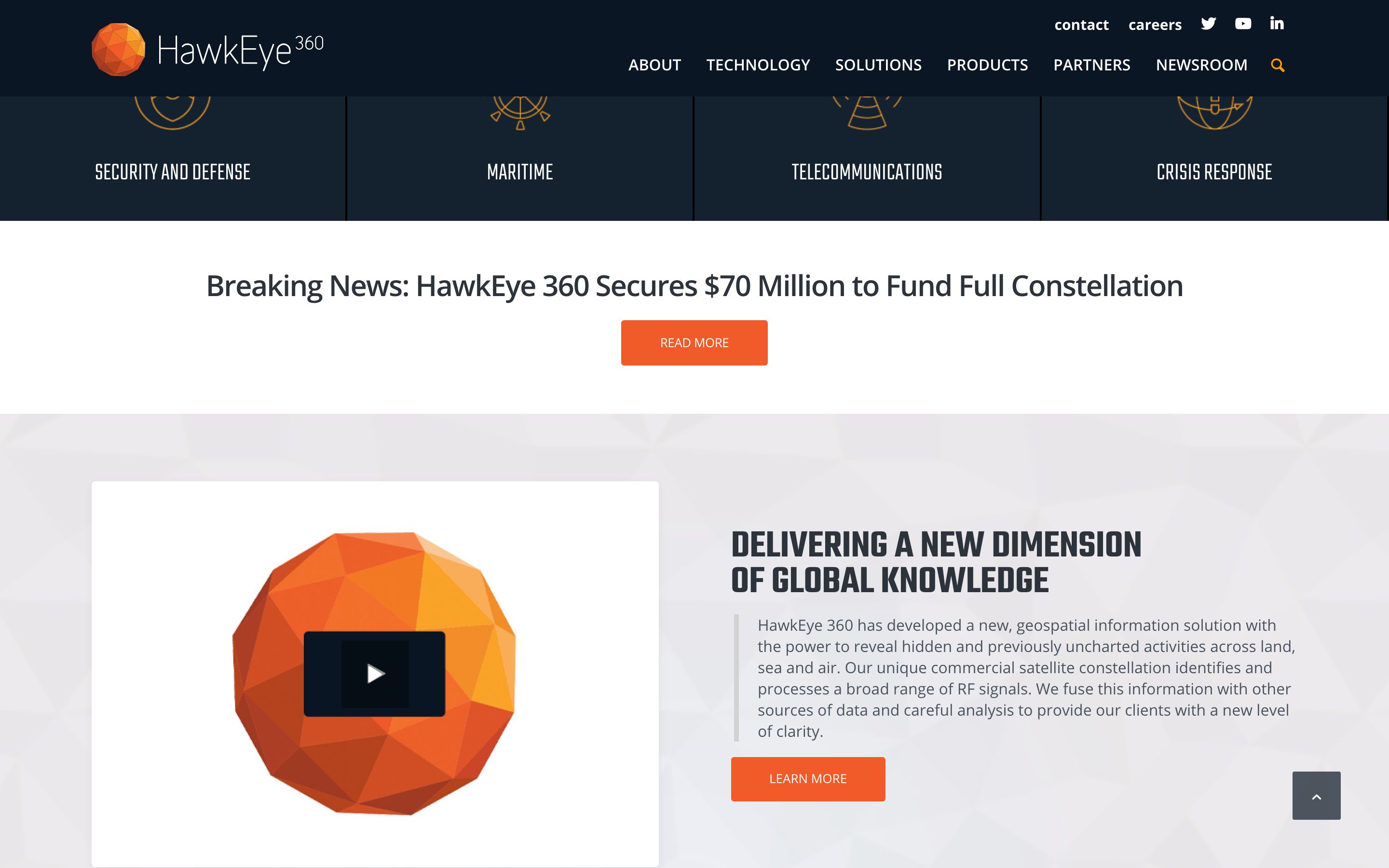
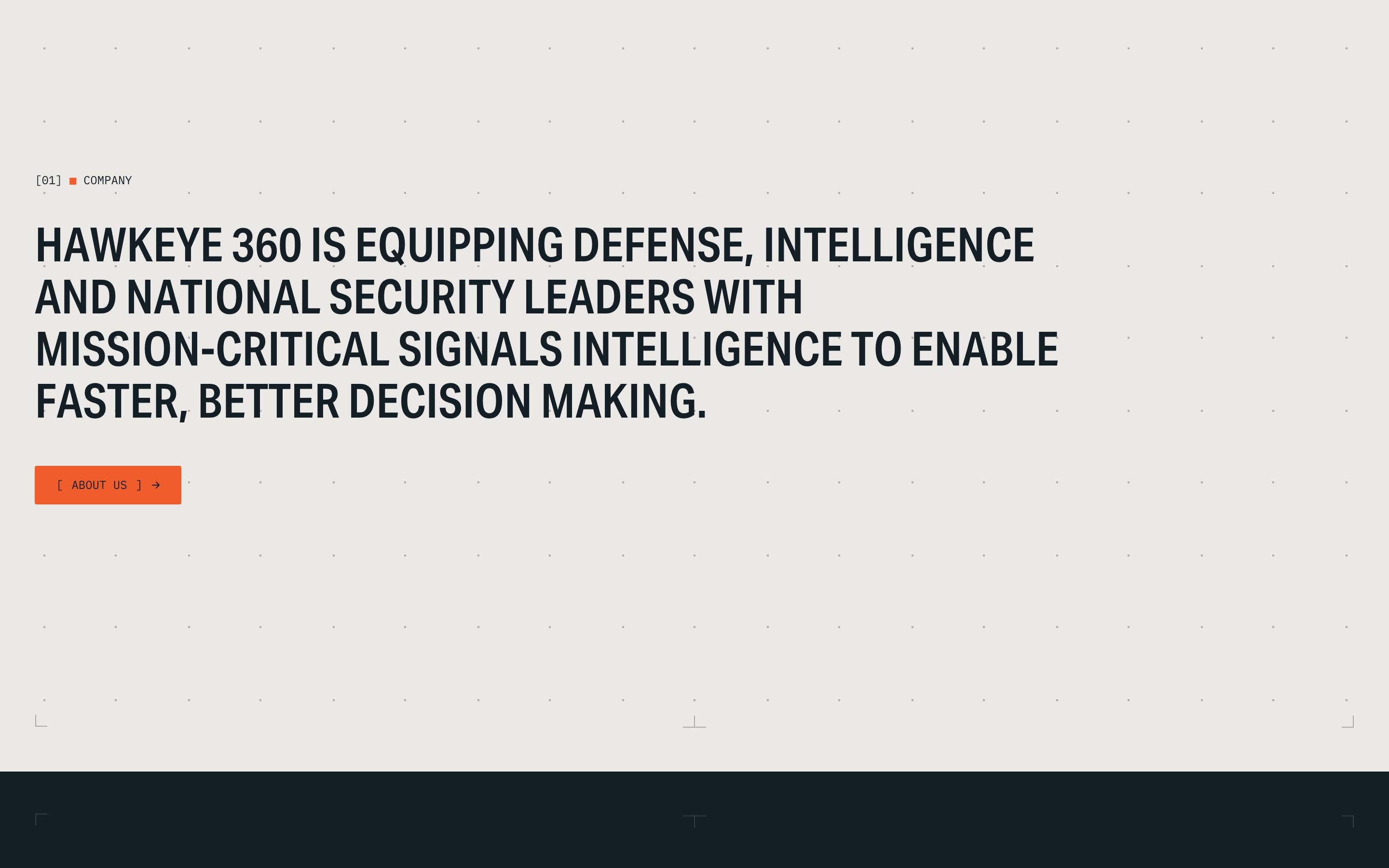
The wording changed in the autumn of 2025, ahead of the Series E in December and the IPO in May. The prospectus now calls commercial work "selective minor commercial applications", leaves commercial buyers out of its market estimate, and records a $0.4 million fall in commercial revenue in 2025.
HawkEye 360 tells it differently. It says it was "purpose built from inception to serve the U.S. Government and its allies" and has "specifically chosen to focus initially on government centric customers and missions". The record backs part of that: in 2018, before its first satellite flew, Serafini told Wired that "our strategy is focused primarily on the US government today", and the company already had ten government customers.
Our reading puts the turn less in who paid than in what HawkEye 360 kept for itself as the payers grew. It let go of the public promise to telecoms and first responders, whose business had stayed minor. What it kept was ownership of the satellites at every step. It sold collection by the task; then the same collection to several customers, "re-purposing of data collected for multiple customers"; then subscriptions to one feed. When customers asked for capacity of their own, it did not sell them satellites. The five-year contract of December 2025, worth more than $100 million, puts dedicated clusters in orbit for one partner while "enhancing overall capacity for HawkEye's global customers"; Cluster 16, launched on 23 October 2026, provides dedicated capacity for one customer under that model.
Why it matters
Before companies like this one, a government that wanted to find radio emitters from space had to own the means: signals intelligence "had historically been limited to state actors", in the prospectus's words, and collection systems bought as hardware were still 37% of the market in a study the company commissioned. The company sets its unclassified data, easier to share among allies, against "traditional government systems", and it names a second weakness of owning one: a country's own system "spends most of its time over other geographies", so "owning such a system is less appealing". The other cheap source, the position a ship broadcasts about itself, can be faked; in a test Wired described in 2018, HawkEye's receivers caught a transceiver faking its position.
What its buyers skip is owning the collector. Revenue grew from $30.5 million in 2022 to $117.7 million in 2025, and existing customers brought 90% of it in both 2024 and 2025. The National Reconnaissance Office went from 24% to 39% of revenue in a year. Abroad, international revenue rose 134% in the April–June quarter of 2026, contracts came from more than ten nations in the third, and Leonardo signed a memorandum to carry "exclusive reserved capacity" over defined European areas through Italian ground stations. All of it is bought as data or reserved capacity, none as a satellite handed over. These are company figures; the company publishes no measure of how often the same collection is sold twice.
The playbook
Owning the collector and selling each buyer its own region's share suits any field where governments or firms buy their own equipment and leave it idle most of the time: survey aircraft, weather radars, seabed sensors. The sign is a buyer who needs only its own patch, and data that can lawfully be shared. HawkEye 360's revenue rose from $30.5 million in 2022 to $117.7 million in 2025. What it costs is capital spent before the contracts, and one agency paying 39%.
The lesson
HawkEye 360 could have done what traditional defence suppliers did: build a collection system and sell it to a government. It kept the satellites instead, paid for them with investors' money – $302 million raised by 2021 – and sold what they gathered. Each buyer wanted only the passes over its own region, and shareable data let one collection be sold to several buyers. When a buyer asked for satellites of its own, the company launched dedicated clusters it owns, with spare capacity for everyone else.
The rule: when your buyers have always bought their own equipment but would use it only for their own patch or their own season, keep the equipment, sell each of them the output for their patch, and when one insists on its own, give it reserved capacity on machines you still own. Each buyer pays for its share of the working hours; the hours its own machine would have stood idle go to the next.
The price is a balance sheet and a concentration. Machines are bought before the contracts, and free cash flow was still negative in 2025; one agency paid 39% of revenue and three paid two-thirds, while the telecom and crisis uses on the 2019 homepage were set aside. The test: which of your buyers would leave the equipment they buy idle most of the time, and who else would pay for those idle hours?
Where else it could work · our reasoning, not a finding
Combine harvesting
A farm buys a combine that works a few weeks a year, and harvests ripen at different times from south to north; a contractor that owns the fleet and sells harvested hectares follows the season across farms, and gives a large estate reserved weeks on machines it still owns.
Aerial firefighting
Each region buys water bombers for a fire season of a few months, and the seasons fall at different times across regions and hemispheres; an operator that owns the aircraft and sells flying hours moves them between seasons, and a region that wants its own gets aircraft on standby that return to the pool when its season ends.
Diagnostic imaging for clinics
A clinic that buys its own scanner fills it a few hours a week; an operator that owns the scanners and sells scans by the slot keeps them full across many clinics, and a hospital group that wants guaranteed hours gets reserved time rather than a machine of its own.
Port dredging
A port that buys a dredger needs it for a few weeks between silting cycles; a contractor that owns the fleet sells dredged volume to many ports and gives a busy port reserved windows, so no single port carries a vessel that sits idle the rest of the year.
Track record
HawkEye 360 · he360.com ↗
- Earliest archived he360.com: “an allied minds company”, for maritime tracking, emergency response and logistics monitoring ↗
- Series A, $11M, led by Razor's Edge Ventures with Allied Minds and an unnamed defence company; John Serafini named chief executive (reported by Global Venturing) ↗
- Series A-3 closes at $14.9M: a $9.6M first tranche in August, then $5.3M led by Raytheon with Sumitomo Corporation of Americas (reported by Global Venturing) ↗
- Pathfinder, the first cluster of three satellites, launched on a SpaceX rideshare ↗
- Series B, $70M, with Airbus, Esri, Allied Minds, Razor's Edge and Shield Capital, to launch four more clusters (reported by Global Venturing) ↗
- Archived he360.com: four markets on the homepage – security and defense, maritime, telecommunications, crisis response ↗
- Series B extended to $85M with $15M from Advance, which had bought Allied Minds' 58% stake for $65.6M in a secondary sale (reported by Global Venturing) ↗
- Series C, $55M, led by NightDragon; over $155M raised in all ↗
- Series D, $145M, led by Insight Partners and Seraphim Space, “to expand dominance of the commercial radio frequency GEOINT market”; $302M raised to date ↗
- Series D second close: $5M from Leidos brings the round to $150M ↗
- Contract from the National Reconnaissance Office's Commercial Systems Program Office to provide commercial RF intelligence to U.S. government organisations ↗
- Series D-1, $58M, led by funds and accounts managed by BlackRock (reported by Intelligence Community News) ↗
- Series D-1 final close: $10M more, from Lockheed Martin Ventures and insiders, $68M in all (reported by Intelligence Community News) ↗
- Archived he360.com, last capture under “The Leader of Spectrum-Based RF Geoanalytics”: tools that help “first responders save lives” and “telecoms utilize spectrum” ↗
- Archived he360.com, first capture of the new site: “the future of signals intelligence is here”, missions include air defense radar monitoring ↗
- Five-year contract worth more than $100M with an unnamed international partner: guaranteed data access and dedicated satellite clusters, operational in early 2027 ↗
- Acquires Innovative Signal Analysis (ISA), with Series E equity and debt totalling $150M, co-led by NightDragon and Center15 Capital ↗
- Last Series E close: $98.8M of equity at $18.86 a share from December 2025, per the company's S-1; the $48.6M of loans taken alongside are debt ↗
- IPO on the NYSE as HAWK closes: 18.4M shares at $26 with the underwriters' option, $478.4M gross; valuation about $2.42B (reported by Tech Funding News) ↗
- Second quarter: revenue $49.8M, up 87%; international $21.0M, up 134%; 2026 outlook $215–220M ↗
- Memorandum with Leonardo: exclusive reserved RF capacity for defined European areas, delivered through Italian ground stations ↗
- $36M of new international contracts in the third quarter, across more than ten nations ↗
- Cluster 16 launched on Rocket Lab's Electron, three satellites providing dedicated capacity for one customer ↗