For eight years it licensed its memory into other companies' chips; now it sells the part itself
Dresden's FMC sold its memory as a licence into other companies' chips until 2024; pointed at AI servers, €77M followed.
The product
FMC makes memory that keeps what is in it when the power goes off and still runs at the speed of the memory bolted next to a processor. That is two families. DRAM+ is sold as persistent memory modules, meant to "combine speed of DRAM with data retention for AI training & low-power systems"; CACHE+ is a chiplet meant to "increase your inference performance with high density and persistent CACHE+". Both rest on one physical fact – that hafnium oxide, already the gate insulator in ordinary CMOS transistors, can be made ferroelectric – which is why the company can promise "seamless integration into existing factory processes".
It sits in Dresden, with centres in Italy and France and people in the US, Japan and Taiwan, and owns no factory. Nothing is on sale yet: in August 2026 FMC reported a feature in FOCUS saying its first wafers were in production and a market launch possible in 2027.
It began in 2016 as a spin-off from NaMLab, a TU Dresden laboratory, on an effect first noticed inside Qimonda – the German DRAM maker whose 2009 insolvency took Europe out of memory. That is a colder inheritance than Proxima Fusion's, where the institute that proved the physics is still standing and ended up a shareholder; the owner of the result FMC was built on had been wound up seven years before there was a company to build on it.
How it works
A visitor gets no price and nothing to download. The homepage offers a single action, "schedule a technology briefing", and the rest of the site explains the physics and lists where the memory is meant to go – AI and cloud compute, edge AI devices, high-availability systems, databases.
Whatever a customer eventually receives will have been made in other people's plants. FMC calls itself fabless: it "designs, develops, and markets its own products while outsourcing production to contract manufacturers", working "in collaboration with leading DRAM memory chip companies and advanced logic foundries in high-volume 300mm production fabs worldwide". Testing comes from Neumonda in Bad Homburg, whose Rhinoe, Octopus and Raptor platforms FMC uses on DRAM+. The CACHE+ chiplet is being built with CEA-Leti in Grenoble, inside FAMES, a pilot line of the European Chips Act – "we are working closely together as one team with Leti", says chief executive Thomas Rückes. In September 2026 EUCLYD of Eindhoven joined to supply the compute architecture that would sit around the memory.
Business model
There is no revenue yet and no price list to find. What FMC means to sell is its own parts and then the machines around them – "from our own chips to complete hardware and software solutions to integrated computing systems for AI data centres and edge applications" – and the November 2025 round was raised so the company could "establish revenue and corresponding P&L structures" and "build targeted business units". The buyers it names are the memory companies and foundries that would make the parts and the operators that would install them: "we are already in talks with European data centre operators and technology companies."
Until then the money has come from the state first and investors second. More than €4 million of government grants under EXIST Forschungstransfer before any round; €4.6 million of Series A from eCAPITAL and HTGF in July 2018; $20 million of Series B in November 2020, led by M Ventures and imec.xpand with SK hynix, Robert Bosch Venture Capital and TEL Venture Capital alongside; then €77 million of Series C equity in November 2025, with €23 million of public money from the IPCEI ME/CT programme and the European Innovation Council announced beside it as €100 million in all.
One rented step it would like to own. In July 2025 FMC announced plans for a memory chip factory at Sülzetal near Magdeburg, on the high-tech park beside the site Intel abandoned; its summary of the FOCUS feature puts construction at about three billion euros and roughly 1,000 jobs. heise reported in January 2026 that the plan was still alive and still contingent on financing.
The spike
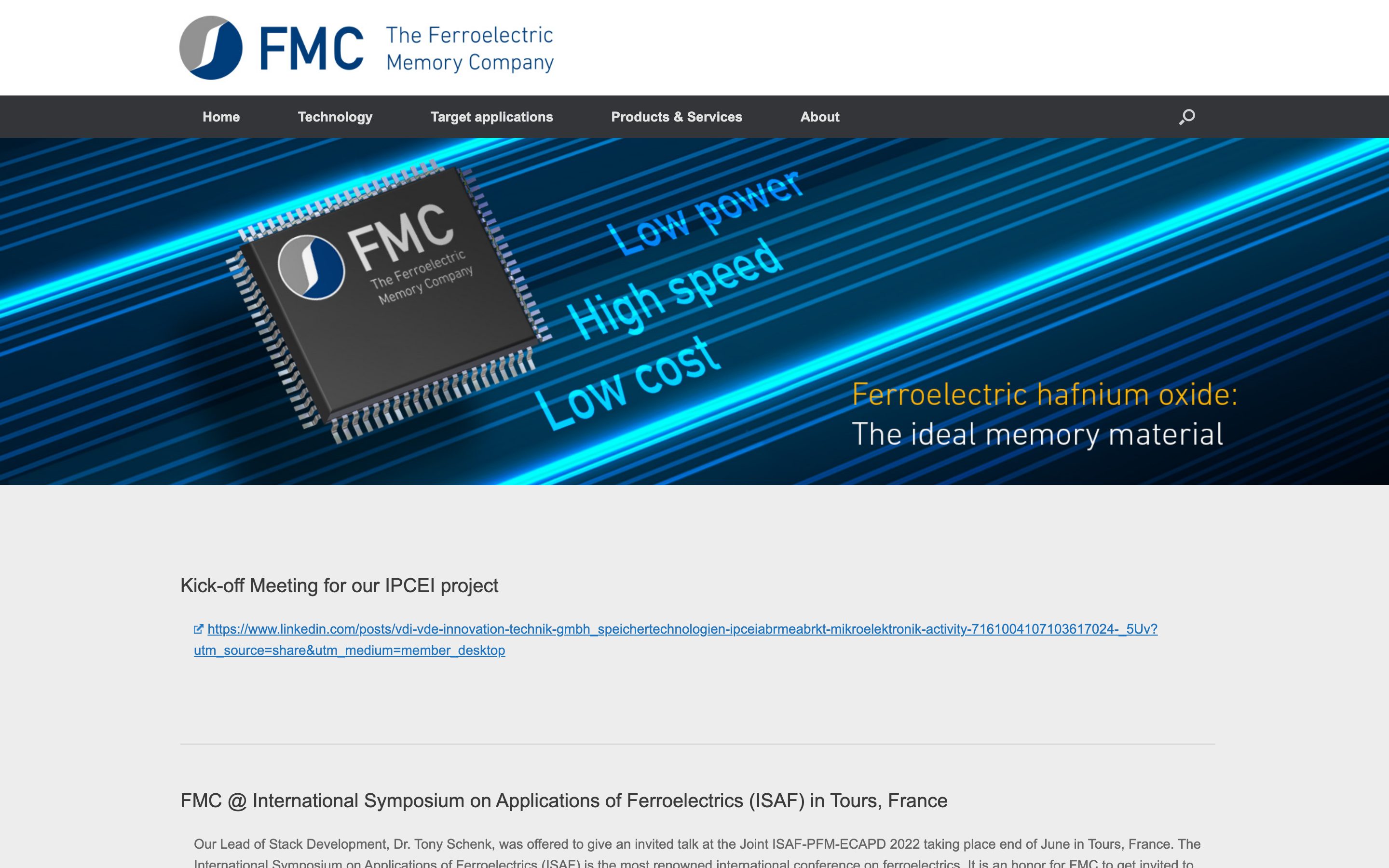
On 2 April 2024 the homepage still read "Ferroelectric hafnium oxide: The ideal memory material", and Target applications and Products & Services were still in the menu. The three pages behind Products & Services said what the company was. Manufacturing support offered chipmakers help getting the material into their lines. IC design products offered "embedded non-volatile memory hard macro products to fabless IC design companies and IDMs". Licensing set the terms: "FMC offers both manufacturing and design licenses to manufacturers, fabless design companies and IDMs. FMC offers access to these licenses based on upfront payments and royalty fees." Target applications listed Internet-of-Things, Consumer Electronics, Ultra-Low Power, Medical, Aerospace, Automotive, Security. Four years earlier, writing up a Saxony-funded project with NaMLab and Fraunhofer, the company had put a size on that ambition: embedded non-volatile memory for 28nm nodes, for microcontrollers at "market volume $25 billion" and systems-on-a-chip at "another $25 billion".
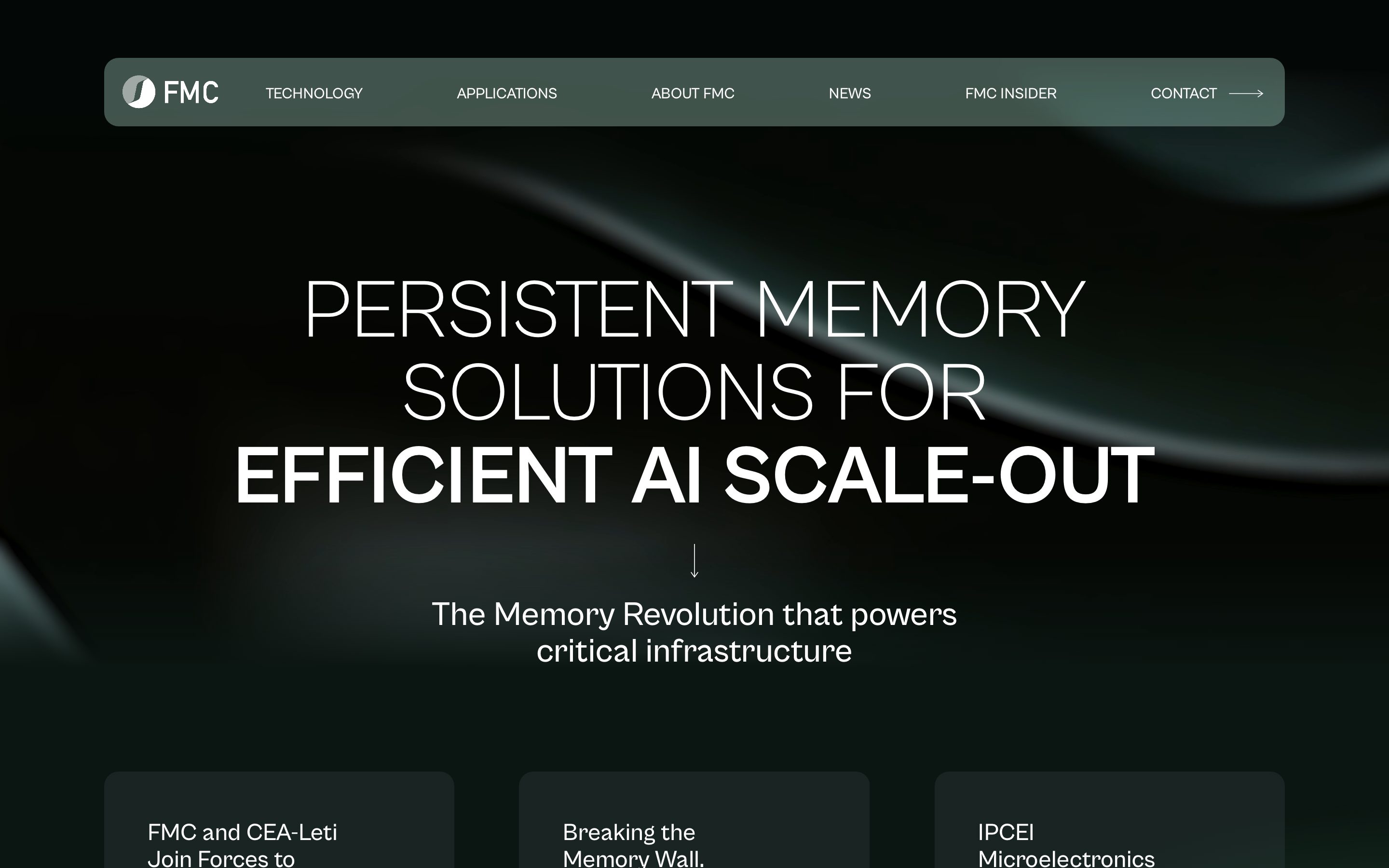
The first public sign that this was ending is not an announcement but a job. By October 2022 FMC was advertising for a "FeRAM / DRAM Design Engineer" in Milan or Dresden, wanting ten years of DRAM design, and describing itself as working on memory "for stand-alone and embedded applications". The name DRAM+ reached the trade press on 3 April 2025, in a joint release with Neumonda about bringing DRAM design and manufacture back to Germany. The site changed last: the new headline, "Persistent Memory Solutions for Efficient AI Scale-out", is in the archive from September 2025, with Products & Services gone from the menu.
Rückes was not there at the founding; he joined, he says, "with the clear mandate to transform the developed technology into marketable products and build FMC as a global semiconductor company", into a company "strongly influenced by a research mentality in its early stages". He tells the change as a lesson rather than a decision. "Just because a device works well technically, it does not mean that it will automatically result in an attractive product that customers are willing to pay for. On this basis, the technology development approaches were adapted and steered towards much clearer, market-relevant technology tracks." He does not find it remarkable: "Such pivots are almost the norm for hard tech and emerging memory companies."
Set the two versions of the site side by side and the change looks narrower than finding a better market, and harder. The physics did not move – the same ferroelectric hafnium oxide, the same claim that it drops into a CMOS line somebody has already built. What moved was the level of the machine FMC offered to sit at, and with it what sort of business it was. Embedded memory came with an opening already cut: a chip designer licences a macro, and FMC takes a fee and a percentage of a product somebody else decides whether to ship. Main memory and cache in an AI server have no opening; the machine is built around the part or the part is not used. That is the position the company is selling into now, and the distance between the two is the distance between a royalty on microcontrollers and the "€100+ billion memory chip market" it now names.
Why it matters
The alternative is the machine everybody already has, and it works. DRAM beside the processor is fast and forgets everything; NAND behind it remembers, costs far less and is much slower. What the split leaves to the user is the carrying. "Every time data is moved between chips, compute, memory and storage, the available bandwidth decreases, latency increases and energy consumption rises," Rückes says, and inside a data centre nothing ever stops moving. FMC's claim is that making the fast tier persistent deletes the trips – "eliminating time-consuming data transfers between volatile, fast, and slower non-volatile storage" – and with them buys "more than 100% higher system efficiency and processing speed than established products". Blocks & Files reports the company's CACHE+ figures as ten times the density of SRAM at a tenth of the standby power.
Somebody has already tried this slot and lost it. Intel built Optane for exactly this gap and shut the business down. Covering the round, Blocks & Files put the obstacle where it belongs – server manufacturers, operating-system suppliers, GPU makers and HBM producers would all have to redesign around the part – and did not expect an answer before about 2030.
So there is no number showing anyone stopped carrying data, because nothing has shipped: no product on sale, no customer count. What can be checked is who has paid. SK hynix, which manufactures memory, and TEL, which makes the equipment memory is manufactured on, have been shareholders since 2020. The Series C was oversubscribed and led by HV Capital and the DeepTech & Climate Fonds, whose investment director has since joined FMC as Chief Strategy Officer. eCAPITAL, which led the first round, says pilot results "confirm design wins with leading OEMs" – an investor's account of a company it is in. And the hole FMC is aiming at is as much political as technical: Europe, on FMC's own figures, consumes roughly a quarter of the world's memory and produces none of it. That is the hole the 2009 collapse left, and nobody has filled it since.
The lesson
What FMC owned in 2016 and what it owns now are the same cell. For eight years it was offered where it fitted: an embedded memory block a chip designer could licence into a system-on-chip, on upfront payments and royalties. An opening was already cut there, with a purchasing category around it – and fitting an opening means being paid a percentage of decisions other people make about products you do not control.
Main memory in an AI server has no opening. A part that remembers, in the place of one that forgets, forces the server, the operating system and the processor suppliers to move too – which is what beat Intel in the same slot. It is also where the buyer's electricity bill already is.
Where you fit the one good thing you own decides what kind of company you are. Into the opening that exists, and you collect a percentage of somebody else's product. Against the cost your buyer already pays to work around, where nothing is ready to receive it, and you have something of your own to sell. The second costs years – eight here – and, in Rückes' words, "significantly more capital"; FMC changed chief executive on the way and still has nothing on sale.
One question to take away: what are your customers already paying to work around, and is the thing you make fitted there, or where it slotted in most easily?
Where else it could work · our reasoning, not a finding
Ore sorting underground
Sensor makers sell sorters into the concentrator, where a sorting stage and a budget line already exist; what the mine actually pays for is hoisting waste rock to the surface, and at the face there is no stage to plug into.
Sample handling in clinical laboratories
Automation is sold into the analyser because the instrument bay and the purchasing category are there; the overtime is paid in receiving, labelling and sorting, a step with no platform to join.
Brine from industrial water treatment
Membrane suppliers sell into the polishing stage every works already has, while the number on the plant manager's report is the cost of trucking concentrate away – and treating that stream means rebuilding the back end.
Trackside inspection on railways
Condition monitoring is sold to depots, which already buy maintenance equipment; what an operator loses money on is the line closed for manual inspection, and putting the same sensors on the track needs an approval route nobody has written.
Track record
FMC · ferroelectric-memory.com ↗
- Ferroelectric switching found in doped hafnium oxide at Qimonda in Dresden, by researchers working on DRAM capacitor dielectrics; after Qimonda's insolvency in 2009 the work continues at NaMLab and Fraunhofer IPMS-CNT ↗
- FMC, a spin-off from NaMLab at TU Dresden, shows a 64kbit FeFET array for embedded non-volatile memory and aims it at GlobalFoundries' 22FDX; more than €4M of government grants received, about €2M of Series A being sought ↗
- Series A, €4.6M, from eCAPITAL and HTGF – HTGF was the first institutional investor and helped negotiate the IP agreement with the university ↗
- In a Saxony-funded project with NaMLab and Fraunhofer, FMC states the market it is aiming at: embedded non-volatile memory for 28nm nodes, for microcontrollers (“market volume $25 billion”) and systems-on-a-chip (“another $25 billion”) ↗
- Series B, $20M, led by M Ventures and imec.xpand, with SK hynix, Robert Bosch Venture Capital, TEL Venture Capital and eCAPITAL ↗
- Earliest public sign of the turn: a job advertisement for a “FeRAM / DRAM Design Engineer” in Milan or Dresden, describing FMC as working on memory “for stand-alone and embedded applications” ↗
- Homepage: “Ferroelectric hafnium oxide: The ideal memory material”, with Target applications and Products & Services – manufacturing support, IC design products and licensing “based on upfront payments and royalty fees” – still in the menu ↗
- First announcement carrying the DRAM+ name: Neumonda and FMC agree to design, test and market non-volatile DRAM+ (both companies' copies of the release misdate the dateline to 2024) ↗
- CACHE+ chiplet being developed with CEA-Leti inside FAMES, a pilot line of the European Chips Act; recorded at Leti Innovation Days in Grenoble ↗
- Plans a memory chip factory at Sülzetal near Magdeburg, subject to financing and regulatory approval ↗
- Homepage: “Persistent Memory Solutions for Efficient AI Scale-out”, over “The Memory Revolution that powers critical infrastructure”; Products & Services has gone from the menu ↗
- Series C equity, €77M, oversubscribed, led by HV Capital and the DeepTech & Climate Fonds with Vsquared Ventures; returning investors eCAPITAL, Bosch Ventures, Air Liquide Venture Capital, M Ventures and Verve Ventures ↗
- A further €23M of public money from the IPCEI ME/CT programme and the European Innovation Council, announced together with the equity as €100M ↗
- Rückes on the years before: “Just because a device works well technically, it does not mean that it will automatically result in an attractive product that customers are willing to pay for” ↗
- heise reports the Magdeburg plant still planned and still contingent on financing, beside Intel's abandoned Eulenberg site ↗
- Advisory board takes on Reinhard Ploss, former CEO of Infineon, and Rutger Wijburg ↗
- FOCUS feature “Preis der Freiheit”, as FMC summarises it: first wafers in production, a possible market launch in 2027, and a Magdeburg plant costed at about three billion euros and around 1,000 jobs ↗
- Torsten Löffler, the DTCF investment director who led the Series C, joins as Chief Strategy Officer ↗
- Collaboration with EUCLYD of Eindhoven, whose Craftwerk architecture is meant to stand in for GPUs, announced at the AI Infra Summit ↗