Launched against the chip buildout, funded nine months later for making the chips work harder
Launched as a data-efficiency lab with $180M; nine months later raised $1B pitching software that gets more from GPUs.
The product
Flapping Airplanes is an AI research lab in San Francisco, about a year old and a couple dozen people strong, and it has nothing on sale. What it says it is building is two things at once: new ways to train models, and the software those models run on inside a GPU. The second is the one it now puts first. Its site describes "the world's most complete megakernel framework": a kernel is a program that runs on the chip, and a megakernel packs a whole job, or several jobs, into one of them, so the chip spends less time waiting between steps.
How it works
There is no customer to follow through the product yet, so the honest order is the one an outsider meets. The usual way of running a model on a GPU breaks it into dozens or hundreds of separate kernels, each with a start and an end in which nothing useful happens; Nvidia's own tools only partly close those gaps. Ben Spector, the chief executive, spent his Stanford PhD in Chris Ré's lab removing them. In May 2025 his group fused an entire Llama-1B forward pass into one kernel; in September it published a version that overlaps compute, memory and communication on Llama-70B.
The company's framework is the next step, by its own description: it "can already perform entire training runs, serve inference, play video games, and even do all three simultaneously in a single kernel", and it lets the team try "weird architectures, weird optimizers" on top. None of this has been released or measured in public since the company was founded. The claims are the founders'.
Business model
For now the model is investors. The $180 million seed, first sold on 16 January 2026 and filed with the SEC as $180.2 million from 79 investors, came with a promise not to sell anything. The launch page said so in as many words, and in February Asher Spector told TechCrunch he could not give a timeline, because "if we start by signing big enterprise contracts, we're going to get distracted."
By October the money had grown and the promise had softened. The $1 billion Series A, co-led by Index and Lux, came with Nvidia among the company's backers, and Bloomberg reported a $6 billion valuation, four times the seed's. Asher Spector told Bloomberg the lab plans to sell its technology eventually, to make AI cheaper for other companies to use, and the site now speaks of "improving unit economics for whole industries". No price, product or customer has been named. Whoever eventually pays would be paying for more work out of chips they have already bought.
The spike
Flapping Airplanes went public on 28 January 2026 as the lab that would not need the internet. "We imagine a world where models can think at the level of humans without ingesting half the internet," the homepage said, estimating that people are 100,000 to 1,000,000 times more sample-efficient than current models. It called itself "a frontier data efficiency lab", "not focused on one specific technical idea", and "not currently trying to commercialize". David Cahn of Sequoia put the bet more sharply in his post that day: "Data is the bottleneck today to further AI scaling, not compute." The page did not mention GPUs once.

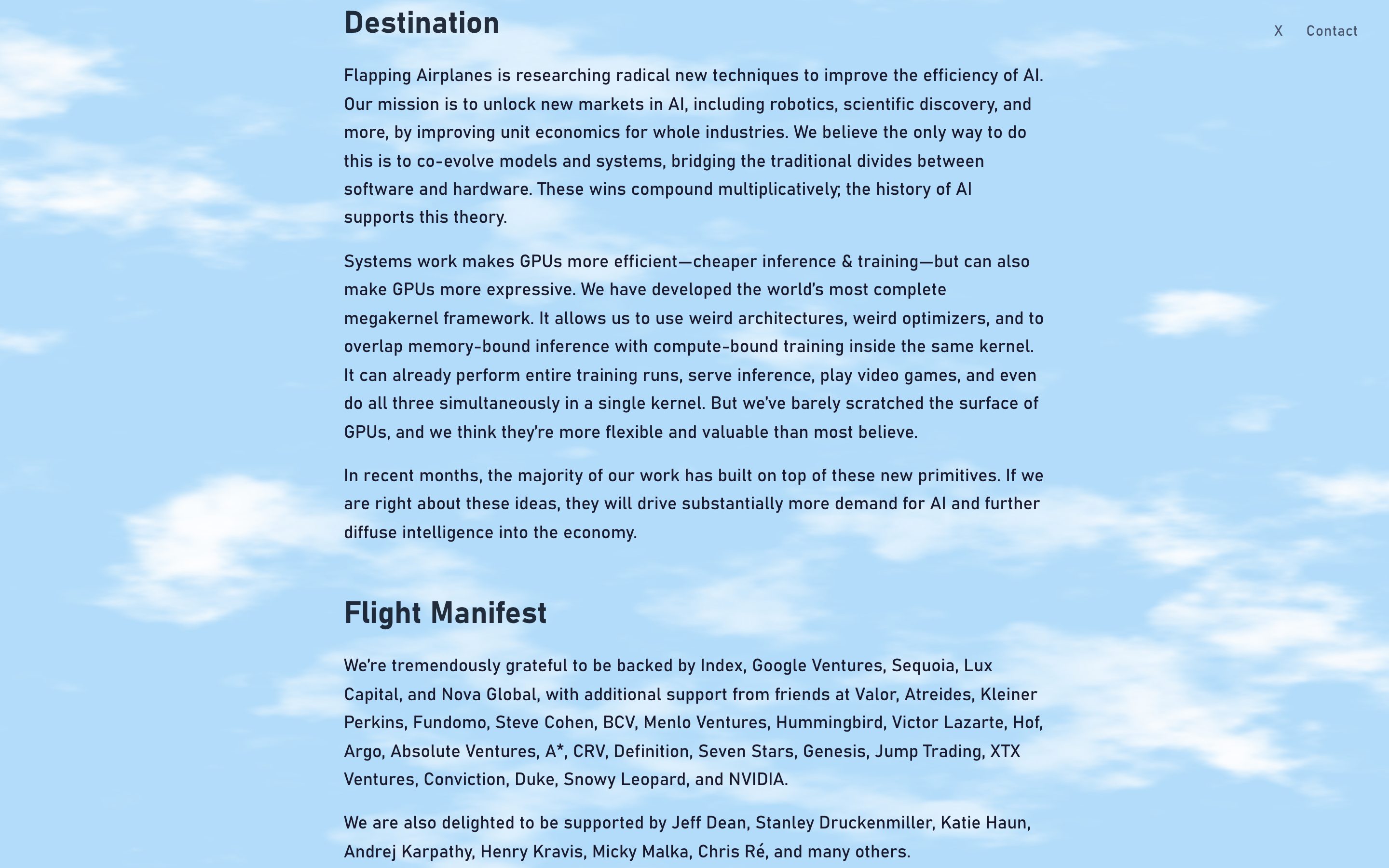
Nine months later the round was announced in other terms. "We've spent the past year developing new primitives for GPUs," the company posted on 21 October, and "We believe this enables new algorithms to change how machines learn, open new markets, and dramatically reshape AI's cost structure." The new homepage opens on "Demand for AI will increase exponentially, outpacing supply of data and compute", says the lab's work now mostly builds on its megakernels, and has dropped "stealth", "data efficiency lab" and the line about not commercialising. Asher Spector gave Bloomberg the thesis in one sentence – "demand for AI is going to outpace chip and data supply" – and added that 10% more performance from each chip would be "tremendously economically valuable". Index, leading again, wrote that it had watched the founders "steer Flappy in directions none of us could have predicted".
Nothing was abandoned in so many words. Training on far less data is still the mission in TechCrunch's account of the round, and the company has never called October a turn. What it kept from before the company existed is the craft Ben Spector had already published at Stanford, which the launch page left out. What moved is the pitch: in January the lab stood apart from the money pouring into chips; in October it stood on top of it. That change of side is, in our view, the decision that mattered. The founders themselves said in February that they "changed our ideas" during the first fundraise, including on "what the right timelines were for commercialization"; they have not said why the GPUs came forward, and this story does not supply a reason for them.
Why it matters
The alternatives to a lab like this are the ones the industry already buys. The first is more chips: Gartner expects $2.67 trillion of AI spending in 2026, $1.48 trillion of it on infrastructure and about 1% on the models themselves. The second is the standard software stack, which leaves the chip idle between steps and patches the gaps only in part. Both leave the buyer paying for hardware that does less than it could.
The evidence that the gap is real predates the company. Ben Spector's Stanford megakernel used 78% of an H100's memory bandwidth and ran Llama-1B more than 1.5 times faster than existing systems; the Llama-70B version beat SGLang's throughput by more than 22%. Those are a university lab's published results, not Flapping Airplanes' – the company has released no numbers, no code and no product, and no usage exists to measure. What someone outside has committed is money: $1 billion, at a valuation Bloomberg puts at four times the January one, with Nvidia, whose chips the software runs on, now listed among the backers. Index's own account of why is that megakernels make "today's chips" "more flexible and more valuable, which benefits the entire ecosystem, from the companies making them to the ones building on them." A lab that promised to need less of the expensive input is now valued as one that makes the input everyone already bought worth more.
The lesson
In January Flapping Airplanes argued against where the money in its industry was going: data, its backers said, not compute, was what held AI back, and the lab was not trying to sell anything. By October it described the same research as a way to get more out of the GPUs everyone was buying, wrote of improving unit economics, said it would eventually sell, and counted the chips' own maker among its investors. The founders' skill had not changed; the version of it the company led with had, and with it who could back it and who could one day pay.
Stripped of chips and data, this is a decision about where to stand when an industry spends heavily. When an industry is pouring money into one costly thing, an idea that proves the thing unnecessary has the spenders and the sellers against it. The same idea, told as what makes that thing earn more, has both of them as backers and gives every buyer a reason to pay out of what they already own. The cost is time: a claim about doing more with the same equipment can be checked by anyone who owns some, so the proof comes due years before a long research bet would, and its fortunes are tied to the wave's. Where is your market spending the most this year, and does your work make that spending pay better or make it look wasted?
Where else it could work · our reasoning, not a finding
Hospital scanners
Hospitals are buying scanners with waiting lists in front of them; more scans a day from a machine already installed is paid for by the hospital that owns it and suits the maker that sold it.
Airline maintenance
Airlines wait years for new aircraft they have already ordered; shorter hangar visits add flying hours to a fleet already paid for, and the manufacturer loses nothing by backing it.
Container shipping
Carriers have just paid for large new fleets; filling each voyage fuller is earned in the owner's freight revenue, not argued against the shipyards' order books.
Track record
Flapping Airplanes · flappingairplanes.com ↗
- Ben Spector, then a Stanford PhD student in Chris Ré's lab, co-authors ThunderKittens, a language for fast GPU kernels ↗
- Flapping Airplanes, Inc. incorporated in Delaware ↗
- Same lab: a whole Llama-1B forward pass fused into one "megakernel", over 1.5x faster than existing systems on an H100 ↗
- Same lab: a throughput megakernel for Llama-70B, more than 22% ahead of SGLang, released as research code ↗
- First sale in the seed round ↗
- Launch: $180M seed from GV, Sequoia and Index; the homepage calls it "a frontier data efficiency lab" that is "not currently trying to commercialize" ↗
- Founders tell TechCrunch they changed their ideas during the fundraise, including on timelines for commercialisation ↗
- Form D for the seed: $180.2M sold to 79 investors ↗
- Reported: talks to raise at a $5B valuation, Index and Lux leading (Forbes) ↗
- Homepage still the January text: data efficiency, no GPUs ↗
- $1B Series A co-led by Index and Lux, announced as the result of "new primitives for GPUs"; Bloomberg reports a $6B valuation ↗
- Index's post on the round leads with megakernels; partner Mark Xu joins the board ↗