Monthly Brief · 31 August 2026 – 4 October 2026
September 2026
Executive Summary
Across AI, leadership and sustainability, advantage comes from turning investment into changes that work in operations, rather than treating deployment or ambition as outcomes. That depends on capability, governance and infrastructure, while returns remain uncertain and energy access is tightening. It also depends on whether employees can use the change with trust and whether customers see practical value. Leaders therefore need to sequence adoption around evidence of value, workforce readiness and delivery constraints.
AI’s operational test is whether activity becomes usable output: coding gains can stall at review, integration, release and user discovery. BCG argues that firms should choose whether to adopt, partner, build or buy according to how widely available a capability is and how much it differentiates the business. Scaling also requires data and cyber controls, workforce capability and infrastructure; compliance priorities and infrastructure talent shortages make these operating prerequisites. Compute expansion faces power, equipment, labour and permitting limits, so firms need to plan with shared infrastructure rather than assume capacity will arrive. EY finds that productivity gains may support growth or be absorbed by complexity and risk, making visibility of costs and returns important.
Even when systems can scale, adoption depends on how work changes: trust can be low among Gen Z employees, and AI may reduce agency, skill use and meaning without eliminating jobs. Falling entry-level hiring alongside rising demand for AI skills could weaken future talent development and adoption. Formal operating routines can connect company priorities to individual responsibilities and sustain capability, but they take effort and can contribute to turnover. Boards need to challenge management without taking over, while clear explanations and employee involvement can make change more credible. Sustainability choices can appeal through benefits such as health and affordability, yet energy access and grid readiness can constrain the infrastructure needed for growth.
On the radar
Beyond these core questions, adaptability is becoming a continuing management capability, but repeated change can exhaust employees and workload mismatch can harm wellbeing. Supply-chain moves need to be tested for whether they genuinely reduce exposure: firms responding to US tariffs often remained reliant on Chinese inputs, and effects vary by sector. This reinforces the case for choosing markets where capabilities can support a strong position and weighing the cost of early entry against the option to learn. Hiring, pay and investment plans also need to be tested against varied economic signals and changing requirements for remote roles.
Commercial growth is not simply a matter of reaching more buyers: customer journeys shift across channels, and personalisation can exploit gaps in customer attention. Deal activity may recover unevenly, and a stronger market does not make entry prices attractive. Private-credit manager performance varies, while semi-liquid funds may face pressure when investors seek withdrawals. Infrastructure and telecoms expansion must also pass tests of delivery and financing, with value judged beyond operational efficiency. These pressures make trust, price discipline and financial flexibility important conditions for selective growth.
Where attention went
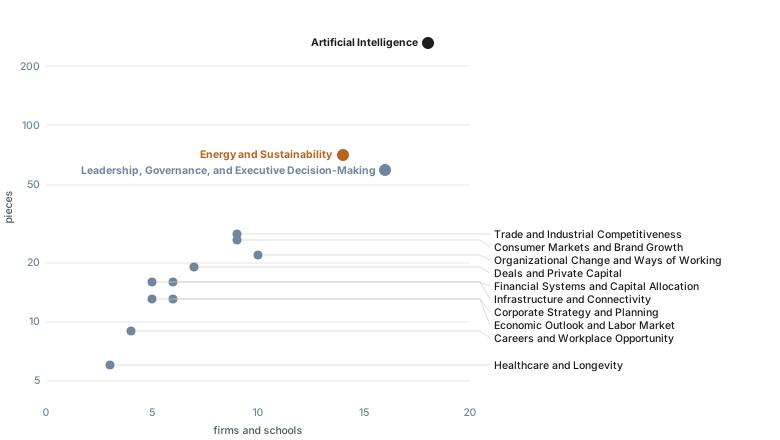
Each main theme of the month: how many firms and schools wrote on it (across) and how many pieces they published (up, log scale). Our count.
Opinions
Leaders’ views converge on a practical test for AI: technology must work for people and produce value that justifies its cost. But enthusiasm alone is not enough; poorly coordinated agents and spending without valuable outcomes can weaken the case for adoption. Senior managers should connect sponsorship to clear outcomes, end-to-end coordination and attention to how people experience change.
AI has to happen with people, not to people.
Denis Machuel
CEO, The Adecco Group1
If the CEO is enthusiastic about AI, after a while, people will start to figure out whether they’re enthusiastic, too.
Bob Bradway
CEO, Amgen1
You can spend a lot of money on agentic AI without achieving real, valuable outcomes.
Sameer Shetty
group head, digital business and transformation and strategic programs, Axis Bank2
The challenge is coordination–moving from one use case to multiple orchestrated agents requires an end-to-end view.
Alessio Marras
cofounder and head of organization, AideXa2
The pace of adoption will depend not only on what the technology can do, but whether the value created by each token exceeds its cost.
Gregory Daco
EY-Parthenon Chief Economist, EY-Parthenon3
AI value depends on redesigning work, not simply deploying more capable tools
Artificial Intelligence
Who wrote: BCG, Bain, Cambridge Judge, Chicago Booth Review, Deloitte, EY, HBS Working Knowledge, IESE, IMD, INSEAD, KPMG, Kellogg Insight, LSE Business Review, MIT Sloan, McKinsey, Roland Berger, Stanford GSB, Wharton; journals: California Management Review, Harvard Business Review, MIT Sloan Management Review.
Headliner: McKinsey, “Revolutionizing semiconductor fab operations with AI”, 31 August 2026.4
AI is moving into operating choices, from software production to decisions about acquiring, partnering for or building capabilities.5,6 Companies are also changing who they hire and how employees encounter AI: demand for AI skills is rising even as entry-level postings fall.7 Bain also reports low trust in AI-assisted work among Gen Z employees.1
These choices matter because more generated output does not automatically become more released or used software.5 AI can also change the quality and meaning of work without eliminating roles.8 Companies must weigh operational gains against the effects of AI on employees and the capabilities they will need.1,7,8
What turns AI output into business value?
AI can raise coding activity without increasing software delivery at the same pace: reviewing, integrating and distributing code remain constraints, and attracting users is a separate hurdle.5 Generated output is therefore not equivalent to released or adopted products.5 The bottleneck shifts from producing code towards human validation, integration and product discovery.5
Why do employees shape adoption?
Employees may resist when AI is associated with job loss or weakens autonomy, skill use, feedback and social connection; Bain reports low Gen Z trust and an expectation of job reduction, while IESE says work can lose meaning even when jobs remain.1,8 Adoption is not just a technical rollout: employees need to experience benefits in their work and retain a sense of agency.1,8 Tool availability alone does not ensure sustained use.1,8
How should firms obtain AI capabilities?
BCG argues that leaders should choose the lightest route—adopt, partner, build or buy—based on whether a capability is widely available or differentiating.6 As AI tools spread, proprietary data, workflows and expertise are more likely to distinguish non-AI firms than ownership of the underlying technology.6 Buying can attract favourable investor response, but it raises delivery expectations, so companies should reserve ownership for capabilities that protect a real advantage.6
Perspectives
- Delivery bottlenecks. Wharton finds that AI coding gains are held back by review, integration, release and user-discovery work; more code does not by itself mean more software in use.5
- Trust and work meaning. Bain links adoption to employee trust and experience, while IESE warns that AI can erode meaningful work if it reduces agency, skill use or connection.1,8
- Entry-level pipeline risk. KPMG argues that cutting entry-level hiring while competing for scarce AI-skilled managers could weaken both future talent development and adoption by younger workers.7
- AI can enable candour. MIT Sloan finds that people may prefer AI advisers when they need to disclose embarrassing information, even though they usually prefer human advisers when both seem equally capable.9
What companies are doing
- Remove work friction first. Bain advises starting with tasks employees find frustrating, while leaders model AI use and support peer-led experimentation.1
- Give workers design agency. IESE advises involving employees in designing AI-enabled work, providing development opportunities and allowing workers to adapt their roles.8
- Match route to advantage. BCG advises choosing adoption, partnership, development or acquisition according to capability availability and its potential to differentiate the business.6
- Offer adviser choice. MIT Sloan recommends clear data-use policies and giving clients a choice between AI and human advisers.9
In figures
- Coding activity rose 180%, while software projects rose 50% and releases rose 30%, showing that output gains did not translate proportionately into delivery.5
- AI-assisted work is trusted by fewer than 3 in 10 Gen Z workers, indicating an employee adoption challenge.1
- AI-skill job postings grew 57% in the US and UK while entry-level postings fell 12%, pointing to a potential talent-pipeline risk.7
Leadership gains depend on pairing strategic change with operating discipline and earned trust
Leadership, Governance, and Executive Decision-Making
Who wrote: BCG, Bain, Cambridge Judge, Chicago Booth Review, Deloitte, EY, HBS Working Knowledge, IESE, IMD, INSEAD, KPMG, Kellogg Insight, LSE Business Review, MIT Sloan, McKinsey, Wharton; journals: Harvard Business Review, MIT Sloan Management Review.
Headliner: IESE, “How you frame the problem is part of the solution”, 1 September 2026.10
AI is becoming a major investment theme, while financial institutions see potential to lower service costs and reach customers previously uneconomic to serve.11 Capturing that opportunity requires capabilities spanning governance, cyber resilience, workforce readiness and infrastructure.11 Operating systems are also emerging as a route from early improvements to durable organizational capability.12
Boards are being asked to support strategy while preserving management’s authority, as CEOs seek candid challenge and boards reassess their skills and engagement.13 Compliance leaders are prioritising cybersecurity and data privacy while using AI in risk assessment, analytics and training.14 Public scrutiny raises the cost of ethical failures and poorly judged communications.15
Why do transformations lose momentum?
Formal operating systems link company priorities to individual responsibilities and create routine accountability.12 In longitudinal comparisons, businesses with these systems improved their capabilities faster, while peers without them often lost earlier gains.12 AI offers financial institutions further efficiency and reach, but BCG says those benefits depend on building the capabilities and safeguards to scale it responsibly.11
How do leaders secure sound decisions and support?
Leaders can make change credible by explaining why the status quo needs to change, offering a practical path and giving people a reason to act.10 Wharton advises mapping who can influence a decision, tailoring requests and seeking input before options are settled.16 At board level, candid challenge and strategic support work best when governance remains distinct from management.13
What must leaders govern as change scales?
AI adoption needs safeguards alongside investment in capabilities, cyber resilience, workforce readiness and infrastructure.11 Compliance leaders are using AI for risk assessment, analytics and training, but their overall view of its use remains measured.14 They also see cross-functional collaboration and data analytics as important to strengthening compliance and demonstrating its business value.14
Perspectives
- Operating discipline. Chicago Booth finds that formal operating systems can build stronger alignment and endurance, but adopting them takes substantial effort and can contribute to employee turnover.12
- Board boundary. Deloitte finds that CEOs value strategic support and probing questions, but boards that overstep or slow decisions can weaken the CEO’s ability to lead.13
- Responsible AI. BCG argues that AI’s potential gains depend on capabilities and safeguards that enable responsible scaling, not investment alone.11
- Trust under scrutiny. IMD argues that CEOs should weigh public statements against business relevance, company values and the risk of dividing stakeholders, while making it safe to report ethical breaches early.15
- Persuasion risk. MIT Sloan reports that a compelling story can increase trust and willingness to concede in B2B negotiations even when the story is untrue.17
What companies are doing
- Install operating routines. Connect company priorities to individual responsibilities through a formal operating system, while allowing for the effort and disruption adoption can bring.12
- Set board boundaries. Use candid strategic challenge, review board skills and engagement regularly, and keep governance distinct from management.13
- Scale AI with safeguards. Pair AI deployment with investment in governance, cyber resilience, workforce readiness and infrastructure.11
- Test and tailor messages. Explain difficult decisions fairly and test communications with diverse audiences before relying on them.15
In figures
- Companies with formal operating systems had mean investability scores 118 points higher than those without them.12
- 66% of board and C-suite survey respondents identified transparent CEO–board communication as the leading factor influencing organizational resilience.13
- 73% of board and C-suite survey respondents said they were meeting more often to work together on scenario planning and strategy.13
- 75% of compliance leaders prioritise cybersecurity and data privacy for additional investment.14
- 50% of compliance leaders use AI for compliance risk assessment and management.14
- AI could make 400M+ additional customers economically addressable, including underserved groups.11
Sustainability creates value through practical benefits, but energy constraints govern delivery
Energy and Sustainability
Who wrote: BCG, Bain, Deloitte, EY, IESE, IMD, INSEAD, KPMG, LBS, LSE Business Review, McKinsey, Roland Berger, Stanford GSB, Wharton; journals: California Management Review, MIT Sloan Management Review.
Headliner: IESE, “What drives sustainability performance? Lessons from family firms”, 1 September 2026.18
Environmental concern is rising again, with extreme weather a leading driver, while consumers make more choices for health and affordability whether or not they call them sustainable.19 Many shoppers still struggle to identify lower-carbon products, and digital tools are changing how they compare options.19 In companies, ownership patterns alone do not determine sustainability performance; leadership and stakeholder alignment also differ.18
Growing energy needs are making access and timing important constraints on expansion, particularly for data centres and energy-intensive operations.20 Grid readiness is also shaping where and when EV charging networks can expand, with needs varying across regions.21 The next phase of the energy transition requires investment in flexibility and resilience alongside low-carbon capacity.22
Where does sustainability create value?
Bain finds that sustainable habits can spread because they offer personal benefits such as health, affordability, and resilience, even when consumers do not identify those choices as green.19 Its survey also indicates that consumers value products combining health and sustainability benefits.19 A Nairobi trial found that subsidized clean cookstoves could reduce emissions at lower cost than EV or rooftop-solar subsidies, while lowering household fuel expenses.23
What can prevent companies from capturing it?
Energy access and timing can limit expansion, while managing costs requires attention to consumption, demand charges, storage, and operations—not only contract prices.20 Reliability, price volatility, and regulatory exposure also make energy a business risk that can affect governance and capital plans.20 For EV charging, Roland Berger’s experts warn that deployment can fall out of step with adoption when grids are not ready or investment is poorly matched to local conditions.21
What should leaders change now?
Companies need to connect sustainability goals to measurable performance: IESE finds that active family leadership is associated with better results in family firms, while measurement, disclosure, and stakeholder alignment can strengthen performance.18 KPMG favours centralised renewable procurement through RAcc, which reduces cost and implementation friction while allowing suppliers flexibility.24 For energy decisions more broadly, Deloitte advises weighing growth, total cost, and risk together in governance and capital planning.20
Perspectives
- Practical consumer benefits. Bain finds that health, affordability, and resilience increasingly shape sustainable consumer choices, even when people do not describe them as green.19
- Grid readiness risk. Roland Berger’s experts argue that charging networks need to match local EV adoption and grid capacity, with disciplined investment to avoid misaligned deployment.21
- Procurement efficiency. KPMG argues that centralised RAcc procurement can reduce cost and friction, while supplier engagement and joint procurement face limits in effort, coordination, and scale.24
- Leadership matters. IESE finds that family ownership alone does not ensure stronger ESG performance; active family leadership and alignment between owners, managers, and stakeholders appear more consequential.18
- Whole-system investment. McKinsey argues that the energy transition needs investment in flexibility and resilience as well as additional low-carbon capacity.22
What companies are doing
- Balance energy trade-offs. Assess energy decisions across growth, total cost, and risk, and bring reliability, price volatility, and regulatory exposure into governance and capital planning.20
- Centralise renewable procurement. Use RAcc to coordinate renewable-electricity procurement centrally while retaining flexibility for suppliers.24
- Strengthen ESG measurement. Improve sustainability measurement and disclosure, and align owners, managers, and stakeholders around a purpose beyond profit.18
- Match charging to grids. Plan EV-charging rollout around local adoption and grid readiness, with disciplined investment in emerging technology.21
In figures
- The estimated abatement cost for the subsidized cookstove in the Nairobi study was $7 per ton.23
- The estimated cost of abating a ton through the EV subsidy was $1,356.23
- The estimated cost of abating a ton through the rooftop-solar subsidy was $237.23
- Household fuel-cost savings over three years of owning an improved cookstove averaged $284.23
- Deloitte projects data-centre power demand will rise from its 2025 level to its 2035 level: 47 GW in 2025 to more than 176 GW by 2035, a trajectory that could tighten grid capacity.20
- Demand charges made up more than 30% of the total bill in 37% of facilities in a study.20
Flagship reports
Across the flagship findings, AI is moving towards operational decisions, but its value depends on sound data, controls, skills and infrastructure. Expected gains sit alongside workforce shortages, energy and power constraints, and uncertainty about returns. For senior managers, sequencing matters as much as adoption: build the foundations, direct released capacity towards priorities and require clear evidence of value.
| Report | Publisher | Main finding |
|---|---|---|
| 2026 KPMG Global Chief Ethics and Compliance Officer Survey | KPMG | KPMG finds that cybersecurity and data privacy lead compliance investment priorities, with 75% of respondents naming them; AI adoption is positive but cautious, and 50% already use it for risk assessment. Managers should strengthen data and cyber foundations while using analytics to make compliance more effective across the business.14 |
| Family Business: ASPAC Perspectives | KPMG | Talent gaps extend beyond AI: 38 percent cite developing future-ready skills as a challenge, while 41 percent rank talent attraction and retention alongside cyber risk. Readiness also varies sharply between China (67 percent) and Japan (7 percent), so succession plans should test leadership capability market by market rather than assume it.25 |
| Future of infrastructure | Deloitte | Deloitte finds AI use in infrastructure shifting from individual-asset maintenance towards decisions across connected systems; predictive-maintenance implementation is projected to move from 61% to 29%. Talent shortages remain a scaling barrier for 34% of executives, so investment in training and governance needs to accompany deployment.26 |
| The 2026 M&A Report | BCG | BCG finds that M&A recovery is uneven: German deal value rose 122%, while Italian value fell 26% and Nordic value increased 74%. Because gains can depend on a small number of large deals, managers should assess regional deal quality and financing conditions rather than rely on headline growth.27 |
| Bain 2026 CEO Sustainability Report | Bain | Bain finds a wide gap between perceived and projected AI energy use: consumers estimate 19%, against a forecast of 0.7%. Sustainable AI leaders are more confident in its potential, while unclear returns remain a barrier for 75%; managers should select high-impact uses and align business and sustainability teams on value and risk measures.28 |
| CEO Sustainability Guide 2026 | Bain | Bain finds environmental concern has risen to 85%, but 68% of consumers struggle to identify lower-carbon choices. Practical benefits such as health can make sustainable products more compelling, with consumers willing to pay 24%; managers should make those benefits and product differences clear.19 |
| Technology Trends Outlook | McKinsey | McKinsey’s outlook signals that technology’s business impact is moving beyond screens and into the physical world. Managers should assess frontier technologies for their operational and workforce implications, not only their potential in digital products.29 |
| Trend Compendium | Roland Berger | Roland Berger projects that urbanisation will reach 67% of the global population by 2050, while population growth is concentrated in less-developed regions and many advanced economies face shrinking workforces. Businesses should plan for uneven talent supply, migration pressures and greater automation of repetitive cognitive work.30 |
| Global Payments Report 2026 | BCG | BCG finds corporate treasury moving from AI-supported advice towards agents that execute payments and manage liquidity under company rules. With more than 90% of cross-border payments already processed straight through in many corridors, banks should build secure access and controls for machine counterparties while deciding which orchestration capabilities to own.31 |
| Technology Report | Bain | Bain projects investment of $5 trillion to $6.5 trillion to add nearly 150 GW of compute capacity, but power, equipment, labour and permitting constrain expansion at the same time. Managers should plan early and coordinate shared infrastructure, power supply and community engagement rather than assume market responses alone will close the gap.32 |
| CEO Outlook | EY | EY finds that 48% of CEOs reinvest AI productivity gains in growth, while 23% say complexity and risk absorb them. With 72% expecting skills shortages to constrain growth, managers should redesign work, direct freed capacity towards strategic priorities and improve visibility of AI costs and returns.3 |
On the radar
Across these themes, advantage depends on adapting without exhausting people or becoming locked into costly choices. The tension is that organisations need to move quickly as conditions shift, while workload, supplier dependence and the cost of entering new markets can limit their options. Managers should test changes and strategic bets in stages, monitor their effects on people and exposure, and concentrate resources where capabilities can support a lasting position.
Adaptability depends on managing the human cost of continuous change
Organizational Change and Ways of Working
Who wrote: BCG, IESE, IMD, INSEAD, KPMG, LBS, LSE Business Review, McKinsey, Roland Berger, Wharton; journals: California Management Review, Harvard Business Review, MIT Sloan Management Review.
KPMG and Roland Berger argue that adaptability needs to become an organisational capability, not a response reserved for occasional disruption.33,34 Harvard Business Review favours experimental transformation over rigid programmes, while MIT Sloan argues that persistent AI-driven disruption can exhaust employees.35,36 Research on long hours links a mismatch between preferred and actual workloads with poorer wellbeing, and IESE urges leaders to address the causes of absence.37,38 INSEAD’s mentoring approach and IMD’s emphasis on energising leadership point to support for the people leading change.39,40
Managers need to build ways to adapt without treating employee capacity as unlimited. Test change in manageable stages, track workload and absence, and give change leaders practical support.37,39,35,38
Resilience and cost advantage now require choices about supply-chain dependence
Trade and Industrial Competitiveness
Who wrote: BCG, Bain, Chicago Booth Review, EY, IESE, KPMG, LSE Business Review, McKinsey, Roland Berger; journals: Harvard Business Review.
KPMG, McKinsey and Roland Berger present supply-chain resilience as a competitiveness challenge, with McKinsey tying US manufacturing ambitions to the work of upgrading factories.41,42,43 LSE Business Review argues that firms responding to US tariffs did not simply replace China with Vietnam; many remained reliant on Chinese inputs.44 Bain sees China’s manufacturing ecosystem as a source of competitive pressure, while Chicago Booth finds that tariff effects differ across sectors.45,46 BCG’s outlook on the European auto aftermarket adds another test: where firms position themselves as the market changes.47
Managers should test whether a supplier move reduces exposure or merely shifts it elsewhere, and compare the cost of resilience with the capabilities it creates. Tariffs and production decisions can benefit some businesses while disadvantaging others, so assess effects by product and sector.44,46
Brands must compete across shifting journeys, channels and value perceptions
Consumer Markets and Brand Growth
Who wrote: BCG, Bain, Chicago Booth Review, Deloitte, IMD, KPMG, McKinsey, Roland Berger, Wharton; journals: Harvard Business Review, MIT Sloan Management Review.
McKinsey argues that travel companies must remain visible as consumers move from discovery towards booking, while Harvard Business Review warns that store-based retail still depends on a changing merchant model.48,49 BCG says smaller consumer brands are growing faster than large CPG companies, and Deloitte argues that sustained creator partnerships can influence purchasing.50,51 KPMG sees GLP-1 medicines reshaping consumer markets beyond healthcare, while Wharton argues that personalised pricing can serve consumers who need it most.52,53 Chicago Booth’s used-car research adds a risk: consumer inattention can affect what people pay.54
Managers should map how customers discover, assess and buy, then decide where stores, creators and pricing can add value. Check that personalisation and convenience build trust rather than exploit gaps in customer attention.48,51,53,54
Deal recovery and private-credit growth bring sharper tests of price and liquidity
Deals and Private Capital
Who wrote: BCG, Bain, Deloitte, HBS Working Knowledge, McKinsey, Roland Berger, Wharton.
McKinsey argues that private-equity returns depend on purchase-price discipline, while BCG sees signs of a wider but uneven M&A recovery.55,56 Deloitte’s power-and-utilities update links deal activity to investor demand for scale, speed and dependable power.57 Bain points to variation in private-credit manager performance, and Wharton warns that semi-liquid funds can face pressure when investors seek withdrawals.58,59 HBS traces private debt’s move from niche to mainstream, while Roland Berger’s European private-credit work signals a regional dimension to the market.60,61
Managers and investors should distinguish attractive deal flow from attractive entry prices, and assess whether asset scale can deliver the promised value. In private credit, scrutinise manager performance and how fund liquidity would hold up under withdrawal pressure.55,57,58,59
Capital systems need stronger retirement provision and a broader CFO mandate
Financial Systems and Capital Allocation
Who wrote: BCG, Deloitte, EY, IMD, McKinsey, Wharton.
BCG argues that Europe’s retirement-savings gap creates room for financial solutions, while McKinsey’s work on Asian consumers points to the challenge of turning retirement concern into action.62,63 Deloitte says finance leaders are moving further into AI and technology decisions and building teams to guide change.64 EY argues that reinsurance must adapt to less predictable conditions, while IMD says CFOs should shape the wider system rather than only support it.65,66 Wharton’s case for annuities adds a further question about how retirement products can attract buyers.67
Managers should consider whether retirement products meet people’s needs and whether customers will act on them, not just whether a savings gap exists.62,63,67 CFOs also need to weigh technology choices and systemic risks as part of their strategic remit.64,65,66
Strategy must balance resilience, innovation and selective bets under uncertainty
Corporate Strategy and Planning
Who wrote: BCG, HBS Working Knowledge, IESE, IMD, McKinsey, Roland Berger; journals: Harvard Business Review.
Roland Berger presents innovation as an imperative, while BCG argues that resilience alone is not enough to secure competitive advantage.68,69 McKinsey says the rise of industry arenas requires businesses to rethink how they compete, and HBS argues that strong strategies do not try to win everywhere.70,71 IESE raises the trade-off between entering a market early and paying for that lead, while IMD argues that volatility can be used as a source of advantage.72,73 Harvard Business Review’s account of established Japanese companies adds that long-standing firms can navigate uncertainty.74
Managers should distinguish the markets where their capabilities can support a winning position from those where entry would spread resources too thinly. Weigh the cost of acting early against the option to learn, and build resilience that supports adaptation rather than preserving the status quo.69,70,72,71
Growth, inflation and labour-market shifts complicate planning assumptions
Economic Outlook and Labor Market
Who wrote: Deloitte, KPMG, Kellogg Insight, McKinsey, Wharton.
KPMG describes a labour market that is holding steady even as the pay gap between people who stay and leave widens.75 McKinsey argues that central-bank signals are not the only forces that matter for economic decisions, while Wharton links persistent growth, inflation pressures and trade developments to interest rates and markets.76,77 Kellogg Insight warns that remote roles demand more skills and experience than comparable in-person jobs, potentially narrowing access for early-career workers.78 Deloitte’s US forecast adds an outlook for managers to consider alongside these labour and policy signals.79
Managers should stress-test hiring, pay and investment plans against more than a single interest-rate or growth assumption. Review whether remote-job requirements are excluding early-career talent and whether retention pressures are changing pay expectations.75,78,76,77
Infrastructure choices must balance deliverability, growth and public value
Infrastructure and Connectivity
Who wrote: BCG, Deloitte, EY, KPMG, LSE Business Review; journals: Harvard Business Review.
KPMG reports falling construction spending, while BCG’s work on Canadian airports and Deloitte’s infrastructure survey point to continued attention on critical assets and project delivery.80,81,82 EY argues that telecoms operators need to renew their core businesses and find new engines of growth.83 LSE Business Review argues that rail projects should be judged by the human experience they create, not only by efficiency.84
Managers should test whether projects can be financed and delivered while producing value beyond operational efficiency. Telecoms leaders also need to weigh investment in the existing business against routes to new growth.81,83,84
Workplace opportunity depends on access, advancement rules and career design
Careers and Workplace Opportunity
Who wrote: HBS Working Knowledge, IMD, LBS, Wharton; journals: Harvard Business Review, MIT Sloan Management Review.
Wharton argues that less visible workplace rules shape access to important projects and leadership attention, while Harvard Business Review links speech patterns to opportunity at work.85,86 MIT Sloan finds that employees with working-class backgrounds who have entered professional roles can invite discussion when they present ideas.87 HBS argues that careers often stall at mid-level, and IMD says leadership structures can create barriers to women’s advancement.88,89 London Business School’s work on longer lives raises the question of how careers should be designed across an extended working life.90
Managers should check who receives high-profile assignments, sponsorship and routes beyond mid-level roles, rather than assuming formal processes create equal access.86,88,89 Career planning also needs to account for changing life stages and the value of different communication styles.87,85,90
Healthy longevity depends on prevention and capacity to deliver care
Healthcare and Longevity
Who wrote: Deloitte, KPMG, McKinsey.
KPMG argues that closing healthcare workforce gaps is necessary to expand care capacity.91 McKinsey presents healthier living as an opportunity to improve health by addressing modifiable risks, while Deloitte argues that proactive care tailored to women’s life stages could improve outcomes and reduce later costs.92,93
Managers should weigh prevention against the capacity to deliver it, including whether the workforce and care pathways can support sustained change. Women’s health offers a case for testing where earlier, life-stage-aware care could improve outcomes and reduce downstream demands.91,92,93
Ranked like the main themes, by how many firms and schools wrote on them. Read from headlines and announcements, so they show what was discussed, not what was proved.
Every source cited in this brief, numbered in order of first mention.
-
Bain. “AI Transformation: The Fears Are New. The Answer Isn’t.”, 31 August 2026. https://www.bain.com/insights/ai-transformation-the-fears-are-new-the-answer-isnt ↩↩↩↩↩↩↩↩↩↩
-
Deloitte. “COOs and agentic AI transformation”, 16 September 2026. https://www.deloitte.com/us/en/insights/topics/technology-management/coo-agentic-ai-transformation.html ↩↩
-
EY. “How can CEOs turn AI productivity gains into lasting value?”, 1 October 2026. https://www.ey.com/en_gl/ceo/ceo-outlook-global-report ↩↩
-
McKinsey. “Revolutionizing semiconductor fab operations with AI”, 31 August 2026. https://www.mckinsey.com/industries/semiconductors/our-insights/revolutionizing-semiconductor-fab-operations-with-ai ↩
-
Wharton. “AI Is Producing More Software. Why Isn’t It Being Used?”, 8 September 2026. https://knowledge.wharton.upenn.edu/article/ai-is-producing-more-software-why-isnt-it-being-used ↩↩↩↩↩↩↩
-
BCG. “How Non-AI Companies Win at AI Dealmaking”, 21 September 2026. https://www.bcg.com/publications/2026/how-non-tech-companies-buy-ai ↩↩↩↩↩↩
-
KPMG. “AI’s workforce collision”, 4 September 2026. https://kpmg.com/xx/en/our-insights/ai-and-technology/ai-workforce-collision.html ↩↩↩↩
-
IESE. “How to preserve the meaning of work in the digital era”, 1 September 2026. https://www.iese.edu/insight/articles/meaning-work-ai-digital-era ↩↩↩↩↩↩↩
-
MIT Sloan. “Clients prefer AI to human advisers when the details are embarrassing”, 31 August 2026. https://mitsloan.mit.edu/ideas-made-to-matter/clients-prefer-ai-to-human-advisers-when-details-are-embarrassing ↩↩
-
IESE. “How you frame the problem is part of the solution”, 1 September 2026. https://www.iese.edu/insight/articles/entrepreneurship-innovation-framing ↩↩
-
BCG. “Balance: Thriving in the Age of AI”, 8 September 2026. https://www.bcg.com/publications/2026/india-balance-thriving-in-the-age-of-ai ↩↩↩↩↩↩↩
-
Chicago Booth Review. “Your Company’s Unappreciated Growth Engine”, 24 September 2026. https://www.chicagobooth.edu/review/your-companys-unappreciated-growth-engine ↩↩↩↩↩↩
-
Deloitte. “Building more collaborative CEO and board relationships may hinge on 3 factors, CEOs say”, 24 September 2026. https://www.deloitte.com/us/en/insights/topics/leadership/building-stronger-ceo-board-relationship.html ↩↩↩↩↩↩
-
KPMG. “2026 KPMG Global Chief Ethics and Compliance Officer Survey”, 31 August 2026. https://kpmg.com/us/en/articles/2026/kpmg-global-chief-ethics-compliance-survey.html ↩↩↩↩↩↩
-
IMD. “How should CEOs respond to the era of hyper-vigilance”, 3 September 2026. https://www.imd.org/ibyimd/leadership/how-should-ceos-respond-to-the-era-of-hyper-vigilance ↩↩↩
-
Wharton. “Top Tips for Persuading Others”, 15 September 2026. https://knowledge.wharton.upenn.edu/article/top-tips-for-persuading-others ↩
-
MIT Sloan Management Review. “A Compelling Story Can Disarm Even a Skeptical Negotiator”, 31 August 2026. https://sloanreview.mit.edu/article/a-compelling-story-can-disarm-even-a-skeptical-negotiator ↩
-
IESE. “What drives sustainability performance? Lessons from family firms”, 1 September 2026. https://www.iese.edu/insight/articles/family-business-ownership-sustainability-purpose ↩↩↩↩↩
-
Bain. “For Consumers, Sustainability Isn’t Gone, But It Is Changing”, 11 September 2026. https://www.bain.com/insights/for-consumers-sustainability-isnt-gone-but-it-is-changing-ceo-sustainability-guide-2026 ↩↩↩↩↩↩
-
Deloitte. “Balancing growth, cost, and risk in enterprise energy strategy”, 3 September 2026. https://www.deloitte.com/us/en/insights/topics/sustainability/enterprise-energy-strategy-growth-cost-risk.html ↩↩↩↩↩↩↩↩
-
Roland Berger. “EV charging across the world – Currents of change”, 29 September 2026. https://www.rolandberger.com/en/Insights/Publications/EV-charging-across-the-world-Currents-of-change.html ↩↩↩↩
-
McKinsey. “Energy transition investment: Time to look at whole-system”, 1 September 2026. https://www.mckinsey.com/industries/energy-and-materials/our-insights/investing-in-the-energy-transition-time-to-look-at-whole-system-value ↩↩
-
Wharton. “Cookstove Subsidies Fight Climate Change at a Lower Cost”, 1 September 2026. https://knowledge.wharton.upenn.edu/article/cookstove-subsidies-fight-climate-change-at-a-lower-cost ↩↩↩↩↩
-
KPMG. “Procuring Renewable Energy for the Supply Chain”, 23 September 2026. https://kpmg.com/us/en/articles/2026/procuring-renewable-energy-supply-chain.html ↩↩↩
-
KPMG. “Talent, succession and next generation readiness”, 3 September 2026. https://kpmg.com/xx/en/our-insights/value-creation/family-business-aspac-perspectives/talent-succession-and-next-generation-readiness.html ↩
-
Deloitte. “AI is emerging as an operating layer of connected infrastructure”, 9 September 2026. https://www.deloitte.com/us/en/insights/industry/government-public-sector-services/future-of-infrastructure/2026/ai-connected-infrastructure-operational-intelligence.html ↩
-
BCG. “The 2026 M&A Report”, 21 September 2026. https://www.bcg.com/publications/2026/m-and-a-recovery-varies-by-region ↩
-
Bain. “Make Better. Sell Better. Protect Better: How Sustainable AI Creates Value”, 11 September 2026. https://www.bain.com/insights/make-better-sell-better-protect-better-how-sustainable-ai-creates-value-ceo-sustainability-report-2026 ↩
-
McKinsey. “Technology Trends Outlook”, 15 September 2026. https://www.mckinsey.com/capabilities/tech-and-ai/our-takeaways/the-top-trends-in-tech ↩
-
Roland Berger. “Roland Berger Trend Compendium 2050: Population and Society”, 16 September 2026. https://www.rolandberger.com/en/Insights/Publications/Roland-Berger-Trend-Compendium-2050-Population-and-Society.html ↩
-
BCG. “Transaction Banks Must Architect for an Agentic Future”, 23 September 2026. https://www.bcg.com/publications/2026/ai-agents-reshaping-corporate-treasury ↩
-
Bain. “AI Data Center Boom: Can We Build It If They Come?”, 29 September 2026. https://www.bain.com/insights/ai-data-center-boom-can-we-build-it-if-they-come-technology-report-2026 ↩
-
KPMG. “Adaptability at scale: KPMG Adaptability Pulse Survey”, 1 September 2026. https://kpmg.com/us/en/articles/2026/adaptability-pulse-survey.html ↩
-
Roland Berger. “The adaptive enterprise”, 2 September 2026. https://www.rolandberger.com/en/Insights/Publications/The-adaptive-enterprise.html ↩
-
Harvard Business Review. “Transformation Should Be a Learning Journey”, 1 September 2026. https://hbr.org/2026/09/transformation-should-be-a-learning-journey ↩↩
-
MIT Sloan Management Review. “When AI Disruption Never Ends”, 10 September 2026. https://sloanreview.mit.edu/article/when-ai-disruption-never-ends ↩
-
LSE Business Review. “Do people get used to working long hours?”, 10 September 2026. https://blogs.lse.ac.uk/businessreview/2026/09/10/do-people-get-used-to-working-long-hours ↩↩
-
IESE. “10 ways leaders can tackle employee absenteeism”, 1 September 2026. https://www.iese.edu/insight/articles/absenteeism-employee-wellbeing ↩↩
-
INSEAD. “Containing Anxiety: The New Role of Mentoring”, 1 October 2026. https://knowledge.insead.edu/career-development/containing-anxiety-new-role-mentoring ↩↩
-
IMD. “Is your leadership energizing or enervating?”, 16 September 2026. https://www.imd.org/ibyimd/brain-circuits/is-your-leadership-energizing-or-enervating ↩
-
KPMG. “KPMG 2026 US Supply Chain Survey: Key Findings”, 31 August 2026. https://kpmg.com/us/en/articles/2026/2026-supply-chain-survey.html ↩
-
McKinsey. “How the US can strengthen manufacturing resilience”, 3 September 2026. https://www.mckinsey.com/mgi/our-research/made-in-america-again-rethinking-us-manufacturing-resilience ↩
-
Roland Berger. “Supply chain POWER: building competitive advantage”, 14 September 2026. https://www.rolandberger.com/en/Insights/Publications/Supply-chain-POWER-from-cost-to-serve-to-competitive-edge-and-resilience.html ↩
-
LSE Business Review. “The US-China trade war reshaped Vietnam’s supply chains less than you would expect”, 24 September 2026. https://blogs.lse.ac.uk/businessreview/2026/09/24/the-us-china-trade-war-reshaped-vietnams-supply-chains-less-than-you-would-expect ↩↩
-
Bain. “Once-in-a-Century Transformation: How China’s Industrial”, 30 September 2026. https://www.bain.com/insights/once-in-a-century-transformatio-how-china-industrial-flywheel-is-reshaping-global-innovation ↩
-
Chicago Booth Review. “Which Sectors Have Benefited from Tariffs?”, 3 September 2026. https://www.chicagobooth.edu/review/which-sectors-have-benefited-tariffs ↩↩
-
BCG. “European Auto Aftermarket Outlook to 2035”, 31 August 2026. https://www.bcg.com/publications/2026/european-auto-aftermarket-outlook-2035 ↩
-
McKinsey. “Winning hearts in an age of infinite travel choices”, 22 September 2026. https://www.mckinsey.com/industries/travel/our-insights/winning-hearts-in-an-age-of-infinite-travel-choices ↩↩
-
Harvard Business Review. “The Store Isn’t Dead—but the Merchant Model Is”, 31 August 2026. https://hbr.org/2026/08/the-store-isnt-dead-but-the-merchant-model-is ↩
-
BCG. “Small Brands Are Outgrowing Big CPG Companies”, 16 September 2026. https://www.bcg.com/publications/2026/small-brands-outgrow-big-cpg ↩
-
Deloitte. “Long-term vs. one-off: A new take on brand-creator collaborations”, 22 September 2026. https://www.deloitte.com/us/en/insights/industry/technology/long-term-creator-partnerships.html ↩↩
-
KPMG. “GLP-1s: Fact, Fiction or Future? - KPMG International”, 2 September 2026. https://kpmg.com/xx/en/our-insights/value-creation/glp-1s.html ↩
-
Wharton. “Personalized pricing can benefit the consumers who need it most - Knowledge at Wharton”, 2 September 2026. https://knowledge.wharton.upenn.edu/opinion/personalized-pricing-can-benefit-the-consumers-who-need-it-most ↩↩
-
Chicago Booth Review. “Consumers Pay for Their Inattention”, 3 September 2026. https://www.chicagobooth.edu/review/consumers-pay-their-inattention ↩↩
-
McKinsey. “Private equity confirms a timeless principle: Purchase price”, 2 September 2026. https://www.mckinsey.com/industries/private-capital/our-insights/private-equity-confirms-a-timeless-principle-purchase-price-matters ↩↩
-
BCG. “The 2026 M&A Report: In Search of a Wider Recovery.”, 9 September 2026. https://www.bcg.com/publications/2026/m-and-a-rebounds-recovery-uneven ↩
-
Deloitte. “Power and utilities M&A 2026 midyear update”, 13 September 2026. https://www.deloitte.com/us/en/insights/industry/power-and-utilities/power-utilities-mergers-and-acquisitions-2026-midyear-update.html ↩↩
-
Bain. “Looking Beneath the Private Credit Headlines with Ares”, 9 September 2026. https://www.bain.com/insights/looking-beneath-the-private-credit-headlines-with-ares-kipp-deveer-podcast ↩↩
-
Wharton. “The Liquidity Risk in Private Credit”, 15 September 2026. https://knowledge.wharton.upenn.edu/podcast/ripple-effect/the-liquidity-risk-in-private-credit ↩↩
-
HBS Working Knowledge. “How Private Debt Went from Niche to a $2 Trillion Industry”, 17 September 2026. https://www.library.hbs.edu/working-knowledge/how-private-debt-became-2-trillion-industry ↩
-
Roland Berger. “Roland Berger: Private credit in Europe”, 22 September 2026. https://www.rolandberger.com/en/Insights/Publications/Private-credit-s-first-stress-cycle.html ↩
-
BCG. “Europe’s Retirement Savings Gap: A 2026 Opportunity”, 31 August 2026. https://www.bcg.com/publications/2026/europes-retirement-savings-gap ↩↩
-
McKinsey. “Moving Asian consumers from retirement angst to action”, 1 September 2026. https://www.mckinsey.com/industries/financial-services/our-insights/asias-75-point-gap-moving-consumers-from-retirement-angst-to-action ↩↩
-
Deloitte. “Deloitte Finance Trends 2027: Shaping the next era of stakeholder value”, 7 September 2026. https://www.deloitte.com/us/en/insights/topics/leadership/finance-trends-leadership.html ↩↩
-
EY. “The future of reinsurance: post-predictability era”, 3 September 2026. https://www.ey.com/en_gl/insights/insurance/the-future-of-reinsurance-welcome-to-the-post-predictability-era ↩↩
-
IMD. “Why the CFO must shape the system, not just support it”, 9 September 2026. https://www.imd.org/ibyimd/cfo-horizons/why-the-cfo-must-shape-the-system-not-just-support-it ↩↩
-
Wharton. “How to Get More People to Buy Annuities”, 15 September 2026. https://knowledge.wharton.upenn.edu/opinion/how-to-get-more-people-to-buy-annuities ↩↩
-
Roland Berger. “The innovation imperative”, 4 October 2026. https://www.rolandberger.com/en/Insights/Publications/The-innovation-imperative.html ↩
-
BCG. “Beyond Resilience Built to Endure. Designed to Win.”, 31 August 2026. https://www.bcg.com/publications/2026/india-beyond-resilience-designed-to-win ↩↩
-
McKinsey. “Strategy in the age of arenas”, 11 September 2026. https://www.mckinsey.com/capabilities/strategy-and-corporate-finance/our-insights/strategy-in-the-age-of-arenas ↩↩
-
HBS Working Knowledge. “Why the Best Strategies Don’t Try to Win Everywhere”, 29 September 2026. https://www.library.hbs.edu/working-knowledge/why-the-best-strategies-dont-try-to-win-everywhere ↩↩
-
IESE. “Is being first to enter a market worth the price tag?”, 16 September 2026. https://www.iese.edu/insight/articles/market-entry-pioneers-technology ↩↩
-
IMD. “What if volatility became your competitive advantage?”, 23 September 2026. https://www.imd.org/ibyimd/strategy/what-if-volatility-became-your-competitive-advantage ↩
-
Harvard Business Review. “How Japan’s Oldest Companies Navigate Uncertainty”, 31 August 2026. https://hbr.org/2026/08/how-japans-oldest-companies-navigate-uncertainty ↩
-
KPMG. “Labor market holds steady”, 1 September 2026. https://kpmg.com/us/en/articles/2026/july-2026-jolts-national.html ↩↩
-
McKinsey. “Central bank signals matter—but these forces tell us more”, 25 September 2026. https://www.mckinsey.com/mgi/media-center/central-bank-signals-matter-but-these-forces-tell-us-more ↩↩
-
Wharton. “What Strong Growth Means for the Fed and Markets”, 25 September 2026. https://knowledge.wharton.upenn.edu/podcast/this-week-in-business/what-strong-growth-means-for-the-fed-and-markets ↩↩
-
Kellogg Insight. “There’s a Higher Bar for Working from Home”, 1 October 2026. https://insight.kellogg.northwestern.edu/article/theres-a-higher-bar-for-working-from-home ↩↩
-
Deloitte. “US economic forecast”, 28 September 2026. https://www.deloitte.com/us/en/insights/topics/economy/us-economic-forecast/united-states-outlook-analysis.html ↩
-
KPMG. “Construction spending sinks overall”, 1 September 2026. https://kpmg.com/us/en/articles/2026/july-2026-construction-spending.html ↩
-
BCG. “Ready for Takeoff: Supporting Critical Infrastructure in Canadian Airports”, 9 September 2026. https://www.bcg.com/publications/2026/canada-ready-for-takeoff ↩↩
-
Deloitte. “2026 Future of Infrastructure Survey”, 29 September 2026. https://www.deloitte.com/us/en/insights/industry/government-public-sector-services/future-of-infrastructure.html ↩
-
EY. “How telcos can build their next growth engine”, 15 September 2026. https://www.ey.com/en_gl/insights/telecommunications/how-telcos-can-build-their-next-growth-engine ↩↩
-
LSE Business Review. “Train travel should be measured by human experience, not just efficiency”, 23 September 2026. https://blogs.lse.ac.uk/businessreview/2026/09/23/train-travel-should-be-measured-by-human-experience-not-just-efficiency ↩↩
-
Harvard Business Review. “Research: How Speech Patterns Shape Opportunity at Work”, 25 September 2026. https://hbr.org/2026/09/research-how-speech-patterns-shape-opportunity-at-work ↩↩
-
Wharton. “The Hidden Rules of Workplace Opportunity”, 1 September 2026. https://knowledge.wharton.upenn.edu/podcast/ripple-effect/the-hidden-rules-of-workplace-opportunity ↩↩
-
MIT Sloan Management Review. “Why Employees With Working-Class Roots Are Better at Getting Their Ideas Heard”, 31 August 2026. https://sloanreview.mit.edu/article/why-employees-with-working-class-roots-are-better-at-getting-their-ideas-heard ↩↩
-
HBS Working Knowledge. “Most Careers Stall at Mid-Level, No Matter How Long People”, 3 September 2026. https://www.library.hbs.edu/working-knowledge/most-careers-stall-at-mid-level-no-matter-how-long-people-work ↩↩
-
IMD. “Is your leadership machinery impeding progress for women?”, 9 September 2026. https://www.imd.org/ibyimd/brain-circuits/is-your-leadership-machinery-impeding-progress-for-women ↩↩
-
LBS. “Living the 100-Year life: insights and practice”, 9 September 2026. https://www.london.edu/think/living-the-100-year-life ↩↩
-
KPMG. “Closing the healthcare workforce gap”, 7 September 2026. https://kpmg.com/xx/en/our-insights/workforce/healthcare-workforce-gap.html ↩↩
-
McKinsey. “The future of healthy living: A $16.4 trillion opportunity”, 22 September 2026. https://www.mckinsey.com/mhi/our-insights/the-future-of-healthy-living-a-16-4-trillion-opportunity ↩↩
-
Deloitte. “A 2030 view of women’s health”, 28 September 2026. https://www.deloitte.com/us/en/insights/industry/health-care/womens-health-growth-better-outcomes.html ↩↩