Three managers who sold a legal drafting tool carried its method into food quality
Founded in October 2025 by three former Henchman managers, it closed €4M nine months later, with Belgian food families aboard.
The product
Backbone AI sells software to the quality department of a food or feed company: the people who keep certificates current, answer retailers' questionnaires, prepare audits against standards such as BRCGS, IFS and FSSC 22000, and chase complaints to closure. It reads the documents and records those teams already hold, maps them to the standards they are certified against, and lets AI agents do the recurring paperwork, with a person signing off. The company, registered in Brussels and based in Ghent, calls it "the quality brain for the food industry".
How it works
A customer connects the places its quality data already lives – SharePoint, OneDrive, email, the ERP, an existing quality system – and nothing is migrated. Backbone reads the documents, "even unstructured", and keeps a running gap analysis against the standards and the customer's own clients' requirements.
From there the work arrives as tasks: certificate renewals, corrective actions, deadlines. The agents handle a named set of jobs, from incoming documents and supplier monitoring to incidents and new product development. The one the company writes about most is the retailer questionnaire, the "147 rows" a quality manager fills in on a Friday afternoon from last year's audit report and a colleague's mailbox. Backbone drafts the answers from the customer's own files, links each to its source, flags what needs a human, and remembers the corrections for the next retailer.
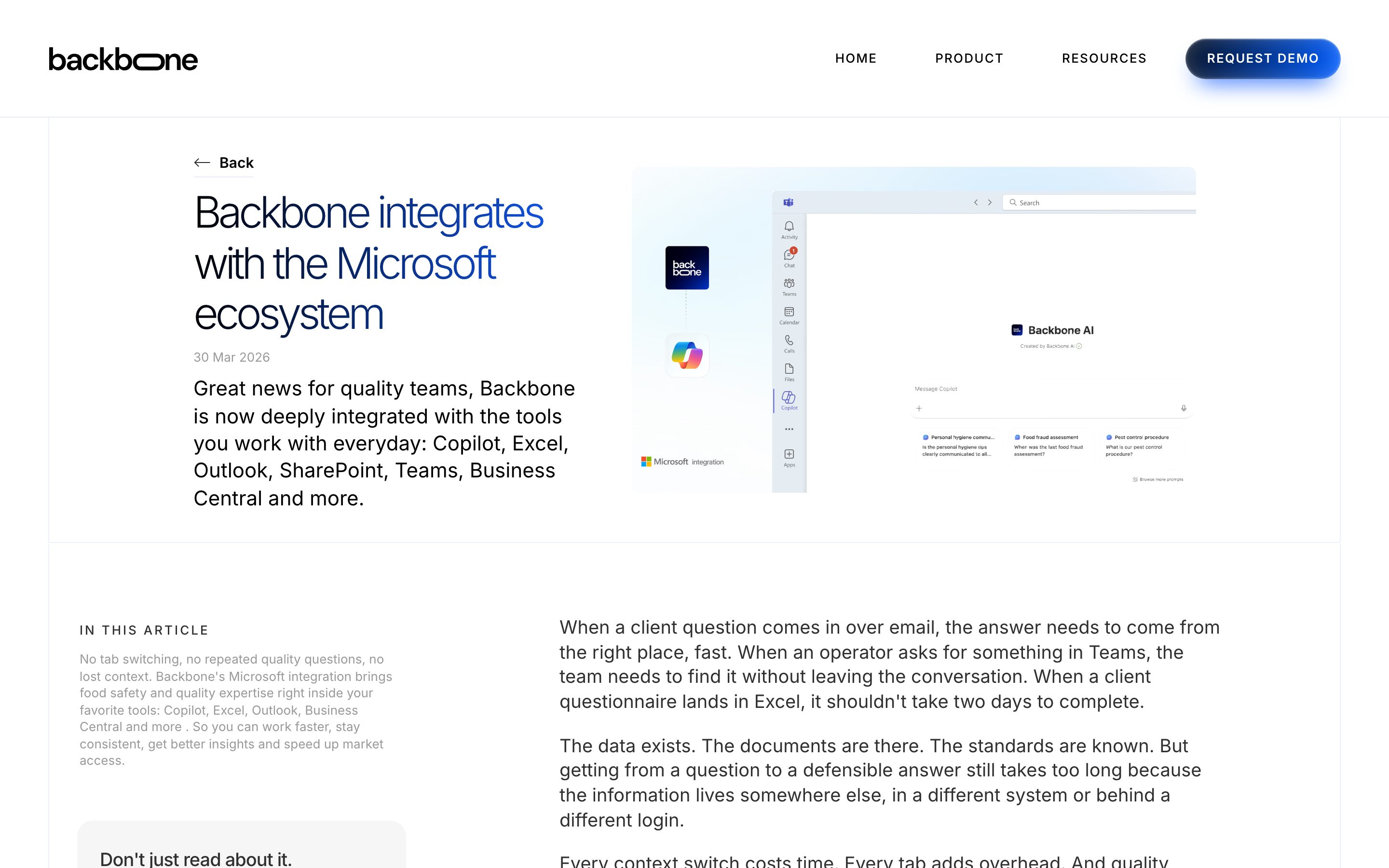
The same assistant also sits inside Excel, Outlook, Teams and Copilot, through Microsoft's marketplace, so a question asked in a Teams sidebar or a questionnaire opened in Excel is answered where it arrived.
Business model
The customer pays for an annual licence. The terms run one year from the effective date, with renewals, and scope the licence by named users, by "Permitted Sites" – the production sites the software monitors – and by the standards the customer must meet. Prices are confidential under the same terms, and the site offers only a demo.
Counting by site ties the price to what the software actually watches, so a group can start with one factory and add the rest as each is connected. The company states its own goal in that unit: 250 production sites by the end of 2028.
The spike
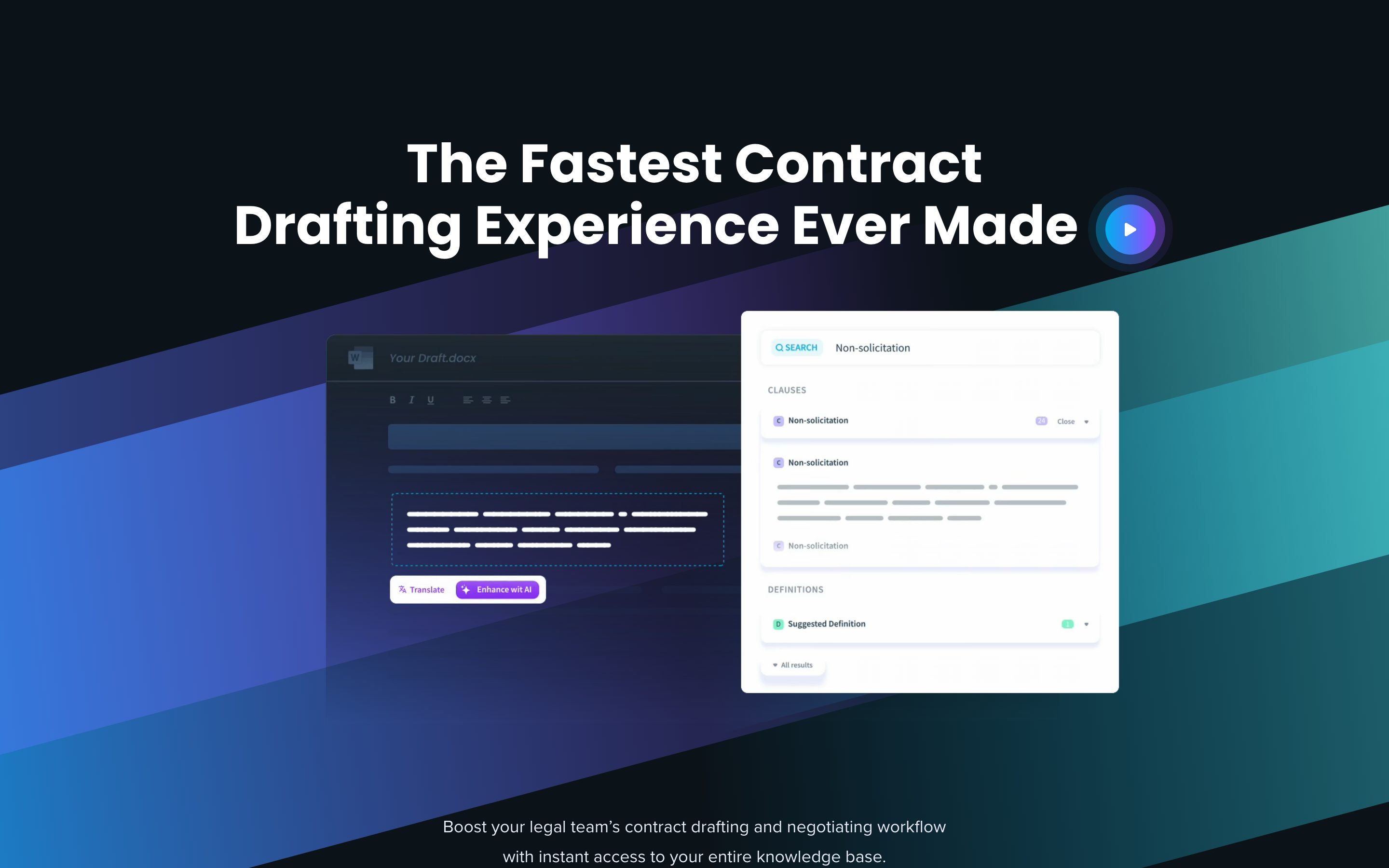
The method came before the company. Henchman, founded in Ghent in 2020, sold law firms a tool that gathered "all your previously written clauses and definitions" from their document stores and served them beside the draft in Word and Outlook. Louis Opsomer ran its operations and fundraising, Siska Lannoo built its partner-led growth, and Julien Steel was its chief product officer. LexisNexis agreed to buy Henchman in June 2024, by then with more than 170 customers.
What the three left behind was the legal market, not the way of working. The company they founded by notarial deed on 30 October 2025 stated an object of software, AI and document management, "niet beperkt qua sector" – tied to no sector at all. Tech Funding News reports that at Henchman they had seen fragmented document review hold law firms back and decided to take on a similar problem in another industry. We read the order the other way round: the deed fixed the team and the method first, and the trade was chosen to fit them. On why food, the company points to its buyers: food firms "kept telling us the same thing 'We need this yesterday.'" Opsomer's explanation of the product could stand for both jobs: "the different data points aren't talking to each other."
The founders do not describe it as a turn, and the traces read as one carried over whole. The first archived homepage, in February 2026, promised "Something smarter is coming to food compliance" and a waiting list; by April it said "Time for real quality". Henchman's founders, Gilles Mattelin and Jorn Vanysacker, put the first money in through 100IN, a pre-seed fund that took part of their exit money, while Backbone had no product. On 22 July 2026 a general meeting issued Class B shares for cash and for a contribution in kind to eleven subscribers, gave the lead investor the right to a board seat, set up an employee option plan and moved the registered seat to Flanders. Six weeks later, on 2 September, the company announced €4 million, led by Pitchdrive, which said it had known the three "for years through Henchman and Rydoo".
The outlet ties the founding to the infant-formula recalls that began in December 2025. Backbone AI BV already existed by then, since October.
Why it matters
Quality teams already had tools. The company says 80% of producers run daily quality work through Excel, Word and email; Tech Funding News names FoodDocs, a documentation tool used by more than 7,000 customers, and Polysense, which watches the line with cameras and is now a Backbone partner. The step each of them still leaves to a person is the assembly: finding the certificate, the audit finding and the specification, and typing the same facts again for each retailer. At J&K Confectionery a gap analysis on a new site meant "days locked in a boardroom"; J&K now says it takes minutes. Zoutman's team spent its time "searching, checking and revalidating data". Both accounts are the company's own posts, and no usage, revenue or retention figure is public.
What someone outside the company has committed is money and introductions. Seven customers are named, and its sales, it says, now reach past Belgium into the UK and the Netherlands. J&K invited Backbone to a supplier event in Manchester to show the software to its whole supply base. And three Belgian food families – Agristo, Darta and Jules Destrooper – put money into the round. None of them appears in any customer list the company or the press has published, so they are not buyers paying twice, as far as the record shows. Darta gave its reason as an owner would: "they are solving a real and growing challenge in the food industry."
The playbook
Compliance paperwork that retypes the same facts for every auditor and every client's questionnaire can be drafted by agents from files the customer already keeps, signed off by a person and priced per site watched. It fits any trade certified against several standards whose staff answer each buyer from last year's report and a colleague's mailbox. At J&K Confectionery a gap analysis that took days now takes minutes, Backbone writes. It has nothing to offer where each answer is given only once.
The lesson
When their employer was sold, Backbone's founders kept the team that had built and sold one tool, kept its way of working – read the client's own files where they already are, answer inside the programs people already use – and pointed it at a trade that still did the same chore by hand. The first cheque came from the people whose exit the three had helped deliver, before there was a product; the round after it brought in owners from the new trade.
The decision travels without the food or the law in it: when a company you helped build is sold, take the team and the method, not the market. Find a trade that does the same chore by hand with nobody building for it, raise first from the people who watched you work, then let owners from that trade onto the cap table, because what you lack is knowledge of the trade, not of the job.
The cost is that knowledge. A year in, Backbone was buying it every way it could: a webinar with BRCGS, events with a food-safety consultancy, interviews with quality leaders at Kraft Heinz, Mars and Barilla, and industry families among its shareholders.
Which chore did your last company take off its customers that another trade still does by hand, and who in that trade would put money in before you have a product?
Where else it could work · our reasoning, not a finding
Hospital accreditation
Before every survey a hospital's quality office pulls policies, training records and audit results out of every department to prove it meets the accreditor's standards, mostly by hand; a team that has already sold a tool which answers from a client's own files could enter, with hospital groups' owners or former directors backing it to vouch for what it does not know.
Tanker vetting
A tanker operator answers the oil majors' inspection questionnaires from certificates, crew records and maintenance logs scattered across ship and shore; family-owned fleets dominate the trade, so the people who could fund a newcomer are also the ones who would vouch for it to the rest.
Subcontractor compliance in construction
A main contractor collects insurance, safety and training certificates from dozens of subcontractors per site and checks them against each client's rules, usually in spreadsheets and inboxes; regional builders are often family firms, and a few of them on the cap table would open the first sites.
Track record
Backbone AI · usebackbone.ai ↗
- Henchman founded in Ghent by Gilles Mattelin, Jorn Vanysacker and Wouter Van Respaille; Louis Opsomer, Siska Lannoo and Julien Steel later join its management team ↗
- Archived Henchman homepage: “The Fastest Contract Drafting Experience Ever Made”, a law firm's own clauses served beside the draft in Word ↗
- LexisNexis announces it will buy Henchman, then with more than 170 customers; price not disclosed ↗
- Backbone AI BV founded by deed by Opsomer, Lannoo and Steel, 10,000 shares each; the stated object names no sector ↗
- First archived homepage: “Something smarter is coming to food compliance”, with a waiting list ↗
- Company post (dated 30 March 2026): Backbone live inside Excel, Outlook, Teams and Copilot through Microsoft's marketplace ↗
- Archived homepage switches to “Time for real quality” ↗
- General meeting issues Class B shares for cash and in kind to eleven subscribers, sets up an employee option plan and moves the seat to Flanders; published in the Belgian Gazette on 30 July ↗
- €4M pre-seed announced, led by Pitchdrive with PROfounders Capital, Passion Capital, existing investor 100IN and Belgian food families including Agristo and Darta ↗
- Partnership with Polysense, a Ghent maker of camera-based quality control for production lines ↗
- Customer story: J&K Confectionery's audit gap analyses go from days to minutes, by the company's account ↗